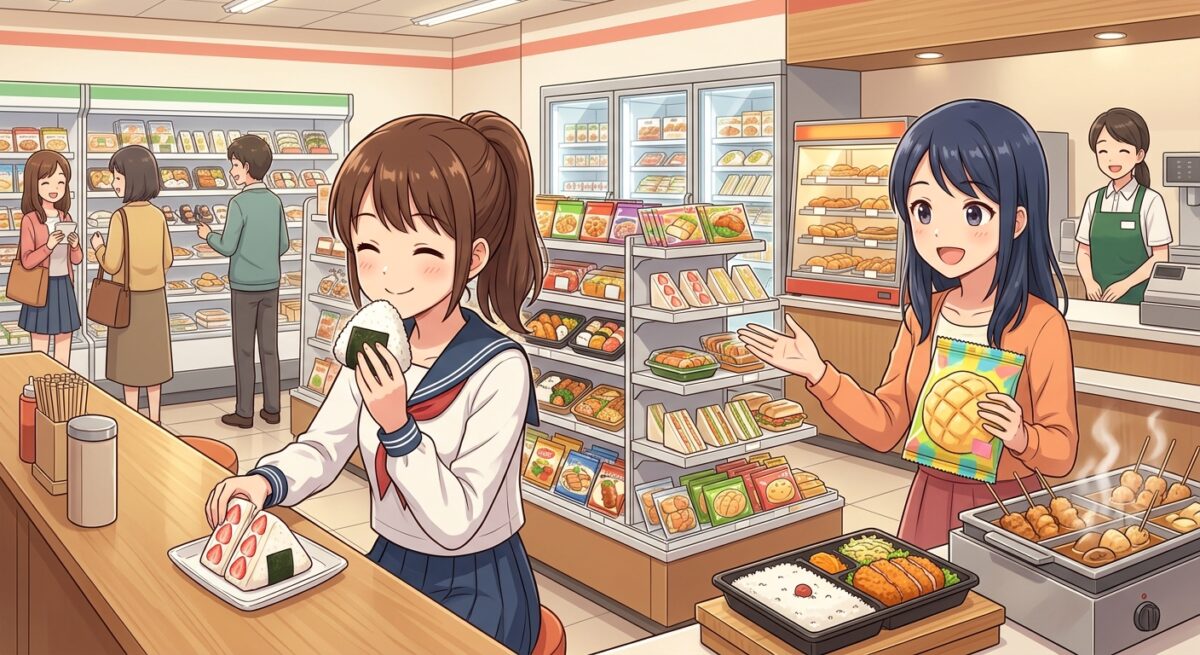
Japanese convenience-store food is useful when you make five decisions before you leave: what the product contains, whether it needs heating, what you’ll eat it with, where you can eat it, and where the packaging will go afterward. The answer can differ by product, branch, chain, accommodation, station, and local disposal system.
This is a purchase-to-disposal guide, not a claim that every item is “high quality,” and not a claim that every service below is available at every store. Use the package, current store setup, and staff answer for the product in your hand.
The 60-second purchase check
- Read the date and storage line. Distinguish the use-by date from the best-before date and keep chilled items chilled.
- Check ingredients and allergens. Japanese labeling rules do not mirror every overseas system.
- Decide about heating. Confirm whether staff should heat it and whether any packet must be removed first.
- Decide about utensils and hot water. Confirm what you need before you leave the counter -- see below.
- Choose the eating place. Do not assume the branch has seats, or that eating in versus taking out makes no difference -- see below.
- Plan the packaging. Use only matching bins; otherwise keep it until you find an appropriate disposal point.
Build a meal by function
| If you bought | You’ll likely be asked or need | Check before buying |
|---|---|---|
| Onigiri, sandwich, bread, salad | A bag; sometimes a fork for salad | Use-by date, allergens, refrigeration, eating place |
| Bento, rice bowl, hot snack | Whether to heat it; chopsticks or a fork; possibly an oshibori | Heating method, removable packets, carrying distance |
| Cup noodle / cup soup | Hot water -- ask if it isn’t obviously available | Hot-water availability at that store -- see below |
| Dessert (yogurt, cake, parfait) | A spoon | Refrigeration, whether it needs to be eaten soon |
| Hotel breakfast | Yogurt, fruit, bread, coffee, chilled side dish | Room refrigerator, utensils, hotel waste instructions |
| Dietary restriction | Packaged item with a label you can verify | All ingredients, allergen system, cross-contact uncertainty |
Stock, recipes, and what you’re asked can vary by chain, branch, region, season, and time of day. A product seen online or yesterday may not be available now, and the table above describes what’s common, not a guarantee for every store.
Dates and storage: two labels are not interchangeable
Japan’s Consumer Affairs Agency explains that 消費期限 (shōhi kigen, use-by date) is the date after which the food may no longer be safe to consume, while 賞味期限 (shōmi kigen, best-before date) concerns expected quality under the stated storage conditions. Read the printed storage instruction too.
- 要冷蔵 (yō reizō) — refrigeration required
- 冷凍 (reitō) — frozen
- 常温 (jōon) — room temperature, subject to the stated conditions
Do not carry a chilled meal for hours and assume the printed date alone guarantees safety. Time and temperature after purchase matter.
Allergies: packaged labels help, but do not answer everything
The Consumer Affairs Agency requires specified allergen labeling for packaged processed foods and distinguishes mandatory from recommended items. It also warns foreign visitors that an allergen required overseas may not be labeled the same way in Japan. Alcoholic drinks and unpackaged or prepared foods can require additional checking.
- Read the complete current package, not only the front name or shelf card.
- Check the ingredient and allergen sections for the exact flavor and size.
- Do not infer that a missing English label means the ingredient is absent.
- If cross-contact or an ingredient cannot be confirmed, do not treat a hesitant answer as safe.
これは〇〇が入っていますか?
Kore wa ___ ga haitte imasu ka?
Does this contain ___?
For a serious allergy, use the Consumer Affairs Agency’s multilingual food-allergy communication sheet and make a cautious choice if staff cannot verify the product.
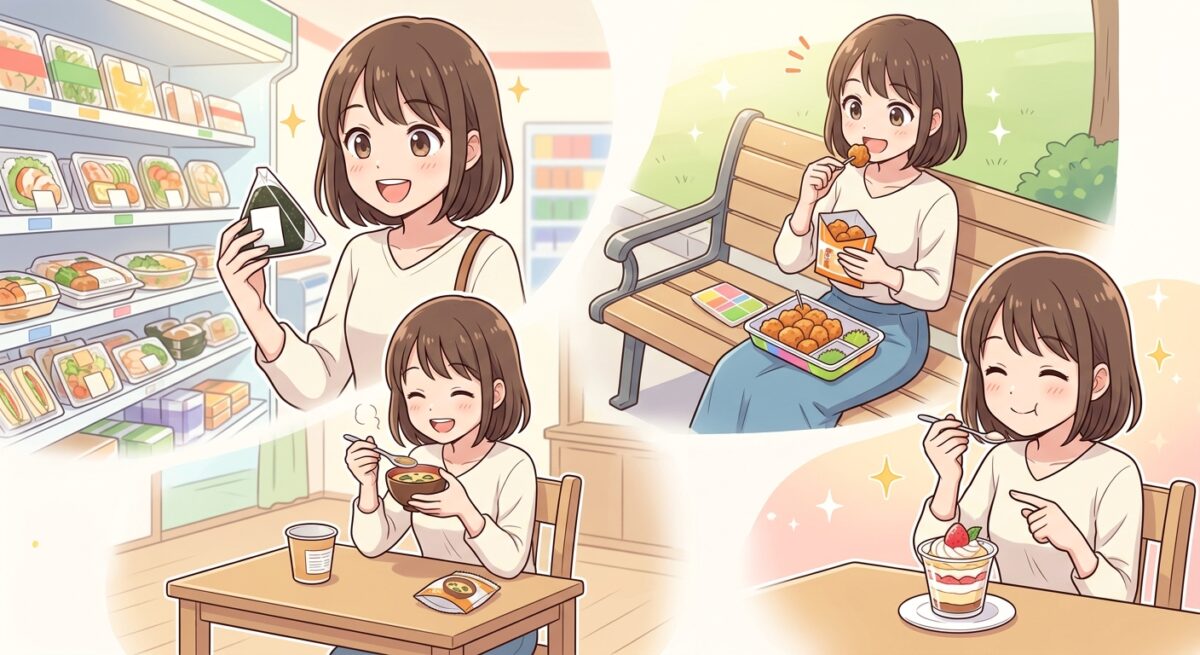
Heating: answer the question, then check the package
At the register, staff may ask 温めますか? (Atatamemasu ka?, “Would you like it heated?”).
- はい、お願いします。 Hai, onegai shimasu. — Yes, please.
- いいえ、そのままで大丈夫です。 Iie, sono mama de daijōbu desu. — No, it is fine as it is.
Not every product or container should be heated the same way, and not every product can be heated at all. 7-Eleven’s own customer support states that some of its 7-Premium frozen and chilled items are designed for a 500-600W home microwave, while the microwave in its stores runs at 1500W -- heating is declined for those specific items to avoid bursting or a change in the intended taste and texture. Lawson’s own guidance for bento items is more direct: use the heating time printed on the package as a starting point, adjusting for conditions. In practice: if staff or a self-service microwave’s instructions say a specific item can’t be heated, that’s a stated product limitation, not inconsistent service. Follow the package and staff instruction, and remove sauce, seasoning, egg, lid, or other parts only when the product directs you to do so. If you plan to eat later, consider whether you can reheat and refrigerate it safely at your accommodation.
Utensils, hot water, and payment
Check that you have what the meal actually needs before leaving the counter. Staff may ask whether you need chopsticks, a spoon, fork, straw, or bag -- and increasingly, whether you need one at all.
- お箸をお願いします。 Ohashi o onegai shimasu. — Chopsticks, please.
- スプーンをお願いします。 Supūn o onegai shimasu. — A spoon, please.
- 袋は要りません。 Fukuro wa irimasen. — I do not need a bag.
Plastic cutlery specifically has changed since Japan’s Plastic Resource Circulation Promotion Act took effect in April 2022, asking businesses using large volumes of designated single-use plastic items -- including spoons, forks, and straws -- to reduce their use. FamilyMart has published its own case study of one response: since January 2024, its directly-operated stores charge a small fee (reported as 4-6 yen) for spoons, forks, dessert spoons, and straws, reporting roughly a 78% drop in units provided per store per day as a result. Other chains have made comparable adjustments without necessarily charging a fee at every location, so expect to be asked rather than to receive cutlery automatically, and don’t be surprised by a small charge at some stores. Disposable wooden chopsticks are a different material and are not among the items this particular law targets; free chopsticks with an appropriate purchase remain common, though not guaranteed at every store.
If you bought a cup noodle, some stores make hot water available near the cup-noodle shelf or at the register, sometimes through a dedicated pot -- this is not confirmed as a formal, chain-wide, always-available service, so treat it as something to ask about rather than something to expect automatically, especially at smaller stores: お湯をいただけますか? (O-yu o itadakemasu ka?, “Could I have some hot water?”).
Some stores also include a small oshibori (wet towel) with purchases likely to get your hands messy, at no extra charge -- but there’s no chain-wide rule requiring it. Whether one is included is generally a judgment call by the staff member helping you, not an automatic feature of any specific product, so don’t assume one will be included and it’s fine to ask if you’d like one.
Author’s note: heating, hot water, chopsticks, and oshibori are the small things that make a convenience-store meal feel finished rather than half-done -- when they’re available, they’re genuinely convenient. None of them showed up every single time, which is exactly why it’s worth asking rather than assuming.
Payment methods differ by store and terminal. Watch the screen, choose the method requested, and check the total and receipt. Broader restaurant payment questions belong in the guide to payment, charges, cards, and receipts.
Where can you eat it -- and does it change the price?
An eat-in area is a branch feature, not a guarantee. It may be absent, closed, time-limited, or subject to instructions. Ask ここで食べられますか? (Koko de taberaremasu ka?, “Can I eat here?”).
One reason staff at an eat-in-equipped store may ask where you plan to eat: Japan’s reduced consumption-tax rate for food depends on it. The National Tax Agency’s own guidance defines “eating out” (外食) as food service provided at a location with tables, chairs, or other facilities for eating, and states this does not qualify for the reduced 8% rate -- it is taxed at the standard 10% rate instead. 7-Eleven’s own customer FAQ confirms this directly for its stores: food eaten in the eat-in space is taxed at 10%, while the same item taken out is taxed at 8%. The Japan Franchise Chain Association, representing convenience store chains, describes a shared industry poster used at eat-in-equipped stores to help customers understand this distinction. So the eat-in question isn’t only about seating -- answering it accurately affects the price you’re charged. (A separate government plan would lower the tax rate on food starting in April 2027 at the earliest; that change is not in effect yet, so the 8%/10% split above is the current rule as of this check.)
- Inside the store: use only a clearly available eat-in space, follow its current instructions, and answer the eat-in question accurately.
- Outside or on the street: avoid entrances, queues, narrow walkways, and places where spills affect others.
- Train: meals fit many long-distance reserved-seat services better than crowded commuter trains.
- Hotel: confirm where food is allowed and how the property wants waste handled.
Buying food at one store does not automatically authorize eating on adjacent private property or leaving waste there.
Two related situations come up often for visitors. If you use a convenience store's restroom, Why Japan's guide on whether you need to buy something after using a convenience store toilet looks at what the major chains themselves actually say. And if convenience-store food is the everyday version of this, supermarkets have their own version worth knowing about: Japan's evening supermarket bento discounts covers how those markdown stickers actually work.
After eating: separate venue cleanup from city waste rules
If the branch provides labeled bins, match the item to the label. Do not assume that a collection opening beside a vending machine accepts meal trays or general waste. If no suitable bin is available, close or bag the item and keep it.
- Drain leftover liquid only where the venue provides a suitable station.
- Keep leaking containers upright and bag them separately.
- Follow hotel instructions for food waste, bottles, cans, and plastics.
- Do not leave waste beside a full bin.
For daytime travel, read what tourists should do when there is no bin. For trays and liquids in eating venues, use the restaurant and food-court guide.
A complete konbini decision
- Exact package, use-by/best-before date, storage, ingredients, and allergens checked
- Heating choice and removable parts confirmed
- Necessary utensils, hot water, or oshibori requested if wanted -- none of these arrive automatically everywhere
- Eating location confirmed before opening, including whether eating in changes the tax you pay
- Disposal route identified or a carry-back bag ready
Official sources
- Consumer Affairs Agency: Food labelling
- Consumer Affairs Agency: Food-allergy labeling information
- Consumer Affairs Agency: Important food labelling in Japan (English)
- National Tax Agency: Reduced consumption tax rate system (eat-in vs. takeout)
- Japan National Tourism Organization: Shopping, public behavior, and waste
Source check: September 12, 2026. Product recipes, stock, branch facilities, utensil/hot-water availability, and disposal arrangements can change; the current package and store instructions take priority.