Paying for a meal in Japan is easier when you identify three things before the bill arrives: when payment happens, where it happens, and which methods that restaurant accepts. There is no single checkout system used by every ramen shop, izakaya, cafe, hotel restaurant, and independent dining room.
Use what the restaurant actually shows you. A sign by the entrance, payment logos near the register, a meal-ticket machine, reservation terms, a bill folder, or a staff instruction is more reliable than a general rule about Japan.
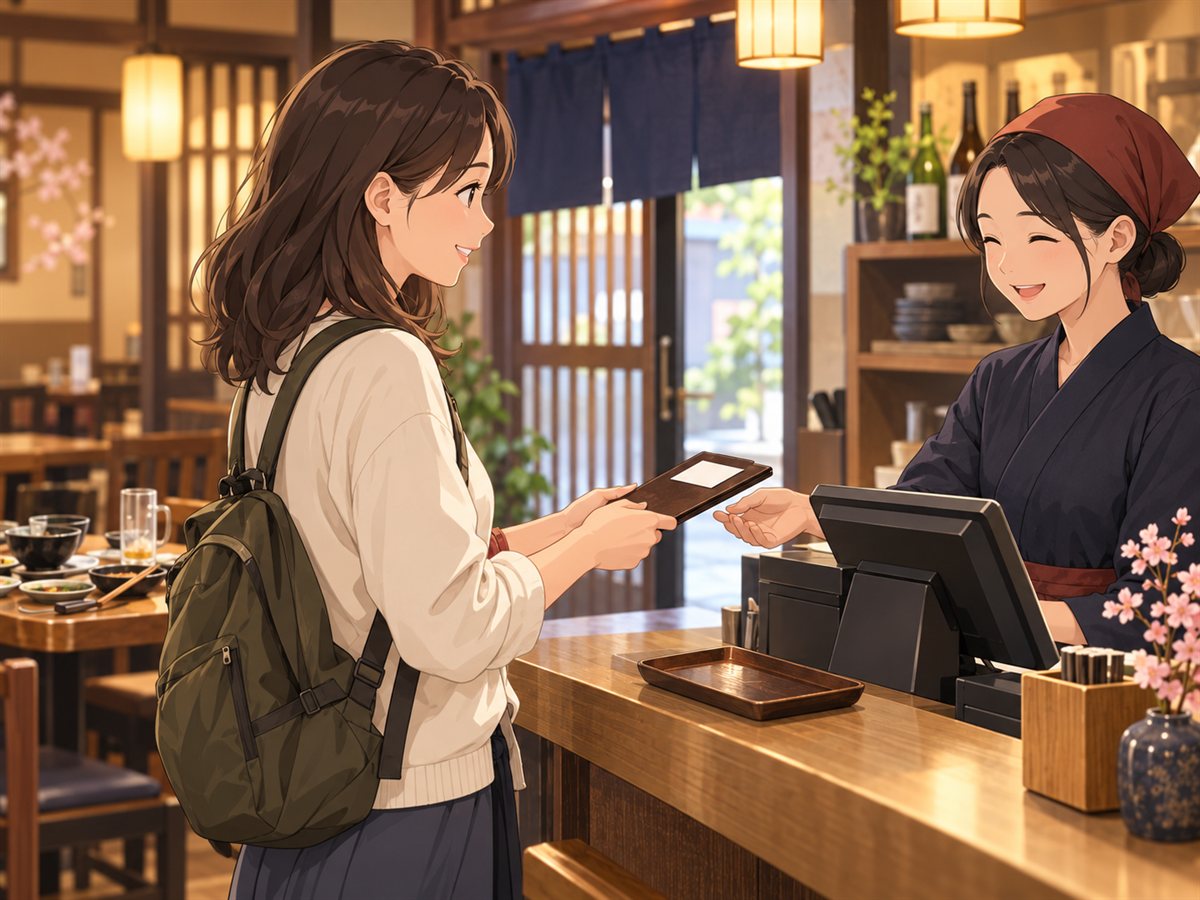
The 30-second payment check
- Look before ordering. Check for a ticket machine, a “cash only” notice, card or IC logos, a self-checkout sign, or payment terms in the reservation.
- Watch what happens after the order. A printed slip or bill folder left at your table often goes to the register; a terminal brought to the table means you can usually pay there.
- Ask before the cashier starts. If you need separate payments, a receipt with particular details, or confirmation that a foreign card works, ask early.
If the signs and the staff instruction differ, follow the current staff instruction. Equipment can be offline, accepted methods can change, and branches of the same chain may not have identical machines.
Four common restaurant payment flows
| What you see | What to do | What to confirm |
|---|---|---|
| Meal-ticket machine near the entrance | Pay before sitting, take the ticket and change, then give the ticket to staff or follow the machine's instructions. | Whether the machine takes cash, cards, IC, or QR; some machines accept fewer methods than the restaurant's main register. |
| Order counter or self-checkout | Order and pay at the counter, or scan/confirm the order at the self-checkout before collecting food or leaving. | Whether a table number, receipt, or pickup ticket must be kept. |
| Bill slip or folder at the table | Take it to the register near the entrance or exit unless staff say they will collect payment. | Do not leave without presenting the slip; it may contain your table or order number. |
| Terminal, QR order screen, or bill brought to the table | Confirm the order total and complete the on-screen or staff-guided payment. | A QR code used to order does not always mean payment is complete. Look for a paid confirmation or ask staff. |
Ticket machines are common in some casual formats, especially ramen shops, but not universal. JNTO's ramen guidance describes prepayment by ticket machine while also noting that some shops take orders from staff. Treat the machine in front of you—not the restaurant category—as the deciding evidence.
Read the amount before you choose a payment method
For consumer-facing prices displayed in advance, Japan's total-price rules generally require a consumption-tax-inclusive amount to be shown. That does not mean every possible restaurant charge is hidden inside the price of one menu item. Check the menu, reservation terms, and bill for separately disclosed charges.
| Line or situation | What it usually means | Safe action |
|---|---|---|
| Consumption tax | Tax included in the consumer-facing total price; another tax-exclusive figure may also be shown. | Use the displayed total and check whether takeout and dine-in prices differ. |
| Service charge | A business-set fee, often seen at hotels or some higher-end venues. It is not a voluntary tip. | Read the percentage and scope in the menu or reservation terms. |
| Seat or cover charge | A charge for using the seat or venue, depending on the restaurant. | Check entrance signs and menus; ask before ordering if unclear. |
| Otoshi | A small dish automatically served at some izakaya and used as part of the table-charge system. | Ask about the charge and ingredients if you have an allergy or dietary restriction. |
| Prepayment, deposit, or cancellation fee | A condition of that reservation rather than a nationwide restaurant fee. | Save the confirmation and read the deadline, amount, and refund terms before booking. |
If a charge is unclear, do not label it a tip or a scam from the name alone. Point to the line and ask staff what it covers. JNTO specifically notes that table charges and an automatically served appetizer can appear at izakaya and recommends asking staff when the cover fee is unclear.
Cards, cash, IC, and QR: check the specific restaurant
Cashless acceptance has expanded, but the useful question is not whether Japan is cashless. It is whether this restaurant, this branch, and this machine accept your method now.
- Look for card, contactless, transport IC, and QR logos at the entrance or payment counter.
- Check whether a nearby “cash only” notice applies to the whole restaurant or only to a ticket machine.
- If you rely on one method, ask before ordering. Do not assume an overseas phone wallet works because the same brand works at home.
- Keep enough cash or a second card for a reasonable fallback.
JNTO advises visitors to check the specific store and notes that foreign smartphone methods may not work, card or mobile errors can occur, and cash remains necessary in some places. A transport IC card is usable only where the appropriate acceptance logo is displayed; its use for trains does not guarantee that a restaurant accepts it.
If a foreign card or phone payment fails
- Stop after a normal retry and confirm that you selected the intended method.
- Ask whether another card network, contactless payment, IC, or cash is accepted.
- If the terminal requests a PIN or signature, follow the terminal and staff instruction; the verification step depends on the card, terminal, and transaction.
- If every available method fails, explain the problem to staff before leaving the payment area. Do not walk out to find cash without their agreement.
A failed transaction does not prove that all foreign cards are rejected. It may be the card issuer, the restaurant's contract, the terminal, a temporary connection problem, or a verification requirement. Use a fallback rather than repeatedly forcing the same transaction.
Tipping: usually unnecessary, with limited context-specific exceptions
JNTO says tipping is not common in Japanese restaurants, cafes, bars, taxis, and hotels. For an ordinary meal, pay the bill shown and do not leave loose cash on the table as an unexplained extra. Staff may treat it as forgotten change or may be unable to accept it under business policy.
A service charge is different: it is a disclosed fee set by the business, not a tip you choose at checkout. Likewise, a seat charge or otoshi is not a voluntary reward for service.
Exceptions should be checked, not assumed. JNTO mentions private guides or interpreters familiar with overseas practices as examples where a gratuity may be accepted, while still saying it is not expected. If an overseas-facing booking page or payment terminal displays a tip field, first determine whether it is optional and whether it belongs to the restaurant or booking provider. The presence of a field does not create one rule for every Japanese restaurant.
Gifts are a separate social decision, not part of settling a restaurant bill. Ordinary restaurant staff do not require a gift. If you are visiting a home, thanking a host, or considering a gift in a continuing relationship, use our separate guide to when and how to give gifts in Japan.
Group payment, receipts, and reservations
Separate or shared payment
A restaurant may allow individual checkout, accept only one payment per table, or limit splitting during busy periods. Ask before the cashier begins processing the bill. If separate card payments are unavailable, one person can pay the restaurant and the group can settle among themselves afterward.
Receipt or ryoshusho
Ask before payment finishes if you need a receipt, a handwritten ryoshusho, or a particular name on the document. Restaurants can issue ordinary receipts, and some business customers may need tax details, but the exact document and available fields depend on the business. A restaurant meal is not automatically tax-free shopping for a visitor.
Reservation payment
Keep the booking confirmation if you prepaid, provided a card guarantee, or accepted a cancellation policy. At the restaurant, compare the bill with what the reservation says was already collected. If you must cancel, use the booking provider's or restaurant's stated process and deadline rather than simply not appearing.
Useful Japanese at the register
| Japanese | Romaji | Meaning |
|---|---|---|
| お会計はどこですか? | O-kaikei wa doko desu ka? | Where do I pay? |
| カードは使えますか? | Kādo wa tsukaemasu ka? | Can I use a card? |
| 別々に払えますか? | Betsubetsu ni haraemasu ka? | Can we pay separately? |
| 領収書をお願いします。 | Ryōshūsho o onegai shimasu. | A receipt, please. |
If a service interaction is indirect or you are unsure whether a polite response means yes or no, our guide to Japanese customer service explains broader communication patterns and their limits.
Before you leave the restaurant
- Confirm that the ticket, register, table terminal, or QR screen shows payment complete.
- Check the total and any service, seat, or reservation charge you did not expect.
- Collect your card, phone, cash change, and receipt.
- Do not leave a separate tip unless the provider clearly accepts it and you intentionally choose to give it.
Official sources used
- Japan National Tourism Organization: Tipping in Japan
- Japan National Tourism Organization: Cashless Payments in Japan
- Japan National Tourism Organization: Japanese Customs and Etiquette
- Japan National Tourism Organization: Ramen Guide
- National Tax Agency: Total Price Display Requirement
- National Tax Agency: Invoice System and Simplified Invoices