Quick answer
Do not treat one Japanese phrase, pause, or polite smile as a secret code. Check the relationship and setting, listen for a concrete next step, and ask a calm follow-up question. The safest goal is not to guess what someone “really means.” It is to confirm what happens next.
Indirect answers can be difficult when you need to plan a deadline, understand an invitation, or know whether a request has been accepted. A phrase such as chotto muzukashii desu (“that may be a little difficult”) can signal a real obstacle. In another conversation, it may open the door to a different date or method.
Communication also changes with the relationship, the speaker’s age and occupation, whether the exchange is spoken or written, and whether one or both people are using a second language. This guide gives you a practical way to respond without assuming that all Japanese people communicate alike.
Use a four-step confirmation method
- Identify the decision. Do you need a date, permission, acceptance, or only acknowledgment that your message was heard?
- Look for a concrete next step. A date, person in charge, alternative, reservation, payment, or promised follow-up is more useful than a positive-sounding word by itself.
- Offer an easy alternative. Give the other person a way to say what would work without forcing an immediate yes or no.
- Confirm the action in plain words. For anything important, restate the date, task, price, or decision in writing.
This process works because it separates politeness from commitment. A friendly response can be polite without confirming the plan. A hesitant response can identify a problem without ending the discussion.
Signals that call for a follow-up question
The following expressions may indicate hesitation, but none has one automatic meaning in every conversation.
- ちょっと…… (chotto...): literally “a little.” An unfinished response can show difficulty or reluctance, but the reason still needs context.
- 難しいです (muzukashii desu): “it is difficult.” This may be a refusal, a scheduling problem, or a request for another option.
- 検討します (kentō shimasu): “we will consider it.” This confirms consideration, not approval.
- 確認します (kakunin shimasu): “I will check.” Ask when and how the answer will be given if timing matters.
- A pause or silence: it can reflect thinking, discomfort, language processing, hierarchy, or uncertainty. A pause alone is not proof of rejection.
JETRO’s guide for international business gives examples in which acknowledgment is mistaken for agreement and recommends clarifying subjective words with a specific deadline or next step. That is useful advice for business, but it should not be turned into a rule for every social conversation.
Work example: confirm the achievable date
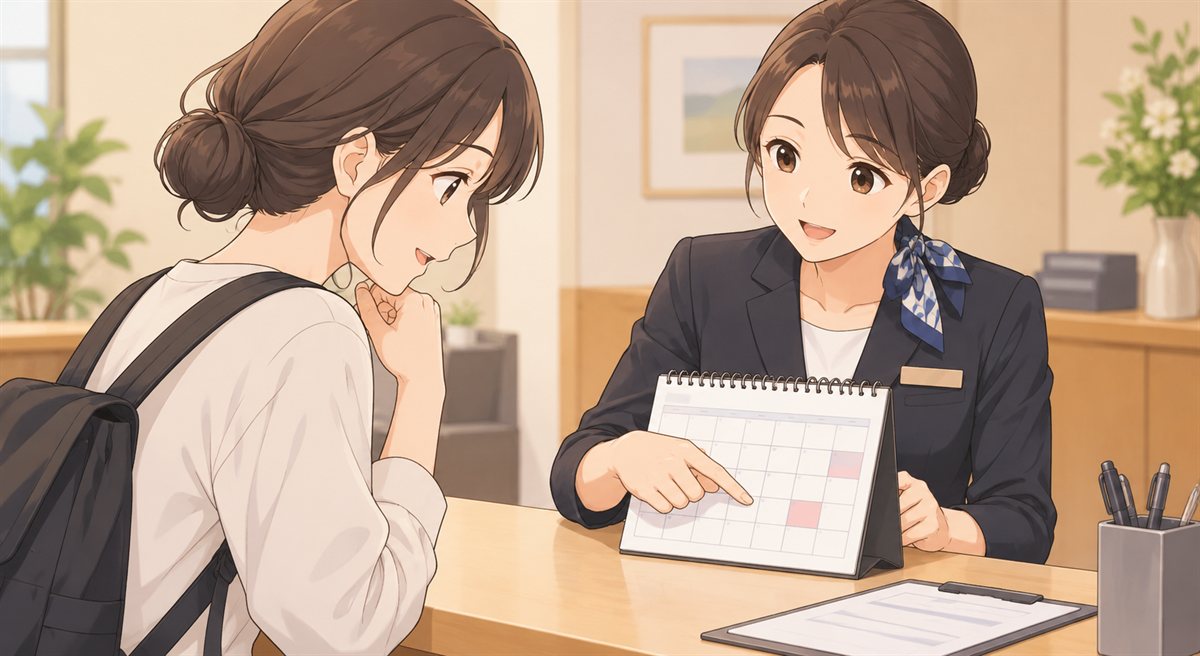
In a work conversation, the cost of misunderstanding can be high. Replace pressure with a specific alternative.
A: 金曜日までにできますか?
Kin’yōbi made ni dekimasu ka?
Can you finish it by Friday?
B: 金曜日はちょっと難しいです。
Kin’yōbi wa chotto muzukashii desu.
Friday may be difficult.
A: 月曜日ならできますか?
Getsuyōbi nara dekimasu ka?
Would Monday be possible?
B: はい、月曜日なら大丈夫です。
Hai, getsuyōbi nara daijōbu desu.
Yes, Monday works.
The useful information is not that the first response was “indirect.” It is that Friday was not confirmed and Monday was. Follow the conversation with a short written confirmation: “The agreed deadline is Monday at 3 p.m.”
For company calendars, leave, event participation, dress rules, or weather procedures, use the formal instructions described in our guide to working in Japan through the year. Do not rely on conversational tone when a company rule or deadline exists.
Social example: leave room without inventing a promise
A social invitation does not always require the same follow-up as a work deadline. If there is no urgent decision, you can leave the invitation open.
A: 今週末、食事に行きませんか?
Konshūmatsu, shokuji ni ikimasen ka?
Would you like to go out for a meal this weekend?
B: 今週末はちょっと……。
Konshūmatsu wa chotto...
This weekend is a little...
A: わかりました。また都合のいい日があれば教えてください。
Wakarimashita. Mata tsugō no ii hi ga areba oshiete kudasai.
Understood. Please let me know if another day works for you.
This response accepts the hesitation without declaring that the person has rejected you permanently. If they later suggest a date, you have a concrete next step. If they do not, you do not need to chase an answer repeatedly.
Service example: distinguish acknowledgment from approval
In shops, hotels, clinics, and other service settings, the same confirm-the-outcome principle applies -- a polite response is a starting point, not the answer itself.
Customer: 明日の朝、受け取れますか?
Ashita no asa, uketoremasu ka?
Can I collect it tomorrow morning?
Staff: はい、確認いたします。
Hai, kakunin itashimasu.
Yes, I’ll check.
Customer: 何時ごろわかりますか?
Nanji goro wakarimasu ka?
About what time will you know?
Staff: 今日の5時までにご連絡します。
Kyō no go-ji made ni go-renraku shimasu.
We will contact you by 5 p.m. today.
The first hai acknowledges the request. The promised call by 5 p.m. is the actionable commitment. For the wider expectations behind service interactions, see our guide to Japanese customer service.
Do not read silence as a single message
A pause can mean that someone is thinking, translating, checking whether it is appropriate to disagree, or waiting for another person to speak. In a video call it may also reflect a delay. In a meeting, a junior employee may hesitate to answer before a manager. Among close friends, the same pause may have little significance.
If the pause matters, ask one focused question and wait. Our separate guide explains how silence and quiet behavior in Japan vary by place and situation.
Relationship and setting change the wording
NARO’s language overview notes differences between written and spoken Japanese and variation by social position, age, and occupation. In practice, a formal client email, a supervisor’s request, a conversation between friends, and a brief exchange with shop staff should not be interpreted with one universal chart.
- Formal or hierarchical setting: disagreement may be softened, so confirm responsibilities and deadlines.
- Close relationship: people may speak more directly because less face-saving is needed.
- Second-language conversation: unusual wording may reflect vocabulary limits, not a cultural signal.
- Written message: use dates, names, quantities, and action owners to reduce ambiguity.
- Regional, professional, and individual difference: preferred phrasing varies. Follow the person and situation in front of you.
Japan–US comparison is only a starting hypothesis
Some US workplaces reward explicit answers and some Japanese workplaces use more contextual or softened wording. The comparison can help explain why a listener expects different levels of detail. It cannot predict an individual’s intention.
Americans also soften requests, avoid conflict, and say “maybe.” Japanese speakers can be very direct when safety, compliance, money, or an urgent deadline requires it. Team culture, personality, profession, language ability, and power relationships may matter more than nationality in a specific exchange.
Mistakes that create more confusion
- Do not convert every vague phrase into “no.” Ask whether another date, method, or condition works.
- Do not treat a smile or nod as consent. Confirm the decision itself.
- Do not demand an instant binary answer when time is available. Offer a reasonable response deadline.
- Do not rely on cultural guessing for safety, contracts, prices, schedules, or medical instructions. Use explicit confirmation.
- Do not copy exaggerated indirectness. Simple, polite language is easier for everyone to check.
A same-day cancellation can look like distrust in the moment and still have an ordinary explanation that only becomes clear afterward. In a 2019 report by Shimane Prefecture and the Shimane International Center, a Japanese-language volunteer felt distrust when a learner cancelled a Japanese lesson on the day itself; it later turned out that the learner’s child had suddenly fallen ill.
A reusable confirmation checklist

- What exact decision do I need?
- Did I receive a date, action, alternative, or person responsible?
- Could language difficulty explain the wording?
- Can I offer one realistic alternative?
- Have I confirmed important details in writing?
- Am I treating this person’s response as individual evidence rather than a national stereotype?
You do not need to “read the air” perfectly. A respectful follow-up question is often safer than silent guessing.
Official and specialist references
- JETRO: Communicating with Japanese in Business — business-specific examples of ambiguous responses and clarification.
- NARO: Language is Japanese — written/spoken language and social-position variation.
- The Japan Foundation: Irodori Japanese for Life in Japan — practical, situational communication resources.
How this guide was reviewed
The Why Japan Editorial Team reviewed the Japanese phrases, romaji, English meanings, setting-specific exceptions, internal-link boundaries, and the scope of the references. The examples are model conversations, not claims that every speaker will use the same wording.