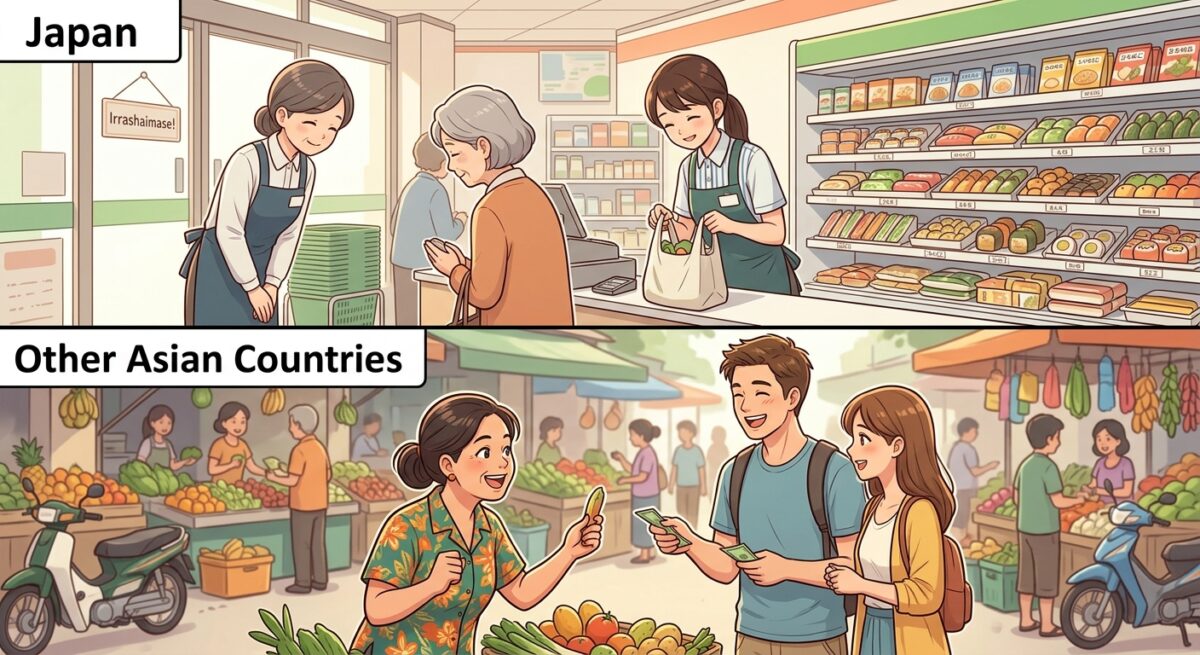
Polite service does not guarantee that a request is possible. In Japan, a clerk may speak gently while following a firm store, hotel, ticket, safety, or reservation rule. The useful skill is therefore not interpreting the bow or tone. It is confirming the request, the condition, the cost, and the next available option.
This guide gives foreign visitors a repeatable method for shops, convenience stores, hotels, restaurants, stations, taxis, and service counters. It separates a business rule from a general custom and shows what to ask when an answer is unclear.
Use this four-step service check
- Show the exact transaction. Present the item, receipt, ticket, booking screen, room number, or destination.
- Ask one specific question. Ask whether a return, exchange, change, or service is possible; do not combine several requests.
- Confirm the conditions. Check the deadline, fee, required document, product condition, and new time or route.
- Restate the result. Repeat the amount, date, item, or alternative before you pay, leave, or cancel.
A nod or hai can acknowledge that staff heard you; it does not by itself prove approval. The practical confirmation is a concrete result: a new booking time, printed receipt, replacement item, refund amount, or clearly stated alternative.
First identify whose rule controls the answer
| Situation | Best source | What to confirm |
|---|---|---|
| Return or exchange | The seller’s displayed policy and staff | Receipt, deadline, tags, packaging, payment method, exclusions |
| Hotel change or cancellation | The booking terms and the party that took payment | Cutoff time, cancellation charge, new rate, meal plan, room type |
| Train ticket or route change | The operator, ticket office, or machine for that ticket | Ticket type, train, seat, validity, fare difference |
| Restaurant request | That restaurant | Ingredients, substitutions, table charge, payment, reservation terms |
| Product warranty or repair | Seller or manufacturer documents | Coverage, proof of purchase, repair time, shipping, data loss |
Do not turn one shop’s answer into a rule for all of Japan. Store policies, booking contracts, ticket conditions, staffing, stock, and safety requirements can produce different answers even when both interactions are polite.
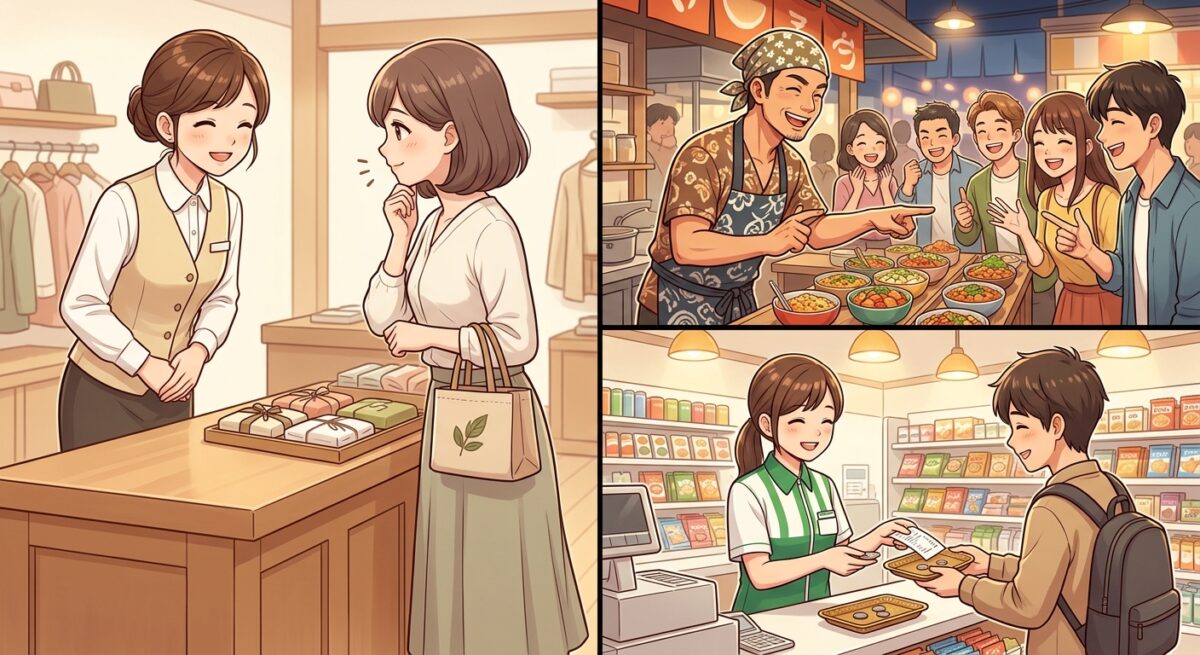
At a shop or convenience store
Watch the register display and answer one prompt at a time. Staff may ask about a bag, heating, cutlery, a point card, or the payment method. If you do not understand, point to the product or screen and ask staff to repeat the question slowly.
- 袋は要りません。 Fukuro wa irimasen. — I do not need a bag.
- 温めてください。 Atatamete kudasai. — Please heat it.
- もう一度お願いします。 Mō ichido onegai shimasu. — Once more, please.
After payment, compare the item count, amount, change, and receipt while you are still near the register but out of the next customer’s way. For a practical purchase-to-disposal flow, see how to buy and eat convenience-store food.
Returns and exchanges: ask before assuming
Keep the receipt because it helps the seller verify where and when the product was purchased. A change-of-mind return, a defective product, an opened food item, a tax-free purchase, and an online order are not the same case. The answer may depend on the seller’s terms and the transaction type.
- Bring the item, receipt, included parts, tags, packaging, and payment card if available.
- State whether the item is defective, incorrect, or simply unwanted.
- Ask separately about return and exchange; one may be available when the other is not.
- Confirm the refund method and timing before surrendering the item.
- 返品できますか? Henpin dekimasu ka? — Can I return this?
- 交換できますか? Kōkan dekimasu ka? — Can I exchange this?
- レシートはこちらです。 Reshīto wa kochira desu. — Here is the receipt.
If staff say no, ask which condition is not met: the deadline, item category, opened packaging, missing receipt, payment method, or purchase channel. Do not claim that a “cooling-off period” automatically covers an ordinary store purchase; Japan’s official consumer guidance describes cooling-off for specified transaction types and treats mail-order returns separately.
Hotels and reservations: confirm the contract, not the tone
Show the booking number and ask for the result in one variable at a time: date, guest count, room, meal, or cancellation. If you booked through an agency, the hotel may direct you back to that agency because it controls the reservation or payment.
- 予約を変更できますか? Yoyaku o henkō dekimasu ka? — Can I change the reservation?
- キャンセル料はいくらですか? Kyanseru-ryō wa ikura desu ka? — How much is the cancellation fee?
- 新しい日付を確認してください。 Atarashii hizuke o kakunin shite kudasai. — Please confirm the new date.
Do not finish with “Is that okay?” Ask staff to show or say the new date, total price, included meals, and cancellation status. Save the revised confirmation.
Restaurants: separate the request from the payment
For ingredients or allergies, show the specific food and ask before ordering. A staff member’s uncertainty is not confirmation that a dish is safe. If the restaurant cannot verify an ingredient or cross-contact risk, choose another dish or business rather than pressuring staff to promise safety.
For bills, ask whether payment is at the table, at a register, or through a machine. Check accepted payment methods and charges at that restaurant. Ordinary tipping is not customary, but a displayed table charge or reservation fee is not a tip. See the separate guide to restaurant payment, charges, cards, and receipts.
Stations and transport counters
Show the destination in writing and the ticket you already hold. “Can I go there?” may produce an answer about the route but not about whether your ticket covers it. Confirm the train, departure time, platform, seat, and additional fare separately.
- この切符で行けますか? Kono kippu de ikemasu ka? — Can I go there with this ticket?
- 追加料金はいくらですか? Tsuika ryōkin wa ikura desu ka? — How much is the additional charge?
- 何番線ですか? Nan-bansen desu ka? — Which platform is it?
How to read a polite refusal without guessing
Expressions such as “it is difficult,” “we cannot confirm that,” or “please understand” may precede or communicate a refusal. But indirect language is not a code with one guaranteed translation. Confirm the practical outcome.
- Ask: “Is this request possible today?”
- If not, ask: “What option is available?”
- Confirm any different date, product, route, or fee.
- Decide whether to accept the alternative.
- 難しいですか? Muzukashii desu ka? — Would that be difficult?
- 別の方法はありますか? Betsu no hōhō wa arimasu ka? — Is there another way?
- できないということですか? Dekinai to iu koto desu ka? — Does that mean it is not possible?
For the wider communication pattern, read how to confirm polite or indirect answers.
If the first staff member cannot decide
Ask for a responsible person only when a policy, safety issue, payment error, damaged item, or reservation record genuinely needs review. A manager cannot necessarily override a contract or operator rule.
責任者の方に確認していただけますか?
Sekininsha no kata ni kakunin shite itadakemasu ka?
Could you check with the person in charge?
Keep your request factual: show the receipt or confirmation, identify the mismatch, and say the outcome you want. Avoid raising your voice, repeating the same demand, or treating politeness as consent.
Before you leave: a 20-second confirmation
- The product, destination, room, seat, or service matches your request.
- The final amount and any extra fee are clear.
- The date, time, deadline, or cancellation status is explicit.
- You have the receipt, ticket, or revised confirmation.
- If the request was refused, you understand the available alternative.
Official sources
- National Consumer Affairs Center of Japan: Cooling-off system and mail-order returns
- National Consumer Affairs Center of Japan: Why a receipt matters for returns and exchanges
- Japan National Tourism Organization: Japanese customs and etiquette
- Japan National Tourism Organization: Tipping in Japan
- Japan National Tourism Organization: Cashless payments in Japan
Source check: August 2, 2026. Business policies and booking terms can change; current written terms and staff confirmation for the specific transaction take priority.