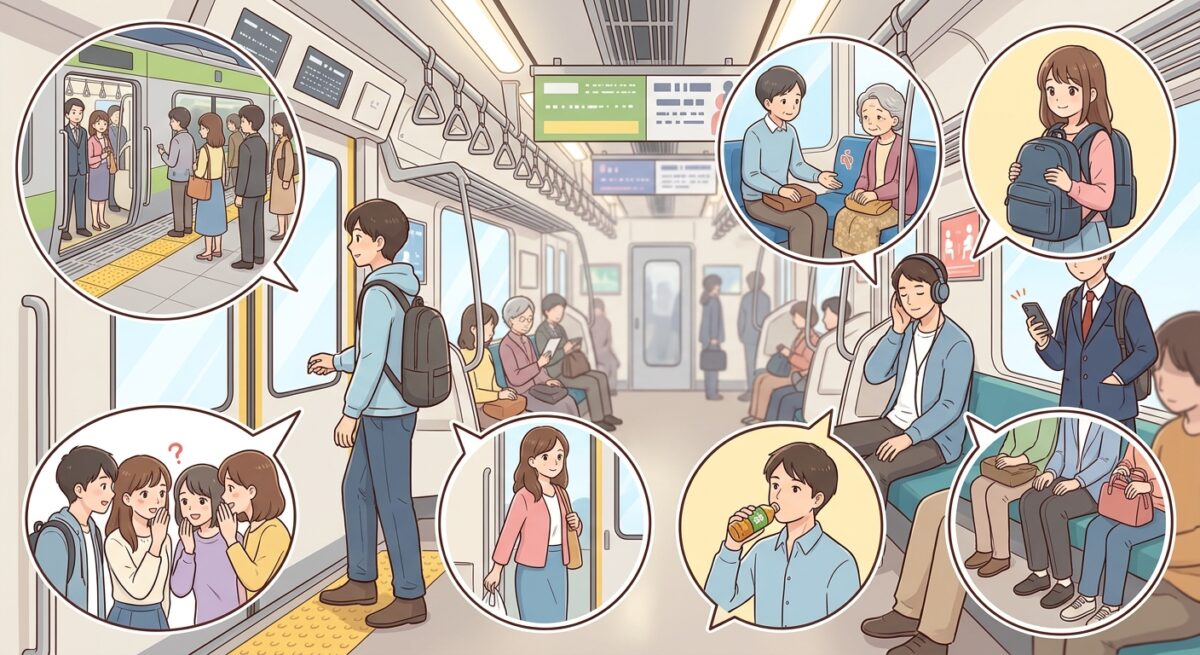
Train etiquette in Japan is a sequence, not a personality test: find the correct line, let people leave, board without stopping at the door, keep sound and luggage contained, and follow the operator’s signs. The details can differ by railway, train type, car, time, and crowd level.
This guide covers conduct on platforms and inside trains. For route planning, seasonal disruption, and oversized-baggage rules on specific services, use the linked specialist guide rather than treating one operator’s rule as nationwide.
Before entering the platform
- Confirm the railway operator, line, direction, and destination; large stations can serve several operators.
- Prepare your ticket or IC card before the gate and move aside if you need to search your bag.
- Check service notices before a tight connection, severe-weather day, or last train.
- If you have large luggage, identify elevators and the specific train’s storage conditions in advance.
For weather, holiday crowds, disruption checks, and service-specific luggage planning, read seasonal train travel in Japan.
If you're curious what Tokyo's famous loop line looks like on foot instead of from a train window, see Why Japan's account of walking the entire Yamanote Line.
On the platform: read the markings
Door positions and queue patterns may be painted on the floor. A platform can have markings for different train lengths or services, so use the display for your train rather than joining the nearest group automatically. Stay behind the safety line and keep bags out of the walking route.
- Find the car and door position for your train.
- Join the end of the indicated line.
- When the train arrives, leave an exit path.
- Wait until passengers have finished getting off.
- Board in order; do not run for closing doors.
If the queue is unclear, ask この列で合っていますか? (Kono retsu de atte imasu ka?, “Am I in the right line?”). The separate queueing guide covers ticket, list, reservation, and line systems outside trains.
Boarding: keep the doorway usable
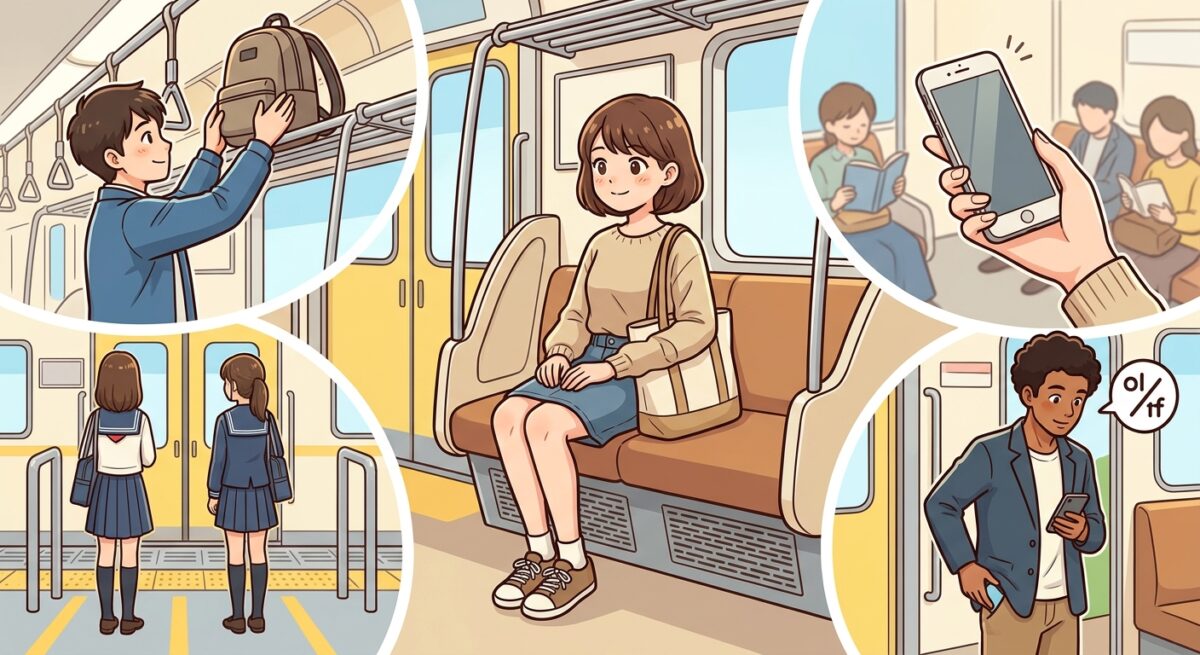
After boarding, move into available space rather than stopping immediately inside. If you stand near the door and passengers need to exit, Tokyo Metro’s operator guidance asks riders to move out temporarily to let them pass. Re-enter after the exit flow clears.
Near your stop, prepare without forcing through too early. A short すみません、降ります (Sumimasen, orimasu, “Excuse me, I’m getting off”) is useful when the aisle is crowded.
Sound: conversation, calls, and media
Quiet conversation is not a blanket prohibition. The safer standard is to keep the carriage calm and avoid making everyone nearby listen to you. Tokyo Metro asks passengers to set phones to silent mode and refrain from calls during the ride.
- Use headphones and check that sound is not leaking.
- Silence keyboard, game, camera, and notification sounds where possible.
- For an urgent call, get off at a suitable station when practical; do not use speakerphone.
- Keep group conversation lower during crowded commutes and in a quiet car.
Volume also depends on time and place. See how loud is too loud in Japan for a broader decision method.
Bags and suitcases
A bag becomes an etiquette issue when it strikes people, occupies a seat, blocks the aisle or door, or rolls during movement. Tokyo Metro’s published guidance says to place backpacks or large luggage on the overhead rack or hold them yourself.
- On a crowded local train, remove a backpack from your back and hold it securely.
- Keep wheels locked or controlled and do not leave a suitcase unsupported.
- Do not place bags on a seat when another passenger could use it.
- Do not assume every train has the same large-luggage space.
Some Shinkansen services have reservation conditions for oversized baggage. Those are service-specific transport rules, not a rule for every train in Japan; check the operator and exact train.
For the specific combination of a large suitcase and Tokyo's most crowded commuting hours, see Why Japan's guide to taking a large suitcase on Tokyo trains at rush hour, which covers timing, station layout, and luggage-delivery alternatives in more depth.
Priority seats: need matters more than appearance
Tokyo Metro asks passengers to give priority seats to older people, passengers with disabilities, passengers with infants, and expectant mothers. Some needs are not visible. If you need the seat, you may use it; if you do not, stay alert and offer it when someone appears to need it more.
Phone instructions near priority seats also depend on the operator and crowd conditions. Tokyo Metro currently asks passengers to switch phones off near priority seats during rush hour and other busy periods. Read the sign in your car instead of presenting that operator rule as universal.
Women-only cars and other marked cars
Women-only car operation can depend on the railway, line, direction, weekday, and time. The platform and car signs show when the designation applies and who may use the car. Tokyo Metro notes specified exceptions including elementary-school-age and younger children, passengers with disabilities, and caregivers. If you are uncertain, check the exact sign or ask station staff.
Eating and drinking: identify the train type
Meals are common on many Shinkansen and long-distance limited-express services where seats and trays are designed for them. A meal on a crowded urban commuter train is a different situation. Consider smell, spills, space, and whether you are seated.
- On a local commuter train, wait if the food is a meal, messy, or strongly scented.
- On a long-distance service, keep food within your seat area and take the waste with you.
- A necessary drink is different from spreading food across a crowded space.
- Follow any operator restriction stated for that train.
Rush hour: change the trip if you can
During the busiest periods, the same bag, group, or doorway pause has a larger effect. If your schedule is flexible, travel outside the peak. If it is not:
- finish route checks before boarding;
- keep your ticket or IC card accessible;
- remove large bags before entering the densest area;
- do not force a crowded train when the next service is a reasonable option;
- follow station staff and platform controls.
If the train stops or you miss your stop
Do not rely only on a third-party map during disruption. Check the train display, station board, announcement, and operator’s current service page. An estimated restart time can change.
- この電車は動いていますか? Kono densha wa ugoite imasu ka? — Is this train running?
- この電車は新宿に行きますか? Kono densha wa Shinjuku ni ikimasu ka? — Does this train go to Shinjuku?
- 次の電車でも行けますか? Tsugi no densha demo ikemasu ka? — Can I also get there on the next train?
- どこで乗り換えますか? Doko de norikaemasu ka? — Where do I transfer?
If you miss a stop, get off safely at the next station and check the return route. Do not obstruct the doors or attempt to hold them.
A ride checklist
- Correct operator, line, direction, train, and platform confirmed
- Queue markings followed and exiting passengers given space
- Phone silent; no call or speaker audio
- Bag controlled and no seat or doorway blocked
- Priority and marked-car signs checked
- Current operator information checked if service is disrupted
Official operator and travel sources
- Tokyo Metro: Things to consider when riding the subway
- Tokyo Metro: Boarding, luggage, smartphone, and priority-seat guidance
- Japan National Tourism Organization: Getting around Japan
- Japan National Tourism Organization: Public transportation customs
Source check: August 2, 2026. Operator rules and service conditions can change; signs, staff instructions, and current operator notices for your train take priority.