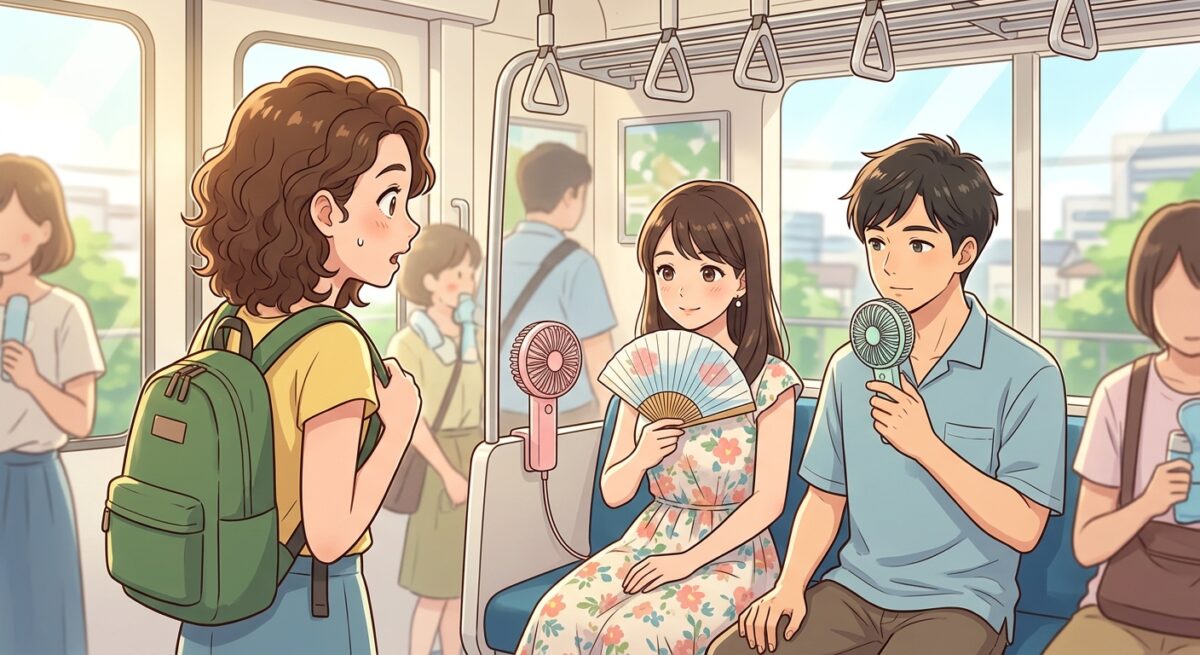
Train travel in Japan changes more with the weather and calendar than a timetable alone may suggest. A route that is simple on an ordinary weekday can require extra planning during heavy rain, a typhoon, snow, a major holiday, or extreme summer heat.
This guide is about seasonal preparation and day-of-travel decisions. For year-round behavior such as boarding, phone use, priority seats, and where to place an ordinary bag, see our separate guide to Japanese train etiquette.
The five-minute check
- Check the forecast and warnings for the exact area you will travel through.
- Check the official operator page or app for your exact line.
- Check every connection, not only the first train.
- Confirm the last train and any reservation or baggage conditions for that date.
- Keep one realistic alternative: another railway, a later departure, or a changed destination.
What to check before you leave
Use official information in a clear order. A general route-planning app is useful for finding options, but it may not explain a weather-related suspension, a planned service change, or when a line expects to restart. During disruption, the railway operator and station staff should take priority over a cached timetable.
| Question | Best source | What to confirm |
|---|---|---|
| Is the weather hazardous? | Japan Meteorological Agency | Warnings for heavy rain, storms, snowstorms, or heavy snow in the areas on your route |
| Is my train running? | The railway operator's website, app, or station notice | Your exact line, direction, affected section, and update time |
| Can I use another route? | Operator information and station staff | Whether an alternative route is operating and whether special ticket handling applies |
| Will I miss the last connection? | Current operator timetable for the travel date | Last departure, transfer time, and any temporary timetable |
Do not treat a delay estimate as a promise. Conditions and restart forecasts can change. If the trip is optional and warnings are escalating, changing the time or destination may be safer than waiting at a crowded station.
If service is delayed or suspended
- Identify the exact affected section. A line name alone may be too broad; another section of the same line may still be operating.
- Check the timestamp. Screenshots and social posts can remain online after the situation changes.
- Check your whole journey. A running first train is not useful if the connecting line is suspended.
- Compare realistic alternatives. Another operator, a bus, a later reserved train, or staying nearby may be more practical than repeatedly changing platforms.
- Follow station restrictions. Platforms or entrances may be controlled when crowding or weather creates a safety risk.
Important
Do not enter a closed area, cross barriers, or assume the next train will run because one map app still shows it. Use the most recent operator notice and follow staff instructions.
A word that sounded familiar -- but wasn't
At a Japanese-language education round-table published by MEXT, Tsutsumi Claudina Mayumi described a real snow-day trip: her aunt told her a line was 不通 (futsū, "disrupted"), and Claudina heard the more familiar word 普通 (futsū, "ordinary") instead -- the two sound identical, so nothing in the sentence itself signaled a problem until the disagreement that followed. If a word about your train doesn't quite fit what's actually happening, asking to see it written can resolve in seconds what a phone call alone might not. MEXT round-table: Claudina's account
Season-by-season train planning
Spring: temperature swings and peak sightseeing days
Spring can combine cool mornings, warmer afternoons, and busy sightseeing areas. Carrying one removable layer is more useful than dressing for only the midday forecast. Cherry blossom destinations can be crowded when bloom timing, good weather, and weekends coincide.
Golden Week, from late April into early May, is one of Japan's busiest domestic travel periods. Long-distance trains and accommodation can fill, and the exact operating or reservation arrangements may change by year. If your dates overlap, check the operator's current announcement and reserve eligible trains early rather than relying on an old holiday timetable.
Rainy season: wet platforms, umbrellas, and changing conditions
The rainy season does not affect every region on the same dates or with the same intensity. Check the forecast for your route rather than assuming that all of Japan has identical conditions.
- Allow more walking time on wet stairs and platforms.
- Keep a wet umbrella close to your body and use an umbrella cover when one is provided.
- Do not let an umbrella, raincoat, or bag drip onto another passenger or block a doorway.
- Use a waterproof inner bag for documents and electronics.
- Bring a small cloth or bag for wet clothing instead of spreading it over a seat.
Some station entrances and nearby buildings also offer a way to deal with a dripping umbrella before you go in -- bag dispensers, shake-dry stands, or a small machine that bags the umbrella for you. See Why Japan's look at Japan's umbrella-bagging machines for what these look like and how to use each type.
Heavy rain can also affect tracks, slopes, and connecting buses even when the rain at your departure station looks light. Check the areas between your origin and destination.
Summer: heat outside, cooling inside, and typhoon risk
Summer creates two different environments: hot, humid streets and cooled trains or stations. Train temperature is not identical on every car or operator. JR East explains that car temperature is adjusted using factors such as outside temperature, humidity, and crowding, while passengers can still experience the same car differently. A light layer lets you adjust without assuming the staff can set a temperature for one passenger.
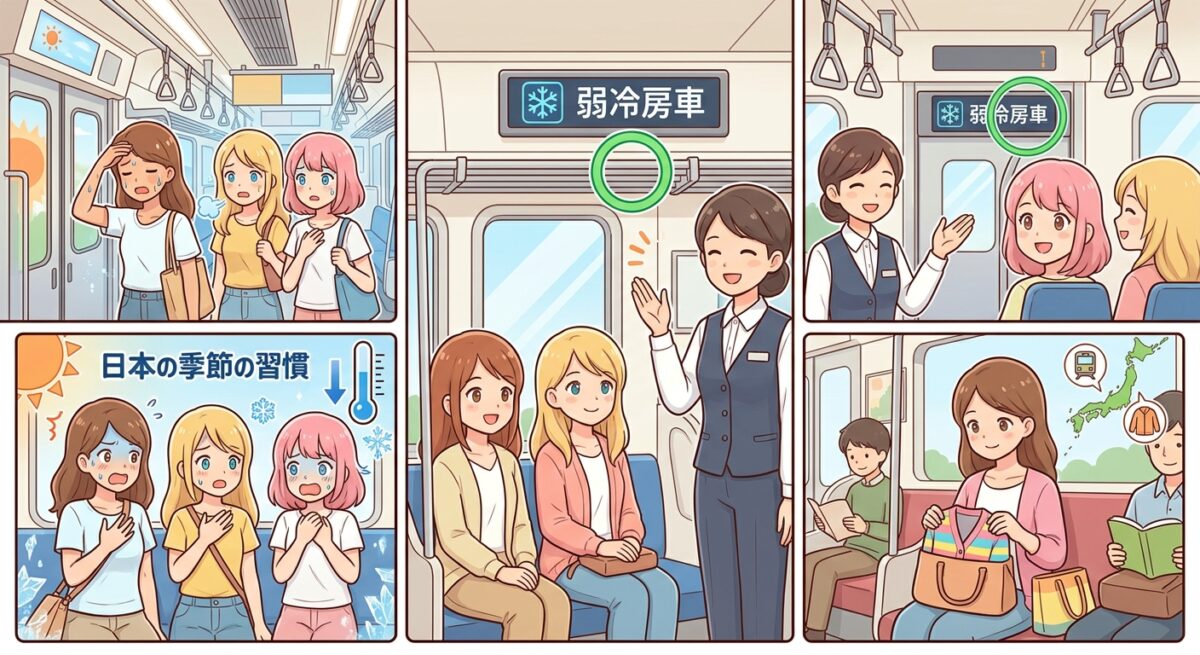
Some operators mark a car as weakly air-conditioned, often with a sign such as 弱冷房車 (jakureibōsha). Availability, position, and temperature policy vary by operator and train. Read the car and platform signs instead of expecting every service to have one.
For heat, carry water, avoid an unnecessarily tight transfer, and know where you can pause in an indoor or shaded area. A station can still feel hot on an outdoor platform even when the train is cool.
August and September may bring typhoons that affect travel, although timing and impact vary. Railways may reduce or suspend service because of wind, rain, flooding, or other safety conditions. Check the JMA and your operators before leaving; do not wait until you reach the station to discover that a long-distance connection has been cancelled.
Autumn: foliage crowds and regional weather differences
Autumn foliage can concentrate passengers on routes to popular viewing areas. The peak date differs by elevation and region, so crowding is also local rather than nationwide. On a rural sightseeing route with infrequent service, missing one train may mean a long wait. Check the return timetable before starting a hike or side trip.
Typhoon effects can continue into early autumn. Later in the season, the difference between a mild city and a cold mountain destination may be large. Pack for the destination and transfer stations, not only your departure city.
Winter: snow, wind, warm cars, and year-end travel
Snow risk differs greatly between regions. Hokkaido, northern Honshu, mountain routes, and areas along the Sea of Japan may face conditions very different from Tokyo or other lower, Pacific-side cities. Snow, ice, and strong wind can slow trains or affect connections, while shoes that work on a dry city pavement may be unsafe on an icy station approach.
- Check weather warnings for every region on a long journey.
- Add a buffer before a reserved connection.
- Wear footwear suitable for the ground conditions at your destination.
- Use layers that can be removed in a heated car.
- Keep medication and one essential warm layer with you, not only in checked or forwarded luggage.
The year-end and New Year period is another major domestic travel period. Timetables, all-reserved arrangements, and overnight services are not guaranteed to stay the same every year. Confirm the exact date with the operator. Never assume that a city train runs all night on New Year's Eve or that a previous year's last-train information still applies.
Urban rail, rural rail, and the Shinkansen are different
| Service type | Seasonal planning issue | Useful action |
|---|---|---|
| Urban commuter train or metro | Rush-hour crowding, wet floors, outdoor platforms, and missed last connections | Travel outside the peak when possible and check the final connection |
| Rural or sightseeing line | Long intervals, limited alternatives, and weather exposure | Check the return train and backup transport before leaving the main station |
| Shinkansen or limited express | Reserved seats, holiday demand, missed connections, and baggage conditions | Check the exact train, operator, reservation, and luggage rules in advance |
Large luggage needs route-specific planning
Keep suitcases close and out of aisles, doorways, and boarding paths. Do not assume that every train has a large luggage area. Space and rules differ by vehicle and service.
On specified Tokaido, Sanyo, Kyushu, and Nishi Kyushu Shinkansen services, baggage with total dimensions over 160 cm and up to 250 cm requires a seat with an oversized baggage area or compartment reservation. That rule should not be presented as a universal requirement for every Japanese train. Check the operator for the train you will actually use.
In rain or snow, luggage becomes harder to handle on stairs and crowded platforms. Avoid a transfer that is technically possible but unrealistic with a large wet suitcase. If using delivery or storage, confirm opening hours and collection timing rather than leaving the decision until the last train.
Read car and platform signs
Priority seating, women-only cars, and weakly cooled cars are identified by signs, but their details are not uniform nationwide. Women-only car restrictions can depend on the operator, line, direction, car, weekday, and time. Weakly cooled cars may not exist on a particular service. Follow the sign for that train and ask staff if the conditions are unclear.
This is also why copying another passenger is not always enough. A person may know a local exception, be transferring elsewhere, or simply be making a mistake. Posted notices and staff instructions are the safer source.
Useful phrases during disruption
| Japanese | Romanization | Meaning |
|---|---|---|
| この電車は動いていますか? | Kono densha wa ugoite imasu ka? | Is this train running? |
| どのルートが使えますか? | Dono rūto ga tsukaemasu ka? | Which route can I use? |
| 運転再開はいつですか? | Unten saikai wa itsu desu ka? | When will service resume? |
| 最終電車は何時ですか? | Saishū densha wa nanji desu ka? | What time is the last train? |
A restart time given during disruption may be an estimate. Ask for the latest update, then keep checking the display or official operator information.
Save this departure checklist
- Weather and warnings checked for the full route
- Exact railway line and affected section checked
- All transfers and the last train checked
- Holiday reservations confirmed where required
- Oversized baggage rule checked for the exact train
- Water, removable layer, and wet-item bag packed for the season
- One workable alternative route or timing decision saved
- Official operator page available on your phone
The practical rule is simple: prepare for the conditions outside, the temperature inside, and the possibility that your planned train may change. Seasonal train travel in Japan becomes much easier when you check the exact date, route, and operator instead of relying on a general image of Japanese railways.