How quiet should you be in Japan? There is no single volume that fits every train, apartment, restaurant, park, or hotel. Check four things instead: the place, the time, the people nearby, and any rule you can see or confirm. This guide helps you make that decision and respond calmly if someone asks you to lower the volume.
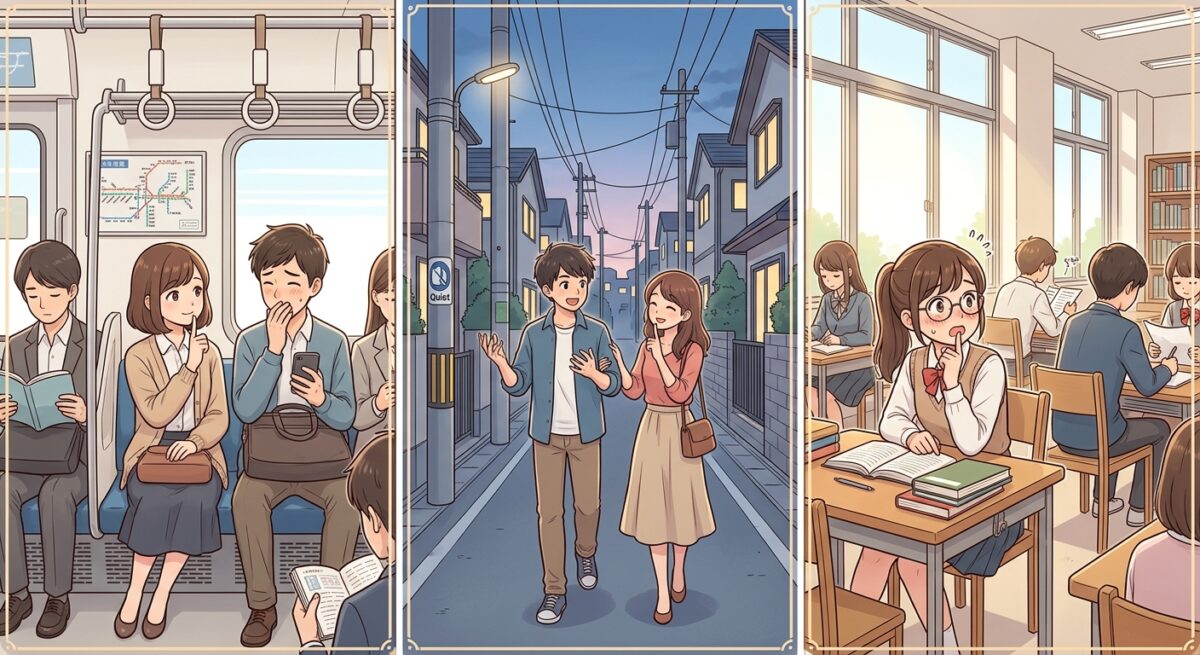
A 30-second noise check
- Place: Are people sleeping, traveling, studying, worshipping, working, or receiving care? Can they move away from your sound?
- Time: Is it late at night, early in the morning, or a quiet period named by the property or facility?
- Surroundings: Is your voice or device clearly louder than the room? Are people listening to an announcement or concentrating?
- Rules: Check signs, announcements, tickets, booking terms, house rules, lease information, and staff instructions.
If one check points toward quiet, lower the sound first. You can then ask what the rule is.
How the four factors change your answer
Place sets the starting point. Use extra care where other people cannot easily avoid the sound, such as a train carriage, hotel corridor, apartment building, hospital waiting area, or library.
Time can change the same place. A hotel lobby at midday and a guest-room corridor after midnight call for different choices. For housing and accommodation, use the hours stated by that building or property rather than assuming a nationwide cutoff.
The surrounding sound is a useful comparison. Ordinary conversation may be fine in a busy cafe but intrusive in a nearly silent room. Match the space without treating every glance as a complaint.
An explicit rule takes priority. An operator or facility may set a rule for its own trains, buildings, or grounds. That rule has a narrower scope than a national law, but it still governs use of that service or property.
Decisions by place
Trains and buses
Start with a low conversational voice and keep audio private. Tokyo Metro asks passengers to set phones to silent mode and refrain from talking on them while riding. JNTO also advises quiet conversations on public transport and headphones for music or video. Follow the operator’s current signs and announcements because wording can differ by service.
This article covers only the noise decision. For boarding, seats, luggage, eating, and other rail situations, use the complete guide to train etiquette in Japan.
Hotels and ryokan
A normal conversation may fit a lobby or dining room but not a corridor near sleeping guests late at night. Check booking terms and house rules before holding a group gathering or using a speaker. JNTO recommends asking accommodation staff when a property’s customs or rules are unclear. A rule at one hotel or ryokan does not automatically apply to another.
Apartments and shared housing
Footsteps, doors, laundry machines, calls, music, and gatherings may carry into nearby homes. JASSO’s official accommodation guidance warns that loud noise can cause conflict with neighbors and calls for particular consideration at night. Your lease, building notices, and management guidance provide the specific rules for your home.
Do not rely on a supposed nationwide start time for quiet hours. If a neighbor raises a concern, reduce the sound and confirm the building rule with the landlord or management company.
Restaurants and cafes
Ordinary conversation is often part of the setting, but the suitable level depends on the venue. Compare a busy family restaurant with a small counter restaurant or hotel lounge. Keep calls brief or move to an area the staff permits, and do not use speaker audio unless the venue clearly allows it.
Parks and outdoor spaces
Outdoors does not automatically mean amplified sound is acceptable. Japan’s official national-parks guidance asks visitors to keep noise down out of consideration for local communities and to check rules for each park. Elsewhere, check local signs and consider nearby homes, ceremonies, wildlife, and other visitors.
Schools, hospitals, libraries, and other public facilities
Look for zones and instructions instead of assuming one national rule. Jichi Medical University Hospital, for example, separates general areas, no-call areas, and no-carry areas for phones. Other hospitals and facilities may use different categories. Silence your device while you check, then follow the signs or ask staff.
When normal conversation is usually reasonable
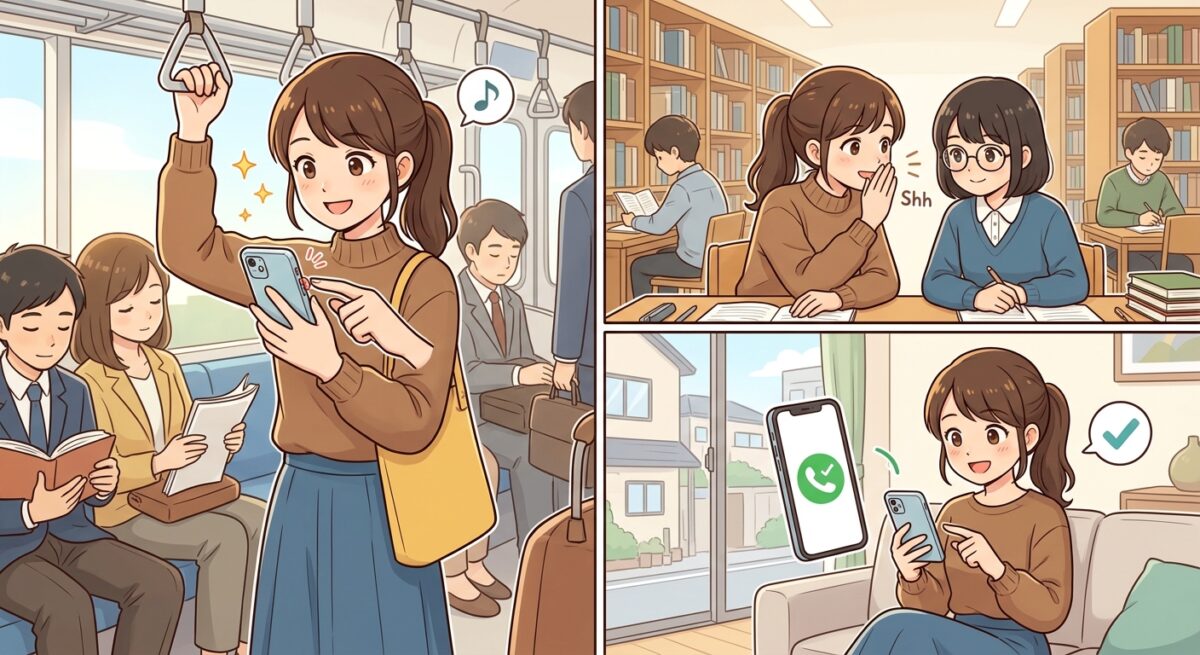
You do not need to remain silent everywhere. Conversation is usually compatible with restaurants, cafes, hotel lobbies, family areas, and busy outdoor spaces unless a sign, event, or staff member indicates otherwise. The practical limit is whether your sound takes over the shared space.
A conversation between two nearby people differs from calling across several seats, addressing a large group, or playing amplified audio. Crowding matters too: a moderate voice reaches more people in a packed carriage or narrow corridor.
Calls, videos, speakers, children, and night noise
- Phone calls: Move to a permitted call area or outside before answering when practical. In an urgent situation, keep the call brief and seek staff help if needed.
- Video, games, and music: Use headphones, check for sound leakage, and still follow any facility restriction.
- Portable speakers: Leave the speaker off until the venue or accommodation clearly permits it. Permission in a private room does not extend to shared areas.
- Children: Some noise from children is unavoidable. Choose family-friendly spaces when possible, and move to a less sensitive area if a child becomes distressed and moving is practical. Do not assume that every look is a complaint.
- Night noise: Near sleeping areas, reduce voices and device audio and avoid repeated door slams, furniture movement, or late gatherings. Use the hours stated by the property or building.
What to do if someone asks you to be quieter
- Pause the sound. Stop the call, video, music, or conversation long enough to understand the request.
- Acknowledge it. A short apology is enough; you do not need to defend your intention first.
- Adjust immediately. Lower the volume, use headphones, or move to another area.
- Confirm the rule if needed. Ask staff, the operator, front desk, landlord, or building manager.
- Step away if the exchange becomes unsafe. Do not continue an argument; move away and ask staff or the relevant authority for help.
If a request sounds indirect and you are unsure what the person wants, see how to confirm indirect communication in Japan. That guide explains communication signals; this one covers the noise response.
Useful Japanese phrases
- ここで電話してもいいですか?
Koko de denwa shite mo ii desu ka?
May I make a phone call here? - 音量を下げたほうがいいですか?
Onryō o sageta hō ga ii desu ka?
Should I turn the volume down? - ここは静かにしたほうがいいですか?
Koko wa shizuka ni shita hō ga ii desu ka?
Should I keep my voice down here? - 静かにする時間は何時からですか?
Shizuka ni suru jikan wa nanji kara desu ka?
What time do the quiet hours start? - 動画を見るときはイヤホンが必要ですか?
Dōga o miru toki wa iyahon ga hitsuyō desu ka?
Do I need headphones to watch a video? - すみません、音量を下げます。
Sumimasen, onryō o sagemasu.
Sorry, I’ll turn it down.
Law, facility rules, and common practice are different
- Law or local regulation: A legal rule has a defined jurisdiction and scope. This guide does not claim that one national law sets a personal conversation volume or nationwide residential quiet hours.
- Operator or facility rule: A railway, hospital, hotel, school, library, park, or apartment building may set rules for its service or property. Check the rule that applies where you are.
- Common practice: People may lower their voices in a shared space even when no sign is visible. Treat that as a contextual cue, not proof of a nationwide legal requirement.
- Direct request: If staff or a resident asks you to reduce noise, adjust first and confirm the details with the person responsible for the space when necessary.
For queues, signs, trash, smoking, and other shared-space questions, read the public manners guide for Japan. For noise, use the same four checks each time: place, time, surroundings, and rules.