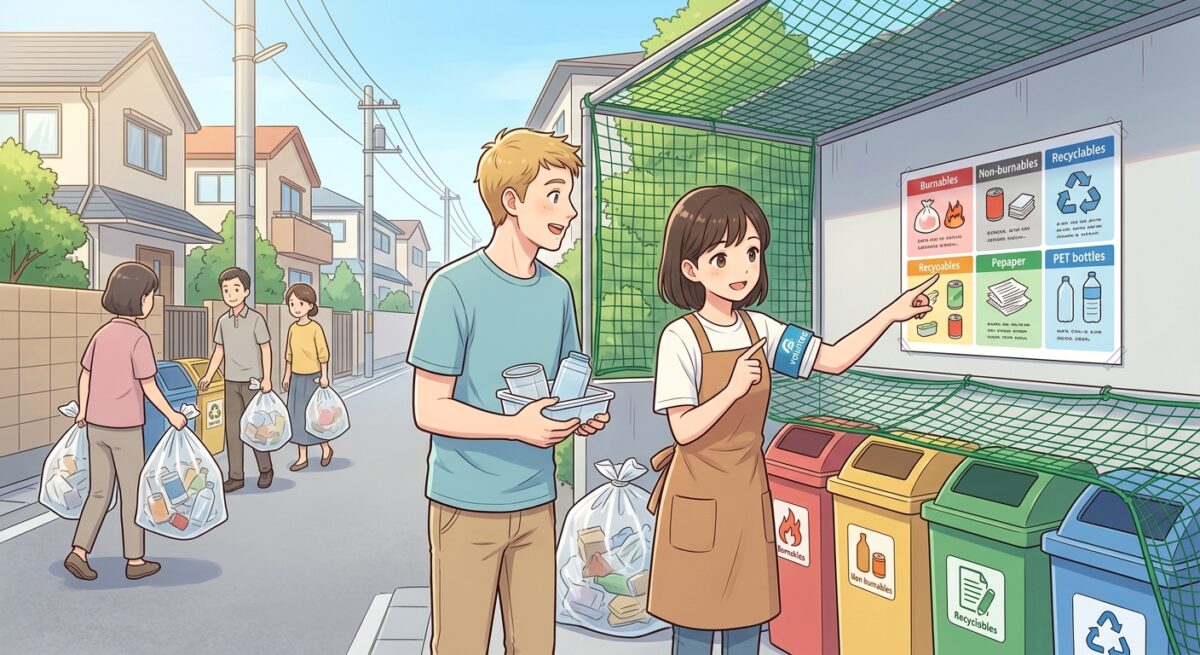
When you move within Japan, even Japanese residents have to learn a new trash calendar. Your first goal is not to memorize a national list. It is to identify the rules for your municipality, address, and building, then build a small home routine that matches them.
Your First-Week Goal
By the end of the first week, you should know four things:
- the current municipal separation guide for your address;
- the collection calendar for your block or district;
- the exact collection point or building trash room you may use; and
- the required bags and preparation rules.
A landlord, real-estate agent, building manager, school, employer, or city office may help you find these. Building instructions can add operational details, but they do not replace the municipality’s categories and collection system.
Day 1: Collect the Local Sources
Start with the municipality’s official guide, not a social-media post or a guide for another ward. Confirm that the calendar applies to your exact neighborhood; collection days can differ inside the same city.
Then check the building. Some apartment buildings have a managed trash room that is available for longer hours. Others use a neighborhood cage or street collection point only on specified mornings. Ask for the exact location rather than assuming that the closest bags belong to your building.
If you are only in a short-term rental and the host controls disposal, use our separate guide to short-term rental trash rules.
Day 2: Build the Smallest System That Works
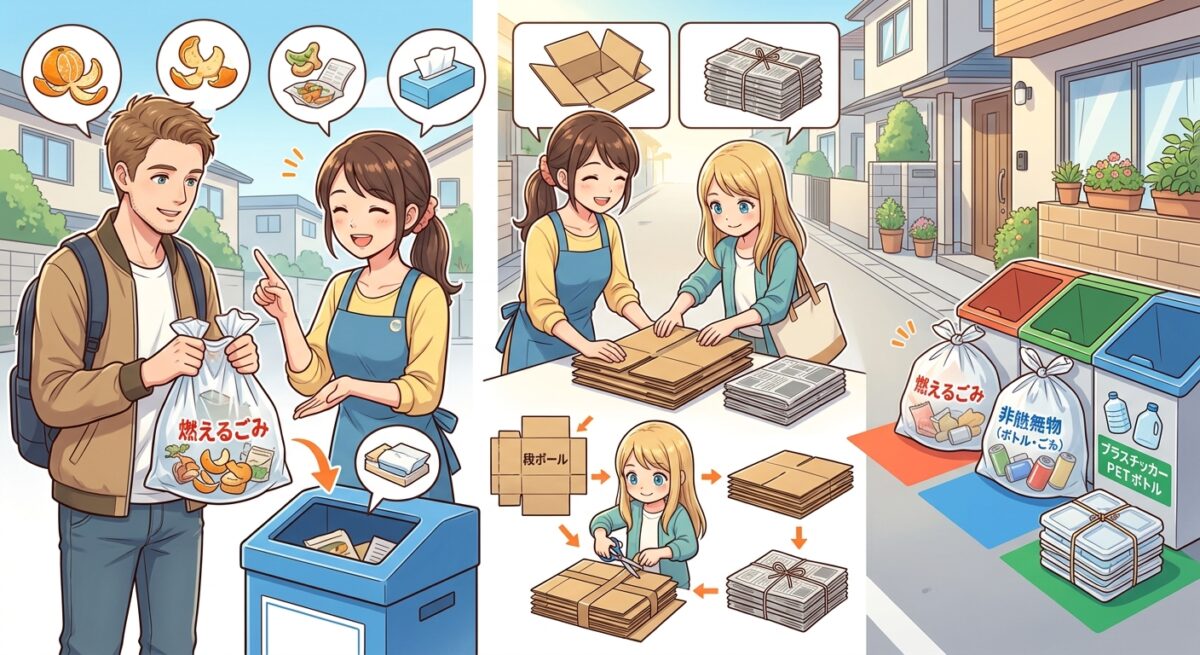
Do not buy seven bins before reading the guide. Begin with washable containers or labeled bags for the categories you generate most often. A typical setup might separate everyday burnable waste, drink containers, paper or cardboard, and a holding area for items that need checking. Your municipality may require a different arrangement.
| Question | Where to verify |
|---|---|
| Is this plastic packaging or burnable waste? | Municipal item list or waste-search tool |
| Must I remove PET-bottle caps and labels? | Municipal recycling instructions |
| Which bag can I use? | Municipal guide and building notice |
| Where and when do I put bags out? | Address-specific calendar and building manager |
| Can I use the trash room at any time? | Building rules |
Day 3: Test One Collection Cycle
For the first collection, check the category, bag, time, and location again. Look at posted examples, but do not open or handle other residents’ bags. If your bag is collected normally, you have confirmed the basic route. If it remains, bring it back and look for a warning sticker or building notice.
Do not put another label over a warning and leave the same bag outside. The category, day, bag, preparation, or collection point may be wrong.
If You Miss Collection Day
Usually, keep the waste inside until the next collection for that category. Do not move it to a different neighborhood point or add it to another category’s pickup. If food waste or another urgent item creates a hygiene problem, ask the building manager or municipal waste office whether an approved alternative exists.
If Your Bag Gets a Warning Sticker
- Bring the bag back inside if it is yours.
- Translate or photograph the sticker without exposing a neighbor’s personal information.
- Check the item, day, bag, preparation, and collection point.
- Re-sort and wait for the correct collection.
- Ask the building manager or city office if the reason remains unclear.
Bulky Waste and Moving-Out Waste
Furniture, futons, large suitcases, and other oversized items often need an advance reservation, fee, and designated date. Some appliances follow separate recycling systems. Size thresholds and accepted items differ by municipality, so do not rely on a rule from another city.
The Ministry of the Environment advises people handling waste during a move to check municipal rules and plan early. This matters because regular collection, bulky-waste reservations, retailer take-back, and licensed collection are different routes. Start before moving week; do not leave large items at the collection point or in a common room.
Regional and Building Differences to Expect
- Some municipalities require designated paid bags; others accept transparent or semi-transparent bags.
- Plastic packaging may be collected separately or handled differently depending on the local program.
- Collection frequency and morning deadlines vary by district.
- A managed apartment trash room may allow different timing from a street collection point.
- Crow-control nets, cages, and rules for cardboard can differ by building or neighborhood.
Official examples from Shibuya and Minato are useful for seeing how detailed local guides can be, but neither should be copied as a nationwide rule.
First-Week Checklist
- Save the official guide and address-specific calendar.
- Confirm the exact collection point with a responsible local source.
- Buy required bags only after checking the rule.
- Label a small number of indoor containers.
- Create reminders for the first two weeks.
- Keep unusual items in a “check first” area.
- Plan bulky or moving-out waste well in advance.
Friends visiting you may have a different problem from residents. You can send them our tourist trash guide.
Two Common Questions
Are burnable and non-burnable categories the same across Japan?
No. The names are common, but item classifications, bags, preparation, and collection schedules vary. Use the official guide for your address.
Who should I ask first: the city or the building manager?
Use the city for official categories and collection services. Use the building manager for the collection point, trash-room access, and building-specific operations. Ask both when the issue crosses those boundaries.