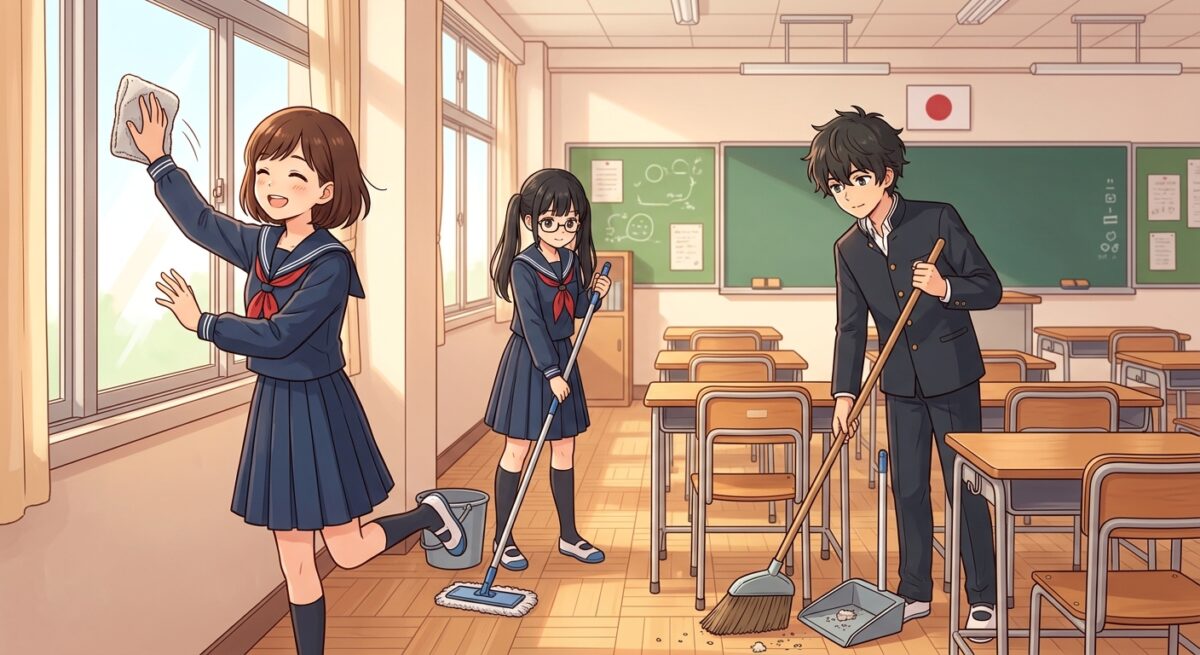
Students sweeping a classroom or wiping a corridor can be an unfamiliar part of Japanese school life. The activity is usually called sōji (掃除, cleaning) or sōji jikan (掃除時間, cleaning time). It is real and widespread enough to appear in official school-life guidance, but it is not one identical national routine followed by every school.
The useful question is not simply “Where are the janitors?” It is: what work are students doing, why has the school included it in the day, and which tasks remain subject to local staffing and safety decisions?
What does sōji jikan mean?
Japan's Ministry of Education, Culture, Sports, Science and Technology (MEXT) tells families entering elementary and junior-high schools that students share responsibility for cleaning classrooms, school grounds, and other areas. This establishes cleaning as a recognizable part of school life. It does not say that every student cleans every space or that every school uses the same timetable.
Cleaning time is different from an academic subject such as mathematics. A current explanation from JNTO's Japan Educational Travel site describes it as an extracurricular activity: it is outside the standard number of class hours, while individual schools may include it in their curriculum to support their educational goals.
| Part of the routine | What it may involve | What must be checked locally |
|---|---|---|
| Assigned area | Classroom, corridor, entrance, school grounds, or another shared space | Which areas students may enter and clean |
| Shared work | Sweeping, wiping, moving light items, sorting tools, or tidying | Age-appropriate tools and safety limits |
| Return and check | Put equipment back and confirm the assigned area is finished | Who supervises or checks the work |
What can a cleaning period look like?
There is no safe universal promise about the exact length or time of day. A school may place cleaning after lunch, near the end of the day, or at another point in its schedule. A practical example has four stages:
- Confirm the area and role. A class or group identifies its assigned space and tools.
- Prepare safely. Students move only the items they have been told to move and collect suitable equipment.
- Clean together. Tasks are divided so that one student might sweep while another wipes or collects debris.
- Restore the space. Tools are returned, moved items go back, and the group or supervising adult checks what remains.
This sequence is an explanatory model, not a nationwide regulation. A younger class may need direct demonstration; older students may work more independently; some schools may organize mixed-age groups. Weather, building design, infection-control needs, staffing, and the day's events can also change the routine.
Why is cleaning treated as education?
The educational rationale is broader than producing a professionally cleaned floor. JNTO's explanation, based on the curriculum work of a former MEXT school inspector, connects cleaning with understanding the significance of work, recognizing one's role, cooperating with others, and developing awareness of social participation.
That distinction matters. A broom is not automatically educational. The learning comes from how the activity is organized and discussed: students have a defined role, coordinate with other people, notice the needs of a shared place, and complete a task that affects the next user.
These are educational aims, not guaranteed personality results. It would be too strong to claim that every student becomes more responsible or that school cleaning alone explains the cleanliness of Japanese streets. The official material supports the intended learning process, not a universal outcome for every child or for society as a whole.
What student cleaning does not mean
| Common assumption | Safer interpretation |
|---|---|
| “The school has no adult cleaning or maintenance support.” | Student cleaning does not describe the school's entire staffing or maintenance system. Repairs, inspections, specialist work, and the division of cleaning duties must be checked locally. |
| “Cleaning is a punishment.” | Scheduled cleaning time is normally presented as a shared school activity. Do not confuse it with a separate disciplinary decision. |
| “Students are expected to meet a professional cleaning standard.” | The educational process and shared responsibility may be as important as the finished result. |
| “Every Japanese school follows the same system.” | Frequency, grouping, assigned areas, adult involvement, and restricted tasks can differ. |
What varies by school, age, and situation?
The MEXT family guide gives a concise description rather than a national list of mandatory tasks. JNTO likewise says individual schools implement cleaning as part of their curriculum. Those details make local variation part of the factual explanation, not an exception to hide in a footnote.
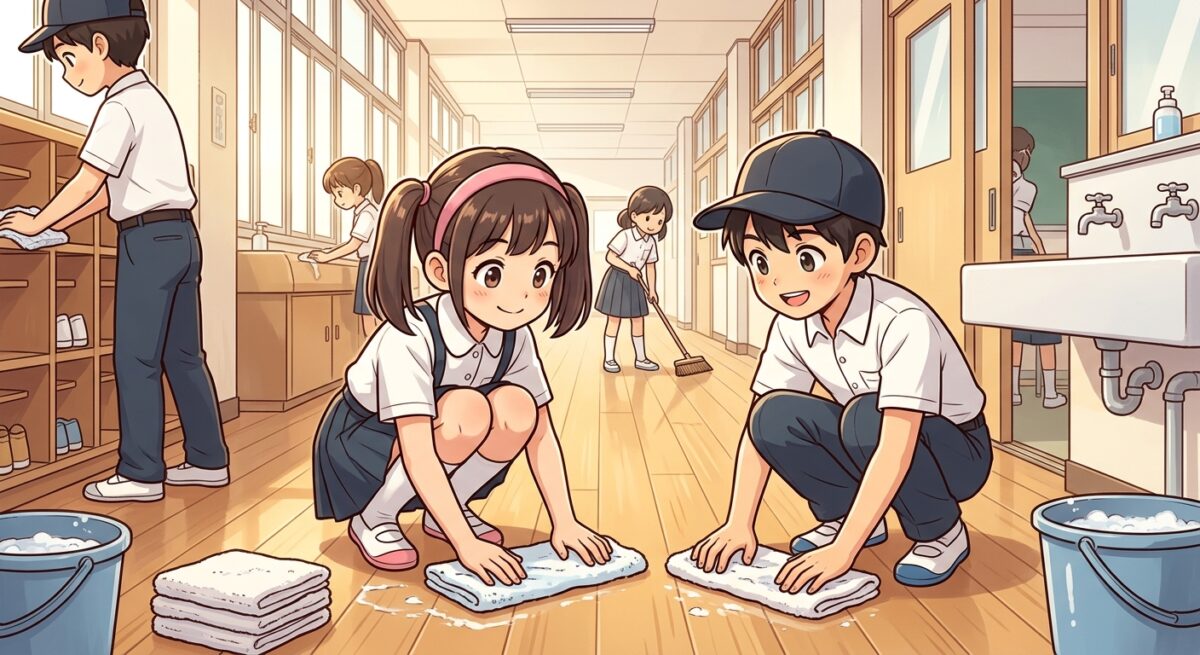
- Age and experience: younger pupils may need demonstration and narrower tasks; older students may be assigned different roles.
- Area: classrooms and grounds appear in official guidance, but restrooms, specialist rooms, stairs, outdoor spaces, and staff-only areas require local confirmation.
- Equipment and substances: access to ladders, chemicals, powered equipment, heavy furniture, or sharp objects is a safety decision, not a cultural assumption.
- Schedule: daily frequency, duration, and placement in the day can differ or change for events and shortened timetables.
- Adult role: supervision, checking, specialist cleaning, repairs, and contracted services depend on the institution and operator.
- Participation: disability, injury, health needs, and other individual circumstances may require an adjusted role. The responsible school decides the arrangement.
If you see cleaning during an invited school visit
A school is not normally a casual sightseeing location. If you have a confirmed reason to be there, stay with the host's instructions. Do not take a broom, enter another area, direct students, or move equipment simply because cleaning has started.
For the full entry, reception, footwear, privacy, and departure process, use our guide to prepare for an authorized school visit. Photography is a separate permission decision; see our guide to photography etiquette and permission in Japan.
掃除の時間は、ここで待てばいいですか?
Sōji no jikan wa, koko de mateba ii desu ka?
Should I wait here during cleaning time?
手伝ったほうがいいですか?
Tetsudatta hō ga ii desu ka?
Would it be better if I helped?
If the answer is unclear, the safe action is to wait with the host rather than join. If you are invited to help, ask which area and tool are appropriate. A parent, exchange participant, employee, and outside visitor may be given different roles.
How to understand the cleaning period you observed
Instead of using one scene to make a claim about all Japanese schools, record six practical details:
- Was this a scheduled routine, a special event, or a response to a spill?
- Who assigned the area and explained the task?
- Which spaces and tools were students allowed to use?
- What work was done by teachers, staff, contractors, or other adults?
- What safety limits or individual adjustments were visible?
- How were tools returned and the work checked?
Those details reveal more than the simple statement “students clean the school.” They show whether the emphasis is routine care, cooperation, practical technique, community participation, or a combination chosen by that school.