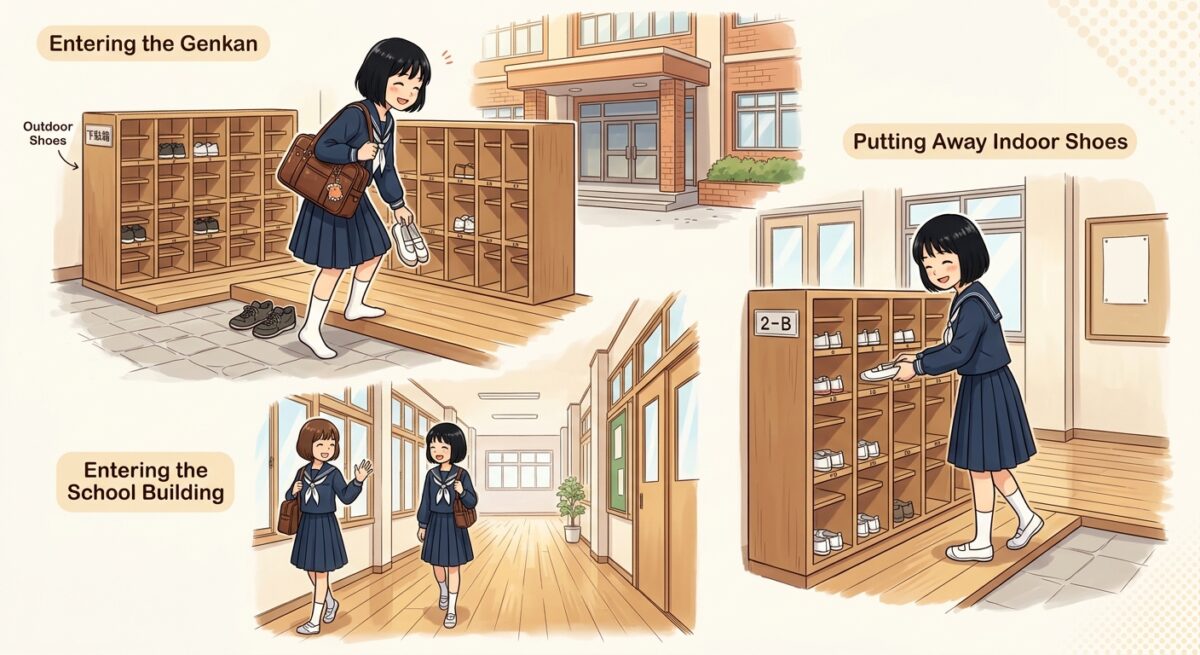
A school in Japan is not normally a place to enter for casual sightseeing. This guide is for a visitor who has a confirmed reason to attend, such as a parent meeting, lesson observation, open day, school event, exchange program, volunteer activity, or professional appointment.
The invitation or current school notice is more important than any general rule. A public open day may accept visitors without individual appointments, while another school may require advance registration, a named contact, a specific gate, or a visitor badge. If you have no invitation or published visitor instructions, contact the school before going inside.
The safe default
Stop at the designated entrance, identify yourself and your purpose, complete reception, and wait for directions. Do not follow students through a gate or explore the building while looking for your contact.
Start with the type of visit
“School visit” can describe very different situations. Decide which instructions apply to you before using general etiquette advice.
| Visit | What usually controls entry | Do not assume |
|---|---|---|
| Parent meeting or lesson observation | The notice sent to families, the child’s class, and school reception instructions | That every classroom or activity is open |
| Open day, festival, or sports day | The event page, ticket or registration, time window, and event-area signs | That an open event permits unrestricted photography or entry to staff-only areas |
| Exchange, volunteer, or official visit | The host teacher or coordinator’s itinerary and safeguarding instructions | That direct contact with students is allowed outside the planned activity |
| Business, delivery, or public-agency appointment | The named staff contact, office entrance, security process, and identification request | That the student entrance is the correct entrance |
| University or vocational school | Campus and department rules for the exact building, class, laboratory, or event | That an open campus means every room or class is open |
Kindergartens, childcare facilities, elementary schools, junior high schools, high schools, universities, and private institutions can use different entry systems. The age of the children and the purpose of the visit also affect how closely a guest is escorted.
Check these details 24 hours before
- Date and time: confirm the arrival window, not only the event start.
- Entrance: check the main gate, office entrance, reception desk, or event entrance.
- Contact: save the host’s name, department, and a number provided for day-of problems.
- Entry requirement: check registration, confirmation email, invitation, photo ID, or visitor-pass instructions.
- Footwear: check whether to bring indoor shoes or slippers and a bag for outdoor shoes.
- Photography: ask whether photography, video, audio recording, and later online posting are each allowed.
- Transport: read parking and bicycle instructions instead of assuming visitor parking exists.
- Changes: check the school website or message from the organizer for cancellation or schedule updates.
If the school’s message does not answer an important question, ask the organizer. Do not use instructions from a different school as proof of what your destination allows.
If a conversation is likely to involve schoolwork given in Japanese, ask in advance whether interpreting or a written summary can be arranged for that part of the visit. If the meeting is about your child’s work itself, the next section covers what to bring and what to ask.
If the meeting is about your child’s schoolwork
A blank page may not tell you why a child is stuck. At a Ministry of Education expert meeting on 28 August 2025, a coordinator from Yokohama’s Minami Lounge described a first-year junior high school student from China whose notebook for maths word problems stayed blank because he could not understand the Japanese wording; when a mother-tongue support volunteer explained the problems in Chinese, he understood what they meant and solved them. The account comes from the support side rather than from the student or his family, and it says nothing about his overall ability or later progress.
If your child brings home blank or unfinished work, taking one example to the meeting can make the conversation more concrete. Ask what the task required, how the instructions were explained, and where the teacher thinks your child got stuck.
Ask the school or your local board of education which language support applies to your child, which languages can be arranged, and who coordinates the request. As one example, Yokohama City’s guide to its municipal schools describes Japanese-language instruction, mother-tongue support volunteers, and interpreter volunteers that a school can request for parents at information sessions and meetings, and tells parents to consult the school when they need an interpreter. Arrangements differ by city, school, and year, so use that as a list of questions rather than an expectation of what is available where you live.
Arrival: a five-step process
- Use the designated entrance. Do not enter behind a student or another family simply because the gate is open.
- Go directly to reception. Look for signs such as reception, the school office, the staff entrance, or the event desk.
- Give the necessary information. State your name, organization or relationship if relevant, purpose, appointment time, and host’s name.
- Complete the local process. Sign the visitor record, show a confirmation or ID if requested, and wear the visitor badge where staff can see it.
- Wait for directions. Stay at reception or the assigned waiting point until a staff member tells you where to go.
Japan’s Ministry of Education describes reception, recording a visitor’s name and purpose, and visible visitor identification as important school-security measures. This is guidance for safe school management, not proof that every school uses the same form or badge.
Indoor shoes: check the building, not the stereotype
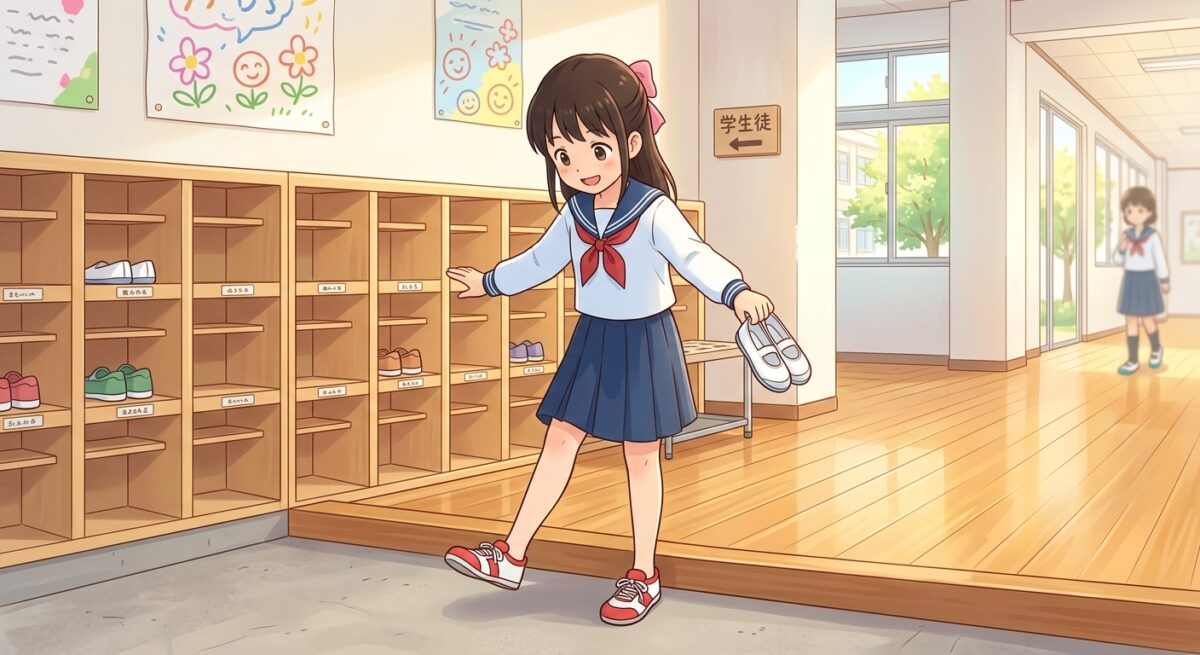
Many elementary and secondary schools use an indoor-shoe system, but not every building does. Current Tokyo school notices show both possibilities: some tell visitors to bring slippers and a shoe bag, while another explicitly says it is a one-shoe school and indoor shoes are unnecessary.
| What you see | What to do |
|---|---|
| Instructions to bring indoor shoes | Bring clean, secure indoor footwear and a bag for outdoor shoes |
| Guest slippers are provided | Use the indicated pair and return it where instructed |
| No clear footwear instruction | Pause at the entrance boundary and ask before stepping onto the indoor floor |
| One-shoe building or no change required | Keep your shoes on and follow the school’s notice |
Choose footwear that is clean, quiet, stable on stairs, and easy to manage. Loose guest slippers can be difficult for long walks or gym stairs, so use the footwear specified in the invitation where possible.
Inside classrooms and corridors
- Stay with the host or within the route and rooms opened for the event.
- Keep conversation brief and quiet while lessons are in progress.
- Do not enter a classroom, staff room, nurse’s room, changing area, laboratory, or club room unless invited.
- Do not read or photograph name lists, schedules, student work, medical information, or notices containing personal details.
- Keep doors, corridors, stairs, and evacuation routes clear.
- If a class or activity changes unexpectedly, wait for the teacher or coordinator to explain what visitors should do.
A parent observing their own child, an invited exchange guest, and a member of the public at an open day do not have the same role. Participate only to the extent stated by the school. During a cleaning period, for example, do not begin using equipment or directing students unless the host invites you to join. For the educational background of school cleaning, see our separate guide to why students clean Japanese schools.
Photography, video, audio, and SNS
School permission should come before the camera. A broad event invitation, a parent’s permission, or the absence of a no-photo sign does not automatically authorize recording throughout the campus.
- Check the event rule. Is recording prohibited, limited to a designated time, or available only to registered participants?
- Ask the responsible staff member. Confirm what may be recorded, where, and for what purpose.
- Check what appears in the frame. Students, faces, name tags, class lists, computer screens, student work, timetables, and location details may require restrictions.
- Ask separately about sharing. Permission to take one photograph is not automatically permission to post it on social media, publish it, or send it outside the agreed group.
If the answer is unclear
Do not record or post. Put the device away and ask the designated coordinator. If staff ask you to stop or delete a recording, stop immediately and follow their instructions.
Some schools prohibit all photography and recording during open lessons. Others use a formal permission system for specific visitors. These are local operating decisions, which is why the exact school’s notice must be checked. For wider place-by-place decisions, see our guide to photography etiquette in Japan.
Interacting with children and students
Follow the teacher or coordinator’s plan. Do not ask a child for private contact details, social-media accounts, home address, or other personal information. Do not move a student to a different location for a photograph or private conversation. Physical contact, gifts to individual students, and exchange of personal contact information should not be improvised.
In an organized exchange activity, conversation, games, or group photographs may be part of the program. That does not make the same activity appropriate in a corridor or outside the scheduled session. Ask the facilitator when you are unsure.
Clothing, belongings, food, gifts, and smoking
| Item | Practical choice |
|---|---|
| Clothing | Follow the event notice; otherwise choose neat clothes suitable for walking, stairs, weather, and the purpose of the visit |
| Bag | Use a compact bag that stays with you and does not block corridors or seats |
| Food and drink | Use only the place and time permitted by the school; do not assume classrooms are eating areas |
| Gift | Do not assume a gift is required; for an official exchange, ask the organizer before bringing one |
| Smoking | Do not smoke on school grounds; follow all posted restrictions and staff instructions |
Under Japan’s revised Health Promotion Act, schools are treated as facilities where smoking is prohibited on the premises, although a qualifying outdoor smoking place may exist in limited circumstances. A visitor should not search for an exception; the safe action is not to smoke on the school site.
Useful Japanese at reception
| Japanese | Romanization | English |
|---|---|---|
| 授業参観のために来ました。 | Jugyō sankan no tame ni kimashita. | I’m here for the class observation. |
| 受付はこちらですか? | Uketsuke wa kochira desu ka? | Is reception here? |
| 靴を履き替えますか? | Kutsu o hakikaemasu ka? | Should I change my shoes? |
| 写真を撮ってもいいですか? | Shashin o totte mo ii desu ka? | May I take a photo? |
| どこで待てばいいですか? | Doko de mateba ii desu ka? | Where should I wait? |
| 来校者証はどこへ返せばいいですか? | Raikōshashō wa doko e kaeseba ii desu ka? | Where should I return the visitor badge? |
| 子どもは授業の内容を理解できていますか? | Kodomo wa jugyō no naiyō o rikai dekite imasu ka? | Is my child understanding the class content? |
| 通訳をお願いできますか? | Tsūyaku o onegai dekimasu ka? | Could I ask for an interpreter? |
Replace “class observation” with the actual purpose of your visit when possible. Showing the invitation or the host’s written name can help if pronunciation is difficult.
Before you leave
- Return the visitor badge, key, slippers, or borrowed material to the specified place.
- Sign out if the school uses a visitor record.
- Check that you have not left a document, device, umbrella, or shoe bag behind.
- Confirm whether any handout or photograph has sharing restrictions.
- Leave through the instructed route and by the event’s closing time.
If an alarm, earthquake, severe-weather instruction, or other emergency occurs, stop the visit and follow school staff. Do not separate from the group to retrieve belongings unless staff say it is safe.
Save this school-visit checklist
- Visit purpose, date, arrival time, entrance, and host confirmed
- Registration email, invitation, and requested identification packed
- Indoor shoes or slippers and shoe bag packed if required
- Photography, recording, and SNS rules checked separately
- Transport and parking instructions checked
- Reception information ready in Japanese or writing
- Visitor badge and sign-out process followed
- Borrowed items returned before departure
The most respectful visitor is not the person who memorizes a single national rule. It is the person who reads the current invitation, checks in properly, follows the school’s route and permissions, protects students’ privacy, and asks before acting.
Official references
- Ministry of Education, Culture, Sports, Science and Technology: School reception and visitor identification guidance
- MEXT School Safety: Preventing unauthorized entry
- Tokyo Metropolitan Musashi School: 2026 open-class visitor notice
- Tokyo Metropolitan Asuka High School: 2026 open-class visitor notice
- Tokyo Metropolitan Kogei High School: Photography and video guidelines for external visitors
- Ministry of Health, Labour and Welfare: Smoking rules for schools and other Type I facilities (Japanese)
- Ministry of Education, Culture, Sports, Science and Technology: Expert meeting record, 28 August 2025 (Japanese)
- Yokohama City: Japanese-language support in municipal schools (Japanese)