I thought it would be easier
Before I climbed Mount Fuji, I thought it would be easier than it was.
It took me about 11 hours, up and back, from the fifth station. It was a day trip; I didn't stay in a mountain hut.
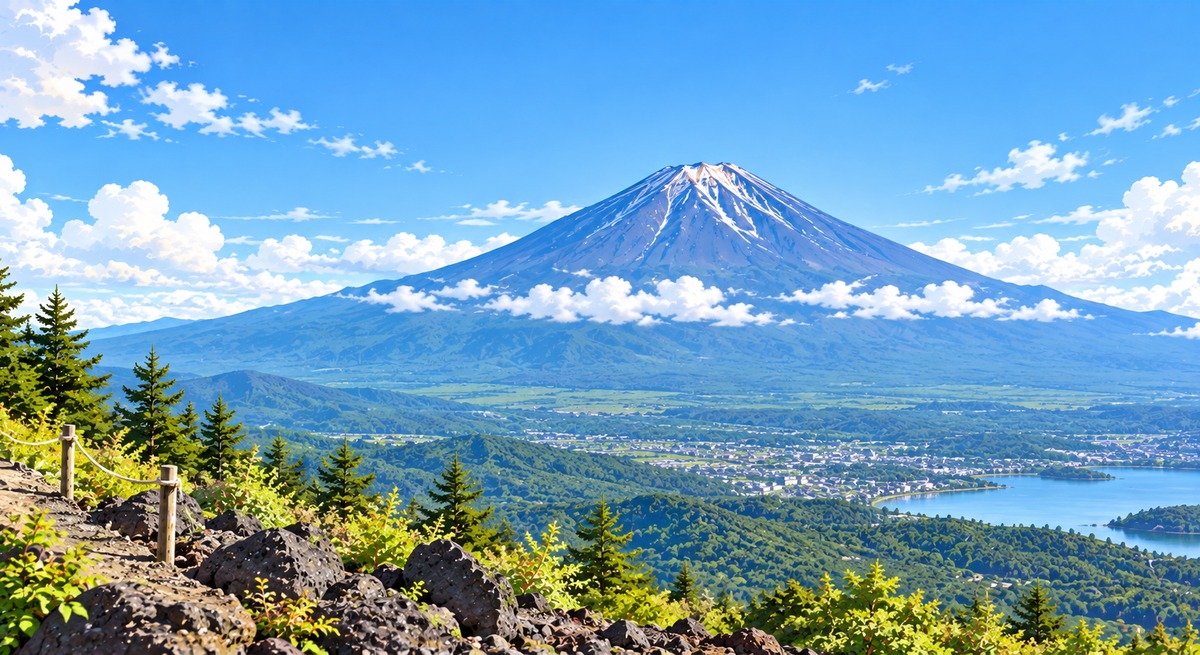
Conceptual illustration of Mount Fuji during the climbing season.
What I remember, and what I don't
I parked at a car park at the foot of the mountain and took a bus up to the fifth station. I don't remember which trailhead that was, so I'm not going to name a route. I can't tell you the year or the season either. What I do remember is that the sky was completely clear.
I don't remember how the 11 hours split between the way up and the way down — only that the round trip came to roughly 11 hours. So that number is one person's round trip on one clear day, not a benchmark for any particular trail.
The hardest part was near the top
I had more stamina back then, and I don't remember changing much about how I climbed. The hardest part was near the summit. I remember taking more breaks as I got closer to the top.
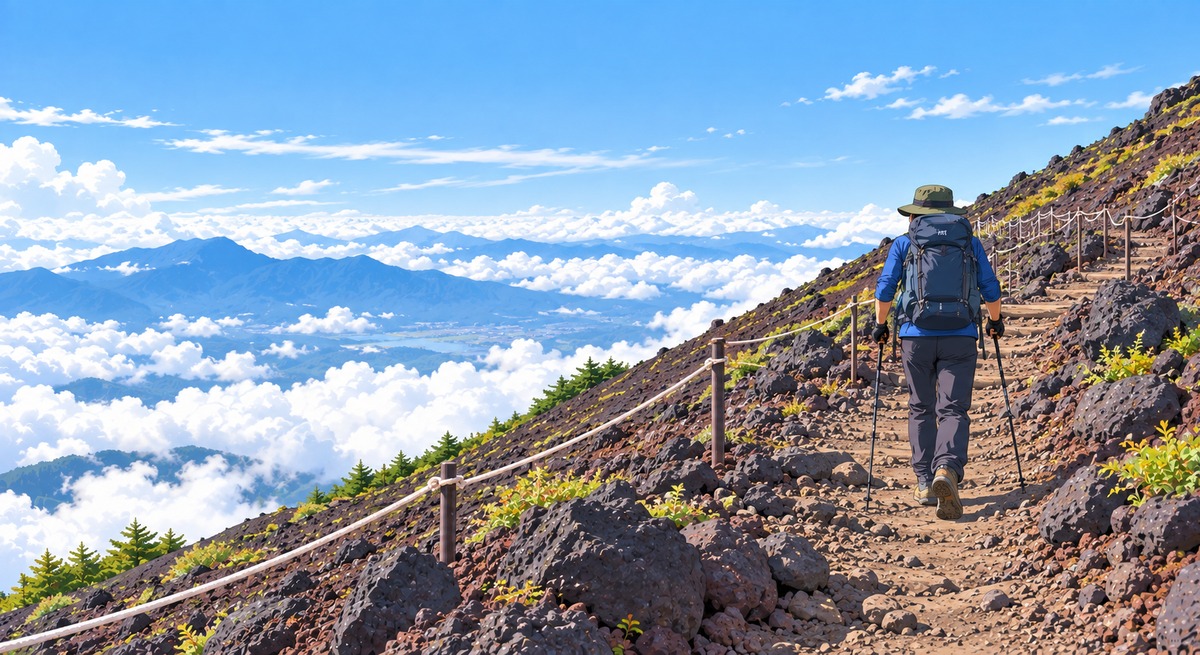
Conceptual illustration of climbing on Mount Fuji; not an exact representation of the author's route.
A bag of potato chips at the summit
One small thing I still remember from the summit: a bag of potato chips had puffed up.
Coming down
My memory of the descent is that I went down at a jog and it was over surprisingly quickly. That's a description of what I did back then, not a suggestion for anyone else.
Looking back
After doing the climb myself, I came away thinking a walking pole would have been useful. I also think you should carry your own trash back down with you.
As for whether it's worth doing: I think climbing Mount Fuji once in your life is fine. I don't want to do it a second time.
The rules as of the 2026 season
I can't place the year I climbed, so I won't compare then and now. Everything in this section comes from official information for the 2026 season, checked on 2026-09-29, not from my own climb. That season ended on September 10, 2026, and rules for a later season may differ.
- Entry fee: 4,000 yen per person per climb on all four routes (Yoshida, Fujinomiya, Subashiri, Gotemba). It is mandatory.
- Yoshida route: climbs can be booked in advance (same-day booking was also possible), within a daily cap of 4,000 climbers, not counting mountain-hut guests. The gate is closed from 14:00 to 3:00 the next morning to anyone without a mountain-hut booking.
- Shizuoka routes (Fujinomiya, Subashiri, Gotemba): climbers register through the prefecture's FUJI NAVI system, complete its online safety and conservation course, and pay the fee there; entering between 14:00 and 3:00 requires a mountain-hut booking.
- Season: early July to September 10, with opening dates that can shift with weather and snow.
- Not verified: whether children pay the same fee — confirm directly before you go.
The official climbing site notes that air pressure near the 3,776 m summit is about two-thirds of that at sea level, that climbing too quickly can bring on altitude sickness, and that descending is the best response if symptoms appear. Temperatures drop by about 0.6°C for every 100 m of height. There are no trash cans on the trails or in mountain huts, and the site advises bringing cash and 100-yen coins for huts and toilets.
Rules change by season, so check the official Yamanashi (Yoshida route) and Shizuoka pages, and the official climbing site's health guidance, before your own trip rather than relying on this article.
For a very different long day on foot, this time in the middle of Tokyo, I once walked the entire Yamanote Line loop — about nine hours and forty minutes of detours and dead ends, as I remember it.