Tokyo trains are convenient — until you add a large suitcase
Tokyo's trains are genuinely one of the easiest ways to get around a big city. That reputation is deserved most of the day. It changes with one specific combination: a large suitcase, on an ordinary commuter train, during the hours when that line is at its most crowded. This guide is about that specific combination — not trains in general, and not a warning to avoid them.
Author's note: this comes from a standing practical view, not one specific trip — I haven't personally been stuck at one exact station or missed a specific train over this. What follows is built mainly on current transit and logistics information, checked directly against operators' own current pages, with that view used only to frame why the topic is worth a close look.
Why rush hour and a large suitcase don't mix
A large suitcase takes up floor space that a packed train car doesn't have to give. On a normal train, that's rarely a problem — there's room to angle it out of the way. In a genuinely crowded car, there isn't room for the case or for the people who need to get past it, and the same is true on the platform and in the corridors leading to it. The suitcase itself hasn't changed; the amount of space available around it has.
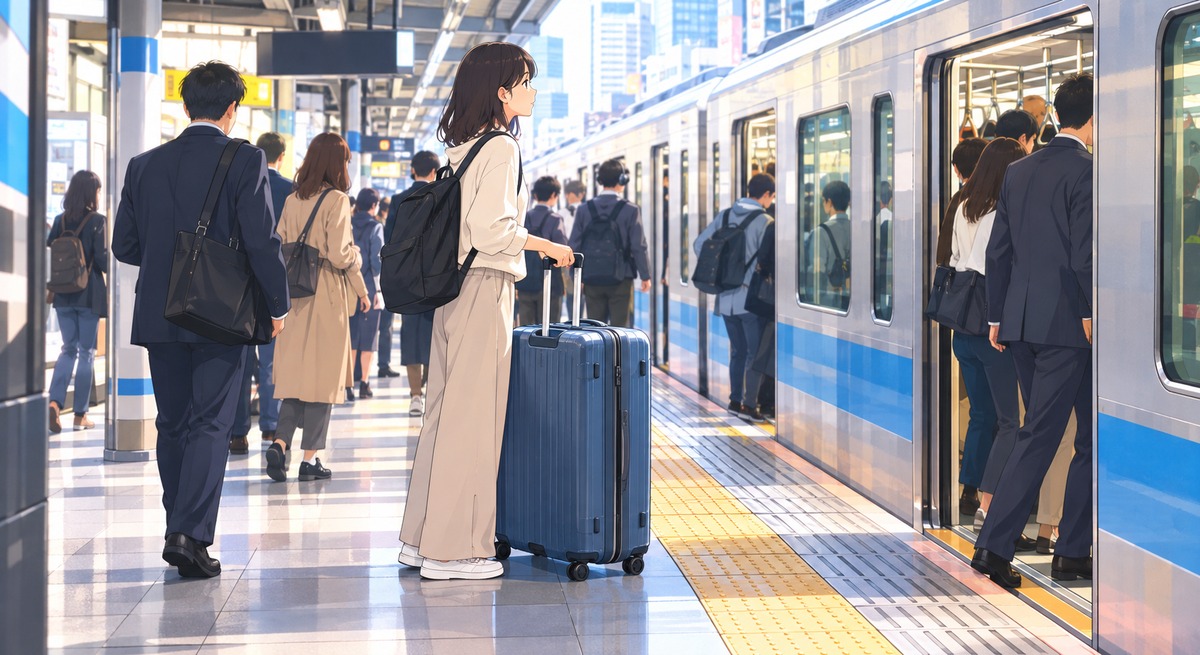
A large suitcase takes up space a crowded train car and platform don't have to spare.
How crowded, and when — without pretending there's one fixed answer
The most recent Japanese government survey (Ministry of Land, Infrastructure, Transport and Tourism, fiscal-year-2025 data, published mid-2026) puts the Tokyo-area average train congestion rate at 143%, up from 139% the year before. Two things matter about that number: it's an average across many surveyed lines, and it specifically measures each line's single most crowded hour of the day — it is not a claim that "Tokyo trains run at 143% all day," and it doesn't describe any one train you might personally board.
What actually drives how crowded your specific trip will be is a combination of factors, not one clock time: which line, which direction, which station you're boarding from, whether it's a weekday or a weekend/holiday, and whether something unusual is happening (a delay, an event, bad weather). Weekday commuter rush hour is driven by people going to work and school, so weekends and public holidays on the same lines are meaningfully quieter. Morning congestion is commonly described as building somewhere in the 7:00–9:00 range and evening congestion in the early evening, but treat that as a rough shape, not a rule — some lines run heavier later toward their city-center terminal than they do further out, and the reverse is also possible depending on the line.
The single most useful thing you can do before a trip with a large case isn't memorizing a schedule — it's checking recent conditions before you leave. If you're moving on a Tokyo Metro line, the operator's own Metro CrowdNavi tool shows statistical crowding patterns by station, time, and train — averaged from the last several days — which is far more useful than a fixed number from an article written months earlier. It's not a live view of the train you're about to board; for that level of real-time, per-car detail, Tokyo Metro's separate "Tokyo Metro my!" app is the tool to use.
Stations are part of the problem too
A packed car is only half of it. Reaching the platform with a large case can mean long connecting corridors, stairs, and transfers between different operators' gates — especially at major interchange stations like Shinjuku, Tokyo, Shinagawa, Shibuya, Ueno, or Ikebukuro. Plenty of smaller stations are simple and step-free by nature; it's specifically the big interchange stations where this adds up.
Elevators do exist. Tokyo Metro states that all 180 of its stations have at least one step-free route from street to platform. That is not the same as saying every exit has an elevator — at a large station, the accessible route can be a real detour from the exit closest to where you're actually headed. If you know you'll be moving through a specific big station with a large case, checking that station's own accessibility map before you arrive is worth the two minutes it takes.
Better options than fighting the crowd
None of this requires giving up on trains. The core moves are simple: shift your travel outside the busiest window and confirm current conditions before you leave rather than guessing; if you're checking out of a hotel, you don't have to leave the moment you're packed; and for airport transfers, compare a limousine bus (cargo-hold luggage handling, longer ride) against the fastest train rather than defaulting to whichever sounds quickest. The next two sections cover the two options that remove the problem rather than just timing around it.
Luggage delivery: removing the problem instead of timing around it
Sending a suitcase ahead by courier is common in Japan, and for this specific problem it's often the cleanest fix — the case simply isn't with you for the crowded leg of the trip.
Yamato Transport's TA-Q-BIN, the courier most travelers use for this, accepts parcels up to 200cm in total dimensions and 30kg (confirmed on Yamato's own current FAQ). Airport-to-hotel and hotel-to-airport forwarding is widely available; Yamato prices by route through its own calculator rather than one fixed table, so check the current rate when you ship rather than relying on a number from an article. Following Japan's 2024 trucking-industry labor reforms, current guidance generally favors shipping a few days ahead over assuming guaranteed next-day delivery — confirm the actual cutoff and lead time with whoever handles your shipment.
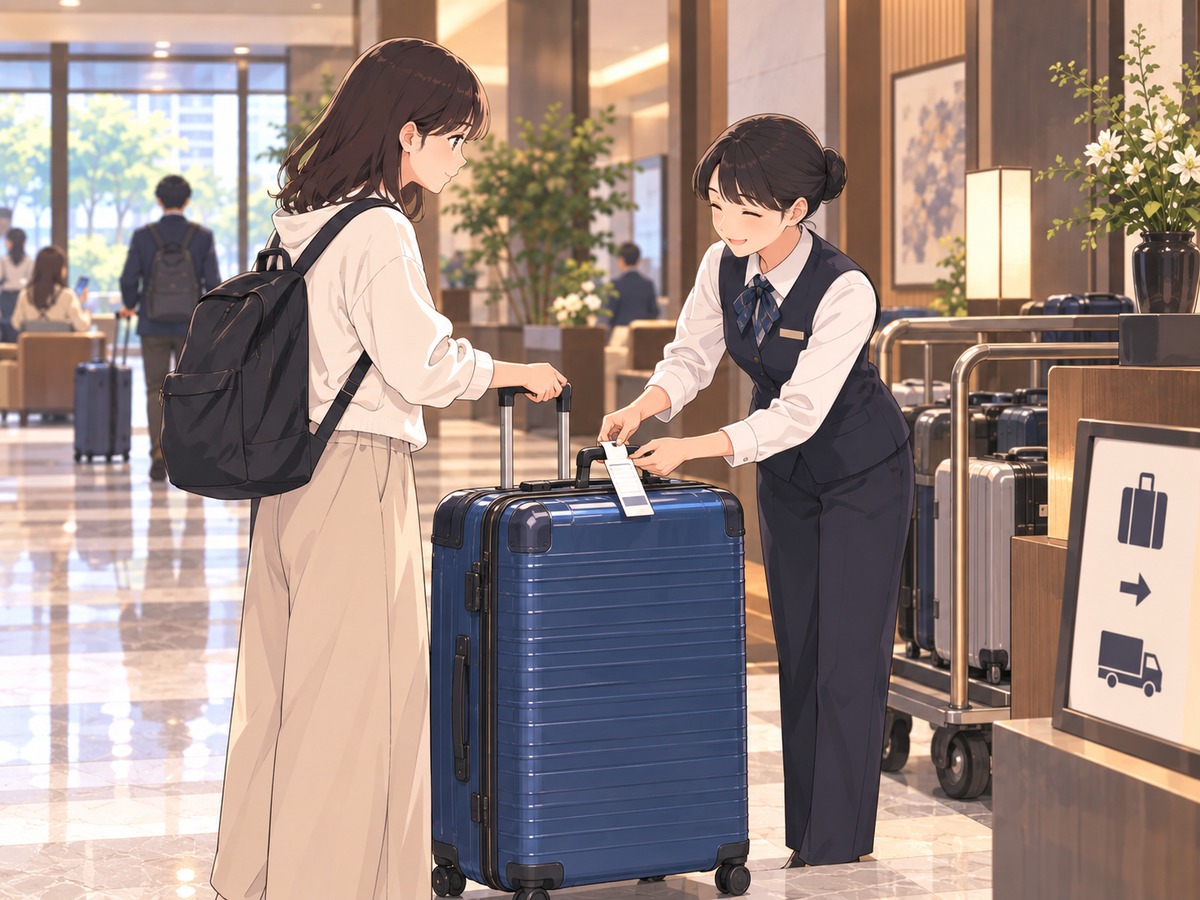
Sending a large suitcase ahead can make train travel easier when you would otherwise be carrying it through busy stations.
If you specifically need your case the same day you land, ABC (JAL's airport delivery service) operates counters at Narita, Haneda, Kansai, Chubu, New Chitose, and Itami for general forwarding, with standard size tiers up to 160cm/30kg. Same-day arrival-to-hotel delivery is confirmed on ABC's own current pages from two airports, each with different coverage: from Kansai International Airport, pickup by 12:30 for delivery the same day to eligible hotels in the Osaka and Kyoto city areas, for an extra ¥1,000 per piece; from Haneda Airport, pickup by 13:00 for same-day delivery specifically to hotels in the Maihama/Shin-Urayasu bay area (around Tokyo Disney Resort), at a flat ¥1,800 per piece with a 20kg limit. Neither covers other hotel areas — if you're arriving elsewhere, or your hotel is outside those specific areas, ask the airport delivery counter directly whether same-day service applies to your route.
Don't confuse this with the Shinkansen's oversized-baggage rule
If your trip also includes a Shinkansen leg, its baggage rule is a completely different system from anything above, and it's worth keeping the two separate. On the Tokaido, Sanyo, Kyushu, and Nishi-Kyushu Shinkansen, you only need to reserve an "oversized baggage" seat if your case's three dimensions add up to more than 160cm (the ceiling is 250cm) — an ordinary 3-to-5-night M or L suitcase is well under that and needs no reservation at all. Bring an oversized case without reserving the right seat and you may be asked to move it, with a handling fee possible.
Ordinary city trains — the Tokyo Metro, Toei Subway, and JR commuter lines this guide is actually about — have no equivalent reservation system in either direction. A large suitcase on the Yamanote Line at rush hour isn't a rule violation; it's simply harder because of the crowding covered above, not because of any baggage-size regulation. Don't let the Shinkansen's 160cm rule make you think an ordinary city train has a size limit of its own — it doesn't.
Which option actually fits your trip?
- One carry-on only: none of this really applies to you — a carry-on is manageable on a packed train. Travel whenever suits you.
- One large suitcase, flexible schedule: shift your travel outside the peak window and check current crowding before you leave; that alone solves most of the problem.
- One large suitcase, fixed schedule (an early flight, a fixed check-in time): consider sending the case ahead by courier a few days out and carrying only a day bag on the day itself.
- Two or more large suitcases: courier delivery is worth it even if your schedule is flexible — multiple large cases in a crowded transfer is a harder problem than timing alone can fix.
- Arriving today and heading straight to a Tokyo-area hotel: compare an airport limousine bus (cargo-hold luggage handling, longer ride) against a direct train, rather than defaulting to whichever sounds fastest.
- Need your case the same day you land: ABC's same-day service is confirmed from Kansai (to Osaka/Kyoto hotels) and from Haneda (to the Maihama/Shin-Urayasu bay area only) as of this check — ask the counter at your specific arrival airport and hotel area whether it applies to you.
- Continuing on to another city by Shinkansen: check your case against the 160cm rule separately — it has nothing to do with the crowding advice above.
A note on sharing the space
None of this is about considerate travelers versus inconsiderate ones — keeping an aisle or doorway clear and using a luggage rack where one exists is simply easier for you too, since a case blocking a door is awkward the moment the train stops and people need to move around it. For everyday train manners beyond luggage specifically, Why Japan's train etiquette guide covers boarding, seating, and phone calls in more depth — this guide stays focused on the suitcase-and-timing problem specifically.
The bottom line
Tokyo's trains remain a genuinely convenient way to get around with luggage, most of the day. The part that gets hard is narrow and specific: a large suitcase during the roughly two-hour windows when a given line is at its most crowded. That's exactly the part you can plan around — by checking current conditions, shifting your timing, sending the case ahead, or choosing an airport transfer that doesn't require you to carry it yourself.
If Tokyo's stations are already part of your trip, you might also enjoy Why Japan's account of walking the entire Yamanote Line loop on foot — a very different kind of day built around the same stations this guide is about.