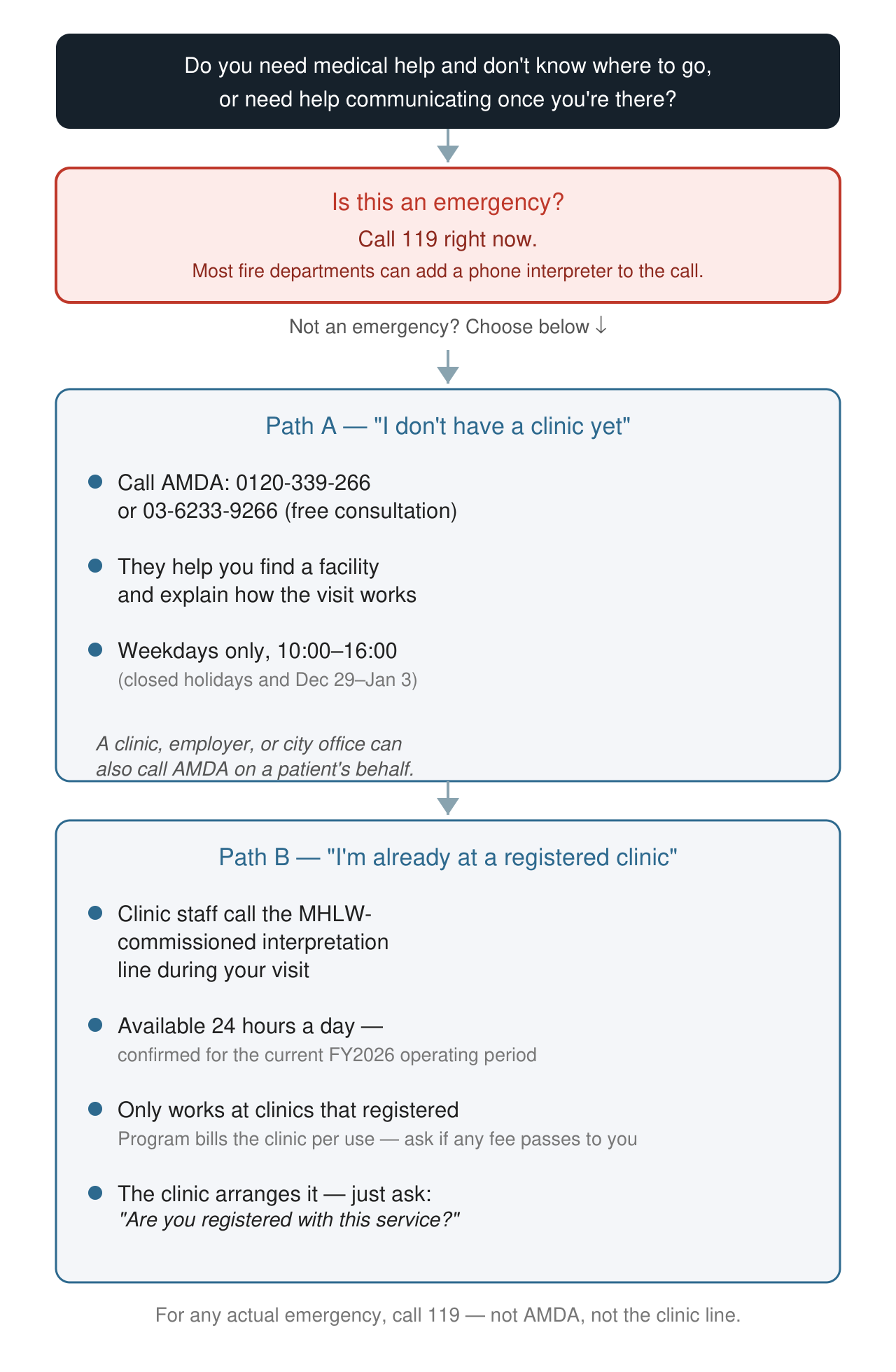
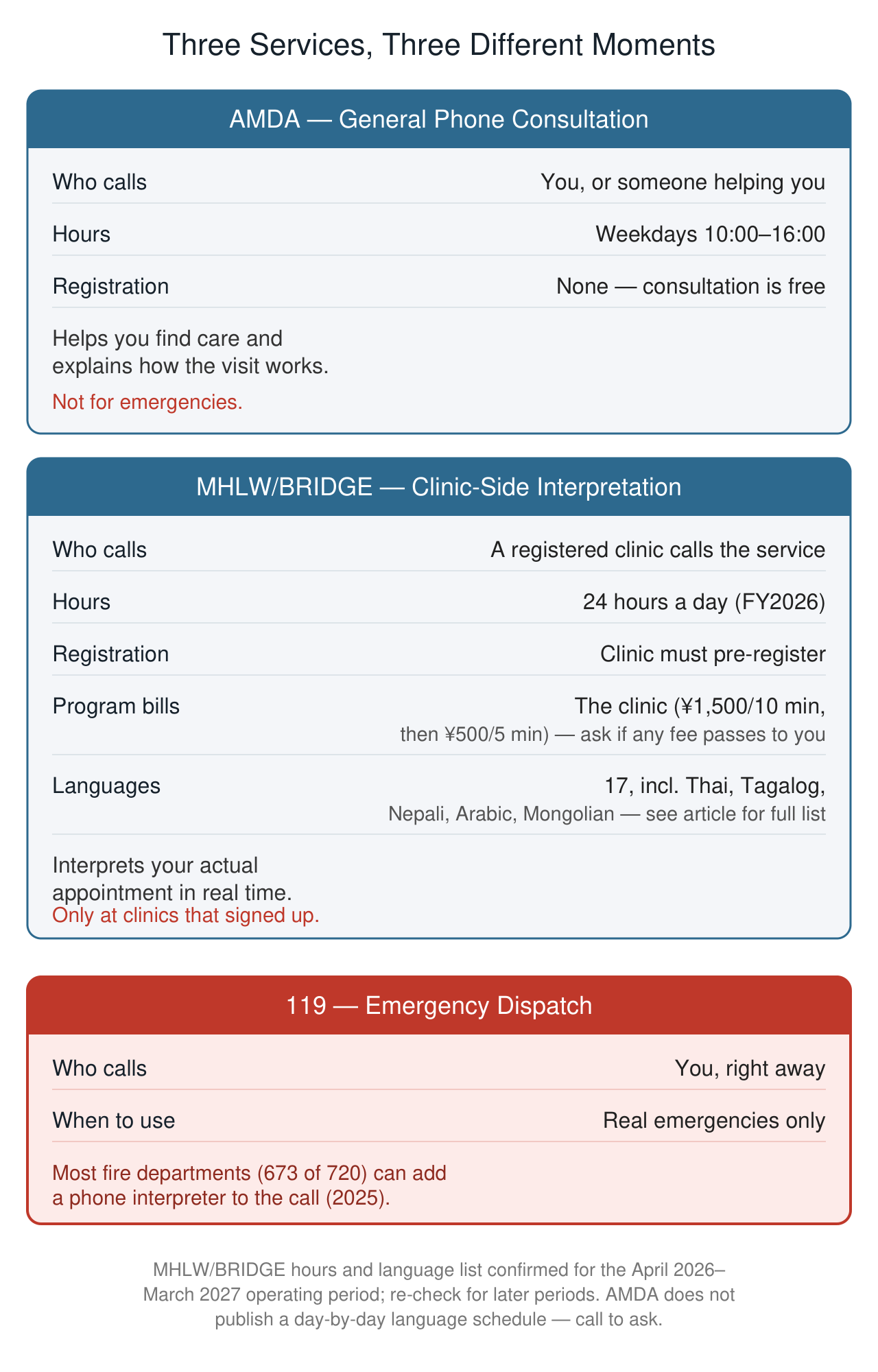
Short answer: there are two separate services for two separate moments, not one all-purpose hotline — AMDA for when you don't have a clinic yet (weekdays, 10:00–16:00), and a clinic-side interpretation line that runs 24 hours a day once you're already at a registered clinic. Neither is for emergencies; that's always 119.
Two moments, two different problems. You wake up with a bad fever and don't have a regular clinic yet — you don't even know where to start. Or: you're already sitting at a clinic's front desk, the receptionist is talking fast, and you can tell from her face that neither of you understood the last two sentences. Search results for “medical help in Japan English” rarely explain which of these two moments a given hotline is for. There are two separate, genuinely different services — one for each moment — and knowing which one applies saves you the one thing you don't have much of right then: time.
If this is an actual emergency, skip everything below and call 119. Most fire departments in Japan can bring a phone interpreter onto a 119 call (673 of 720 departments, about 94%, as of January 2025), and English, Chinese, and Korean are covered wherever this is offered. Neither service described in this article is an emergency line, and neither replaces it.
Moment One — You Don't Have a Clinic Yet, and It's Not an Emergency. Call AMDA.
The AMDA International Medical Information Center runs a multilingual phone consultation line — 0120-339-266 or 03-6233-9266. This is the “where do I even go” service: you call, explain roughly what's wrong, and they help you find a nearby facility and understand how a visit works. You call them — no registration needed — and notably, it's not limited to the patient alone: a clinic, your employer, or a city/ward office can also call on a patient's behalf.
What AMDA doesn't do: sit in on your actual appointment, or take calls outside its hours. It's open weekdays only, 10:00–16:00, closed on national holidays and from December 29 to January 3 — plan around that, not around when you happen to get sick. AMDA states on its own site that its services are provided free, funded by donations — the page doesn't specify whether that covers your own phone charges for the call itself, so budget for a normal call cost just in case. A staffing document on AMDA's own website (checked November 12, 2026) lists roughly eight languages plus Japanese — English, Chinese, Korean, Thai, Spanish, Portuguese, Filipino/Tagalog, and Vietnamese — handled from its Shinjuku office. That's the most recent list we could find, but it describes AMDA's staff rather than a guaranteed service schedule, and it may have changed since. What AMDA's site does not publish (as of November 2026) is a day-by-day breakdown of which language is staffed on which weekday. If you've seen a specific language schedule on a city or ward flyer, treat it as that municipality's own note rather than AMDA's official schedule — call and ask which language you need before you rely on a specific day.
One mix-up worth avoiding: searching for AMDA online, you'll likely land first on amda-imic.com, an older site that now describes itself as a closed reference archive. The organization's current site is amdamedicalcenter.com — use that one.
Moment Two — You're Already at a Registered Clinic. The Clinic Calls, Not You.
Separately, Japan's Ministry of Health, Labour and Welfare (MHLW) runs a commissioned remote-interpretation service built specifically for medical institutions. This is not a number you call yourself. During your visit, the clinic's own staff dial into it — for languages where finding an in-person interpreter is hard — and it only works at clinics that registered for the program in advance. If the clinic's phone system supports it, a registered clinic can also use the service for a three-way call when a foreign patient phones the clinic. If you're at a clinic and the staff seem unsure what to do with you, it's worth asking directly: “Are you registered with the MHLW interpretation service (厚生労働省の遠陲通訳サービス)?” Some clinics are, some aren't.
This service runs 24 hours a day, every day — according to the program's guidance for the April 2026–March 2027 operating period, not just during business hours like AMDA. The operator behind it changed on 2026-04-01, from Mediphone Co. to BRIDGE MULTILINGUAL SOLUTIONS Co. — already-registered clinics didn't need to do anything to keep using it.
Languages covered: for the current operating period (April 1, 2026–March 31, 2027), the program's guidance lists 17 languages — Thai, Malay/Indonesian, Tamil, Vietnamese, French, Hindi, Italian, Russian, Nepali, Arabic, Tagalog, Khmer, German, Burmese, Bengali, Mongolian, and Ukrainian (Ukrainian is currently offered free of the usual per-minute charge, as a response to Ukraine's refugee situation). This is a different list from AMDA's — it's built specifically to cover languages that are hard to staff in person, not the handful of major languages (English, Chinese, Korean) that most clinics already have some way to handle.
Who the program bills — and what it doesn't settle. There's no registration fee and no monthly contract fee for the clinic to join the program itself. Each time the interpretation line is actually used, though, the clinic is billed by the program: the fee schedule is ¥1,500 for the first 10 minutes, then ¥500 per additional 5 minutes, invoiced to the clinic monthly, with the clinic also covering the call charges. That's who the program's own fee schedule charges — the clinic, not you directly. What the program's official materials don't address is whether a clinic can separately bill you, the patient, for using the interpretation service during your visit; some clinics may add an interpretation or translation charge to the visit, some may not, and that's the clinic's own policy, not something this program's fee schedule settles. If cost matters to you, ask directly: “Is there an extra charge for using the interpretation service?”
What This Actually Means for You
- Fever, no clinic lined up yet, not an emergency? Call AMDA — weekdays, 10:00–16:00.
- Already at a clinic's front desk and no one seems able to help in your language? Ask if they're registered with the MHLW interpretation service — it's available any time the clinic is open, day or night.
- Can't breathe, can't move, or any other real emergency? Call 119. Don't call AMDA for this.
Living in Japan longer term? The other tool worth setting up before you need it is Safety tips, the free disaster-alert app supervised by the Japan Tourism Agency.
Official sources
Checked November 2026.
- AMDA International Medical Information Center (phone consultation hours, numbers, scope, fee wording)
- MHLW — rare-language remote interpretation program (operator, registration requirement, linked 2026.04 service-guide documents confirming 24-hour operation and the current 17-language list for FY2026)
- Fire and Disaster Management Agency — 119 multilingual interpretation status (February 2025)
Header image: AI-generated illustration.