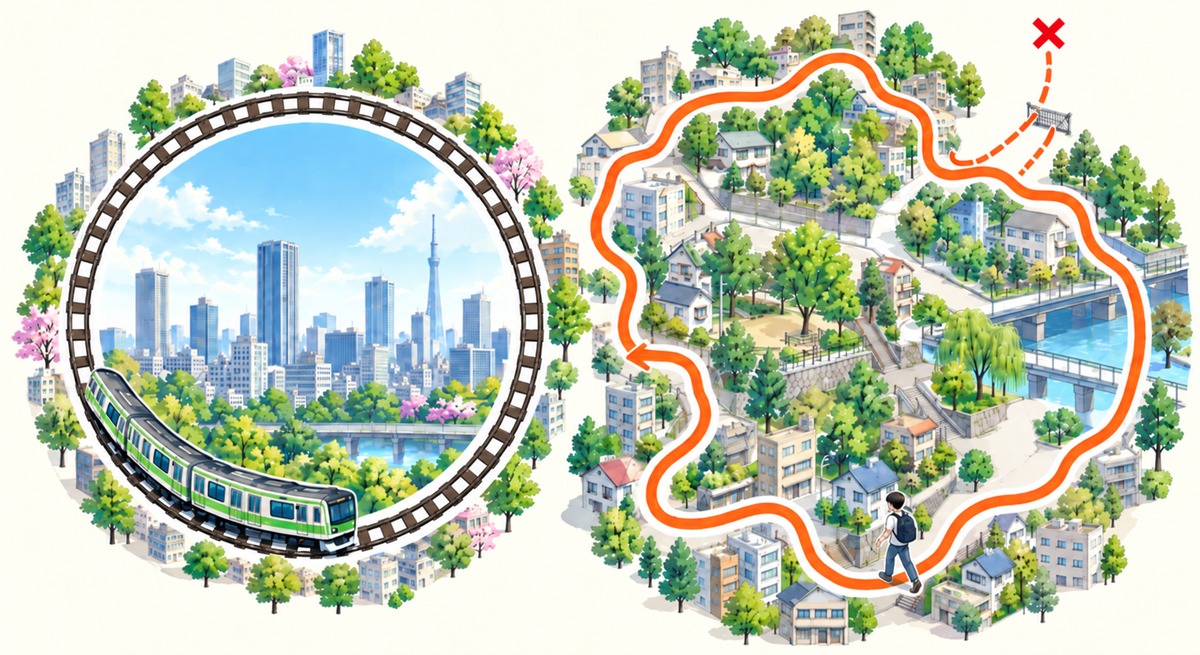
Conceptual illustration — not to scale.
How I ended up walking it
About five years ago, in spring, I walked a full loop of Tokyo's Yamanote Line. I'd already ridden the loop once on a bicycle, which took me about four hours — my own time on my own route, not a benchmark. Afterwards I went looking online for write-ups of cycling it, and somewhere in that reading I found an account by someone who had walked it instead. My first thought was: maybe I could do that too.
On a separate day, I set off from Nishi-Nippori in the early afternoon, heading clockwise, on my own. At first I thought, "No, let's not," and turned back. Then I changed my mind again — "No, I'm going" — and started over.
Nishi-Nippori to Shinagawa in one go
The plan was simply to follow the line: stay near the tracks, keep the loop on one side, and come back around to where I started. I walked with Google Maps open the whole way.
I walked the whole first stretch, from Nishi-Nippori down to Shinagawa, without a proper stop. The last part of it, from Shimbashi to Shinagawa, was hard: the stations there felt far apart. You walk, and walk, and the next one still isn't near. At Shinagawa I took my first real break and bought a sweet coffee.
Where the road runs out
On a map the Yamanote Line is a tidy closed ring. On foot it is not tidy. The road that runs alongside the tracks keeps ending, and each time you have to find another way around, which is always longer than the gap you're trying to close.
The place where I had to turn back was, as I remember it, somewhere around Okubo and Shin-Okubo. The road beside the tracks just stopped, and I had to go back the way I'd come to reach a bigger road. My legs were already very tired by then, and walking back over ground I'd just covered was one of the hardest parts of the day.
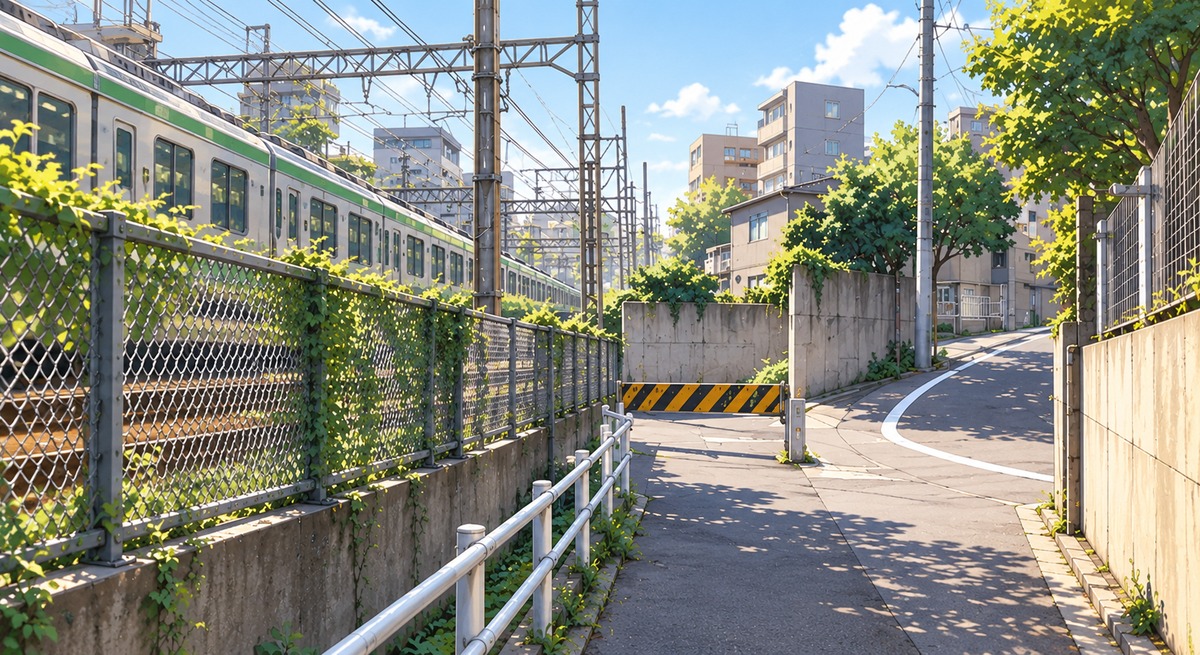
Illustration, not a photo from my walk.
Nearly giving up at Ikebukuro
Around Ikebukuro I came close to stopping. My legs were simply too tired, and it was really tough. I took my second real break there. What kept me going was a plain thought: I'd come this far, so I might as well finish.
Somewhere around Komagome I got hungry and bought some bread at a convenience store.
Finishing
I made it back around. It was after 10 p.m. by the time I got back, I think, and as I remember it the walk took about nine hours and forty minutes — again, my own time, not a target. My Mount Fuji day trip took even longer — about 11 hours, up and back.
My legs hurt for two or three days afterward.
Compared with walking it, doing the loop on a bicycle was a lot easier.
Would I do it again?
No. I'm glad I did it once — there was a real sense of achievement, and it didn't feel like an ordinary day. I think it's the kind of thing that's worth experiencing once. But once was enough. The only version that still tempts me a little is going the other way round, counter-clockwise.
If you're thinking about trying it
I did this once, in one direction, so this isn't a recommended route. But a few things I wish I'd understood first:
- Don't assume you can stay beside the tracks all the way. Around Okubo and Shin-Okubo, I reached a dead end and had to backtrack to a larger road. I had Google Maps open throughout.
- The backtracking is worse than the walking. Retracing ground you've already covered, late in the day, is what wears you down.
- Plan for it to take much longer than the loop's length on a map suggests. I started in the early afternoon and wasn't back until after 10 p.m.
- Be prepared for the point when you seriously consider stopping. For me, that happened around Ikebukuro.
Nine-odd hours is a lot to commit to. If you'd rather test your legs for a quarter of an hour instead, Tokyo Tower has an outdoor staircase of roughly 600 steps up to its Main Deck — I climbed that too, and it was harder than I expected.