Giving a gift in Japan is not an automatic requirement. The right choice depends on the relationship, the occasion, the recipient's rules, and whether the gift would be useful or create an obligation.
This guide is for a foreign resident, worker, or long-term visitor deciding what to do for a home visit, return from a trip, workplace, business relationship, or personal thank-you. Weddings, funerals, hospital visits, and other formal occasions may have family, venue, or regional rules that need separate confirmation.
Start with three questions
- Is there a clear occasion or reason to thank this person?
- Is the recipient a private person, a group, or someone acting for an organisation?
- Could a gift conflict with a workplace, public-service, school, medical, or other acceptance policy?
If the occasion is unclear or the policy answer is unknown, a sincere message is safer than buying something expensive. Asking first is not a failure of etiquette; it prevents waste, pressure, and compliance problems.
First decide whether a gift is useful
| Situation | Practical default | Check before buying |
|---|---|---|
| Invited to someone's home | A modest host gift may be appropriate, but it is not an admission ticket | Food restrictions, household size, storage, and whether the visit is casual |
| Returning to a work team after a trip | Shared omiyage may fit the team custom; it is not a nationwide job requirement | Team practice, number of people, allergies, and whether food can be shared at work |
| Thanking a friend or neighbour | A message, practical help, or a small item can all be valid | What the person would actually use and whether a gift would feel disproportionate |
| Client, supplier, public official, teacher, or medical worker | Check the organisation's policy before offering anything | Acceptance rules, conflicts of interest, value limits, and an approved recipient such as the organisation rather than an individual |
| Restaurant or ordinary service encounter | Polite thanks are normally enough; do not turn payment into a gift decision | For the separate payment question, see tipping and gifts in Japanese dining |
| Wedding, birth, funeral, hospital visit, or another formal event | Use instructions from the family, organiser, venue, or institution | Whether gifts are accepted, the correct format, timing, names, and return-gift practice |
For a home visit, the gift is only one part of the visit. Arrival time, shoes, food, and the host's instructions also matter; see our guide to visiting a Japanese home.
Check the recipient's rules before the product
A person may want to accept your gift but still be unable to do so. Employers, government bodies, schools, hospitals, care facilities, and professional organisations can have their own acceptance or conflict-of-interest rules.
Japan's National Public Service Ethics Code is one concrete example: national public officials generally may not receive money or goods from an “interest party,” subject to defined exceptions. That rule should not be copied onto every worker in Japan. It shows why the recipient's role and organisation matter more than a general cultural rule.
- Ask the recipient or organiser: “Are gifts accepted here?” is more useful than asking only what item is popular.
- Identify the recipient: an item for one employee can create a different issue from an approved item for a whole office.
- Do not disguise value: cash, gift cards, expensive goods, repeated gifts, or personal delivery can create concerns even when your intention is friendly.
- Respect a refusal: if the recipient says policy does not allow the gift, take it back without pressing them to make an exception.
Choose something that fits the people and the place
Consumable items are often convenient because they do not need permanent storage, but “food is safe” is not a complete rule. Use the same product check whether you are buying sweets, tea, coffee, fruit, or a speciality from your home region.
| Check | Why it matters | Safer question |
|---|---|---|
| Allergies and ingredients | A familiar snack can still contain a serious allergen | Can the recipient verify the ingredient label, and have you asked about allergies? |
| Diet and religion | Alcohol, gelatine, meat ingredients, and other contents may not fit | Is there a non-food choice or a product the recipient already uses? |
| Individual packaging | It can help a group distribute items, but creates waste and is not always needed | Will people actually share the item at this location? |
| Shelf life and storage | Refrigerated, fragile, or short-dated food can become work for the recipient | Can it be stored until people are ready to use it? |
| Quantity | Too few pieces exclude people; too many create leftovers | Do you know the group size, or should you choose a non-shared gift? |
| Transport | Large, heavy, melting, scented, or breakable items can burden a commuter or host | Can the recipient carry it home safely? |
The Consumer Affairs Agency publishes a current framework for allergen labelling on processed food. Use the label as information, not as a guarantee that a product fits every recipient or that cross-contact is impossible.
If you bring a gift from overseas, check import rules
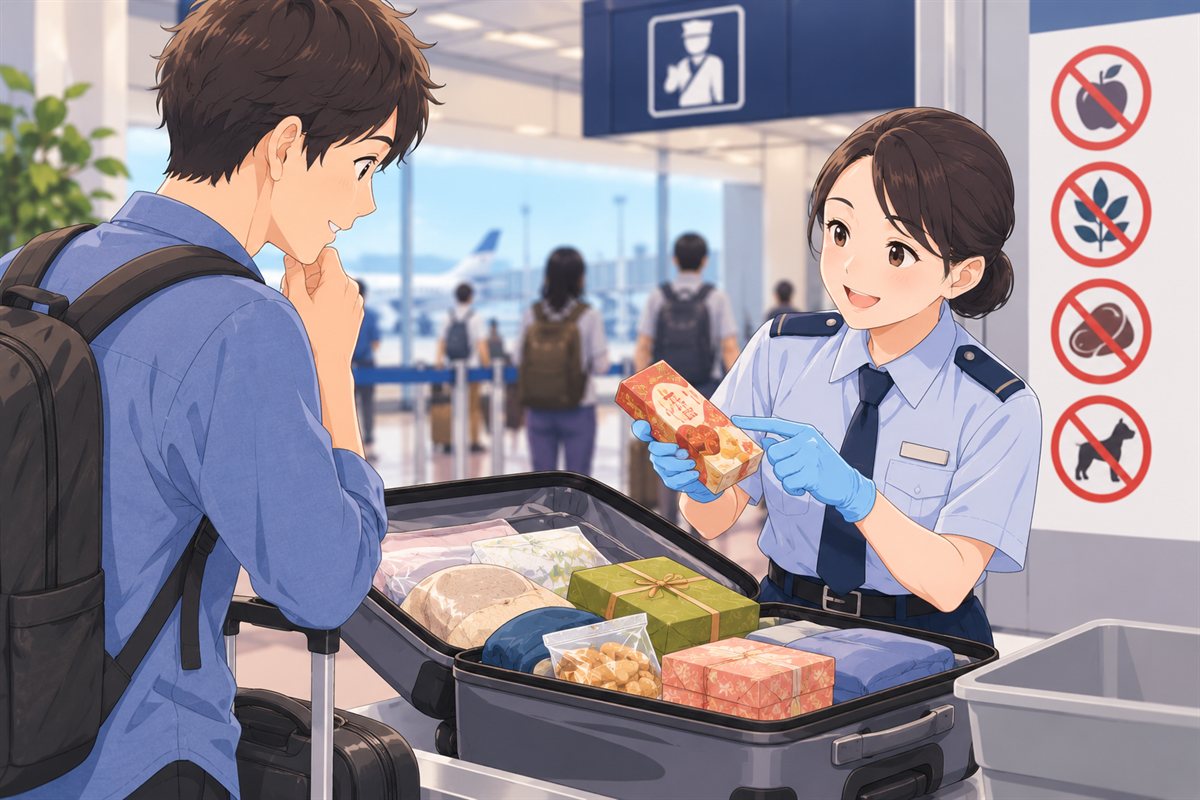
A food item that is normal in your country may not be legal to carry or mail into Japan. MAFF states that meat products are subject to animal quarantine and that items without the required government inspection certificate generally cannot be brought in, even when they are souvenirs or for personal consumption. Plants, fruits, vegetables, seeds, and other plant products also have country- and item-specific restrictions.
Check the Animal Quarantine Service and Plant Protection Station before travel or international mailing. Do not rely on the fact that an item is sealed, cooked, bought at an airport, or intended as a small gift.
Set a budget without inventing a national price
There is no single safe amount for every gift in Japan. A casual home visit, a team souvenir, a close friend's celebration, and a business relationship should not use one price chart.
Use these four limits instead:
- Purpose: is this a small acknowledgement, a shared souvenir, or a formal event?
- Relationship: would the value feel normal between these people, or unusually personal?
- Reciprocity: could the gift make the recipient feel they must match its value?
- Policy: does an employer, institution, or event set a limit or prohibit gifts?
If you cannot answer those questions, reduce the value or use a message instead. “More expensive” does not mean “more respectful.” For ordinary host, neighbour, and team situations, cash and gift cards also create more value and policy questions than a simple message or modest item.
Do not mix everyday gifts with formal gift systems
| Type | Basic purpose | Safe treatment |
|---|---|---|
| Temiyage | Something brought to a host or meeting | Match the visit and recipient; do not make it a fee for hospitality |
| Omiyage | A souvenir brought from a trip, often for others | Check whether the family or team actually exchanges it; it is not mandatory after every journey |
| Ochugen / oseibo | Seasonal thanks in an established relationship | Do not start an annual exchange by assumption; ask a family member, colleague, or organisation first |
| Celebration, condolence, or formal return gift | Occasion-specific social and family practice | Follow the named event, family, venue, or specialist retailer; this guide does not set a universal amount or return ratio |
“Never give this” lists need context
Online lists often say that knives, combs, potted plants, white flowers, or items connected with the numbers four and nine are always offensive. Some recipients or formal occasions may recognise negative associations, but these are not universal bans for every age, region, and relationship.
Do not solve uncertainty by memorising a longer folklore list. For a hospital, wedding, funeral, or business event, ask the institution, organiser, family, or retailer about the exact occasion. For an ordinary personal gift, choose something the recipient can use and avoid items that are too intimate, difficult to store, strongly scented, unsafe, or burdensome to return.
Wrapping and noshi: tell the shop the occasion
Neat shop wrapping is enough for many ordinary gifts. A formal `noshi` or decorative paper is not required for every box of sweets. Its wording, cord design, name placement, and inside/outside wrapping can depend on whether the gift is a celebration, condolence, seasonal gift, or return gift.
If the occasion is formal, tell the retailer exactly what the event is and who the giver and recipient are. Japan Post's gift store publishes a practical explanation of common `noshi` terminology, but it is a retail guide—not a law or proof that every family and region uses the same format.
How and when to hand over the gift
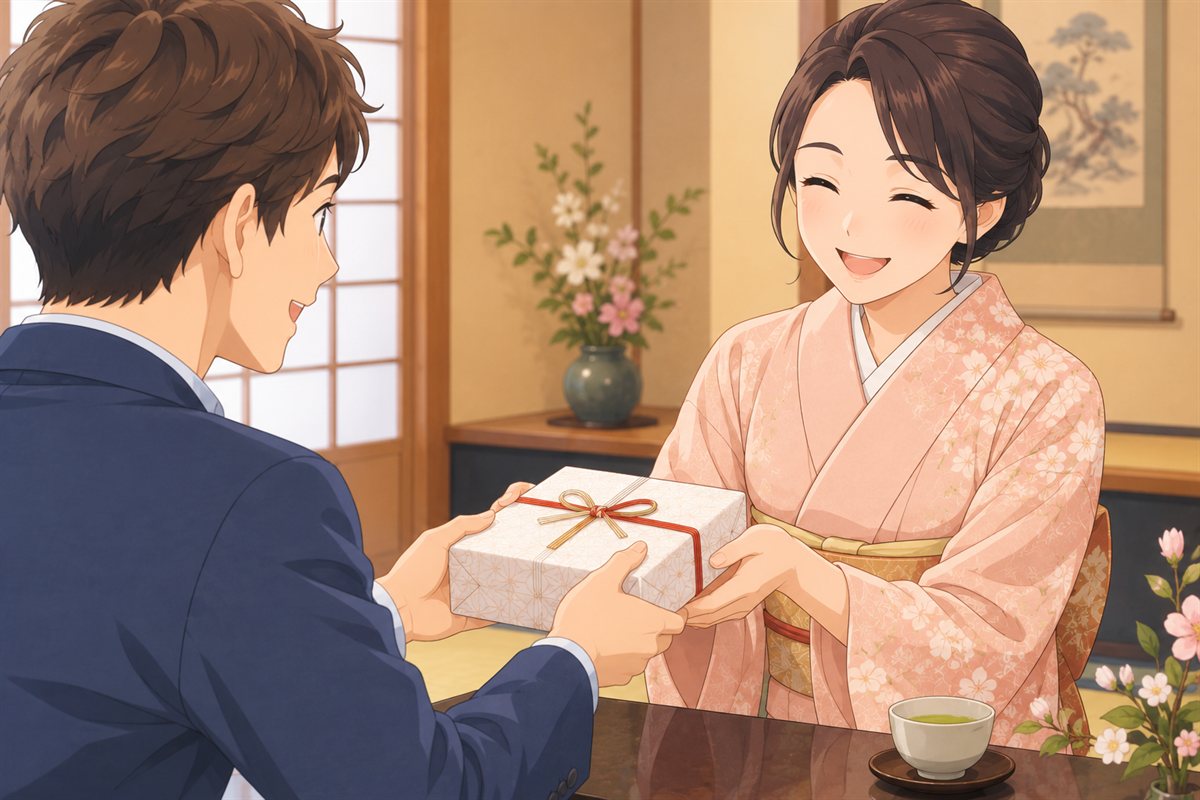
- Choose a calm moment. At a home, wait until greetings and entry are settled. At work, avoid interrupting a meeting or customer interaction.
- Remove the transport bag if practical. The bag protects the gift; it is not automatically part of the presentation. If removing it is awkward, explain and keep the exchange simple.
- Use both hands when practical. This can make the handoff clear and careful, but safety and the recipient's situation come first.
- State the purpose briefly. Do not exaggerate the price or force the recipient to praise the item.
- Accept the answer. If the person or organisation cannot receive it, say you understand and take it away.
Short Japanese phrases
| Japanese | Romanization | English |
|---|---|---|
| ささやかですが、どうぞ。 | Sasayaka desu ga, dōzo. | It's just a small gift, but please accept it. |
| 皆さんで召し上がってください。 | Minasan de meshiagatte kudasai. | Please enjoy this together. |
| お口に合えばうれしいです。 | Okuchi ni aeba ureshii desu. | I hope it's to your taste. |
| こちらでは贈り物を受け取れますか? | Kochira de wa okurimono o uketoremasu ka? | Are gifts accepted here? |
| 食物アレルギーはありますか? | Shokumotsu arerugī wa arimasu ka? | Do you have any food allergies? |
| お返しはお気遣いなく。 | Okaeshi wa okizukai naku. | Please don't feel you need to give anything in return. |
The last phrase communicates your intention, but it cannot cancel a formal family or event custom. Use it for a genuinely no-strings-attached personal gift, not to instruct someone during a wedding, funeral, or business process.
After the handoff: opening, refusal, and return gifts
| What happens | What to do |
|---|---|
| The recipient opens it immediately | Let them set the pace; do not demand a reaction |
| The recipient sets it aside | Do not assume dislike; they may be busy, sharing later, or following their normal routine |
| The recipient declines | Accept the refusal. Do not repeat the offer if policy, allergies, storage, or burden is the reason |
| You receive a casual host gift or souvenir | Thank the giver; an immediate item-for-item return is not automatically required |
| You receive a formal celebration or condolence gift | Record the giver and consult family, organiser, or occasion-specific guidance before deciding on a return gift |
Check this before you leave or send the gift
- I know why I am giving this and why this recipient is appropriate.
- I checked whether the person or organisation can accept it.
- The value will not create pressure or a conflict-of-interest concern.
- Food ingredients, allergies, diet, quantity, storage, and shelf life are suitable.
- An overseas item complies with Japanese animal and plant quarantine rules.
- The gift is easy for the recipient to carry, store, share, or use.
- I asked a retailer or organiser before using formal `noshi` or event wording.
- I can take the gift back calmly if it cannot be accepted.
- I have not assumed that an immediate return gift is always required.
A useful gift decision begins with the recipient, not a list of supposedly universal Japanese rules. Confirm the relationship and policy first, select something that creates little burden, and let the recipient's answer guide what happens next.
Official and practical references
- National Personnel Authority: Outline of the National Public Service Officials Ethics Code
- National Personnel Authority: Ethics Law and Code Q&A
- Consumer Affairs Agency: Processed-food allergen labelling handbook
- MAFF Animal Quarantine Service: Bringing animal products into Japan
- MAFF Plant Protection Station: Request to people coming to Japan
- Japan Post gift store: Practical `noshi` terminology and wrapping guide