Finished eating, but not sure whether to leave everything on the table or carry your tray somewhere? In Japan, the answer depends more on the venue’s service system than on one nationwide rule. A full-service restaurant may want staff to clear the table, while a food court or self-service cafe may expect you to return a tray and sort several items.
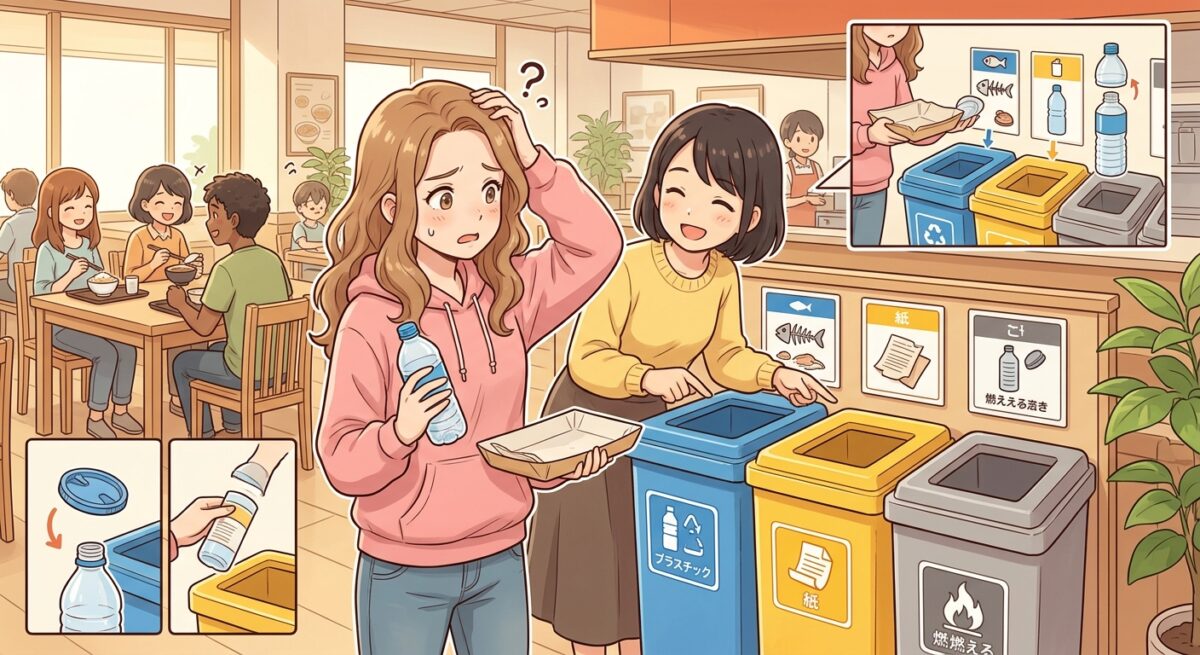
The 30-Second Decision
- Check the service style. If staff bring food, clear nearby tables, and there is no return sign, leave dishes neatly on the table.
- Look for a return area. Tray stacks, dish shelves, bin labels, or a liquid drain mean customers probably handle part of the cleanup.
- Separate only what the station shows. Do not invent categories or put reusable dishes into a trash opening.
- Ask when the setup is unclear. A short question is safer than carrying dishes into a staff-only area.
The useful rule is not “always clear your table.” It is “follow this venue’s return system.”
Leave It or Return It? Use the Venue Type
| Venue | What usually happens | What to confirm |
|---|---|---|
| Full-service restaurant | Staff usually clear plates and cups. | Is there a visible return shelf or instruction? |
| Food court | Customers often return the tray and sort waste. | Is the return counter shared or specific to the shop? |
| Self-service cafe or fast food | Customers commonly return trays, cups, and dishes. | Is there a separate place for leftover liquid? |
| Convenience-store eat-in area | Use the store’s labeled bins if provided. | Are the bins available to customers at this store? |
| Small cafe or ramen counter | Either staff clear items or a small return shelf is used. | Watch the counter signs; do not assume. |
Full-Service Restaurants: Keep the Table Safe, Not “Perfect”
At many sit-down restaurants, carrying plates away is unnecessary. Keep used tissues and wrappers together, and leave dishes where staff can lift them safely. Do not hide trash inside bowls or balance cutlery where it can fall. Unless a sign says otherwise, do not take dishes toward the kitchen.
Hotel restaurants, izakaya, sushi restaurants, family restaurants, and independent restaurants can operate differently. The presence of table service is a clue, not a guarantee; posted instructions and staff guidance take priority.
Food Courts and Self-Service Shops
In a food court, first identify where the tray belongs. Some malls use one shared return station. Others require you to return reusable dishes to the same shop that served the meal. A tray from one shop may not belong on another shop’s return shelf.
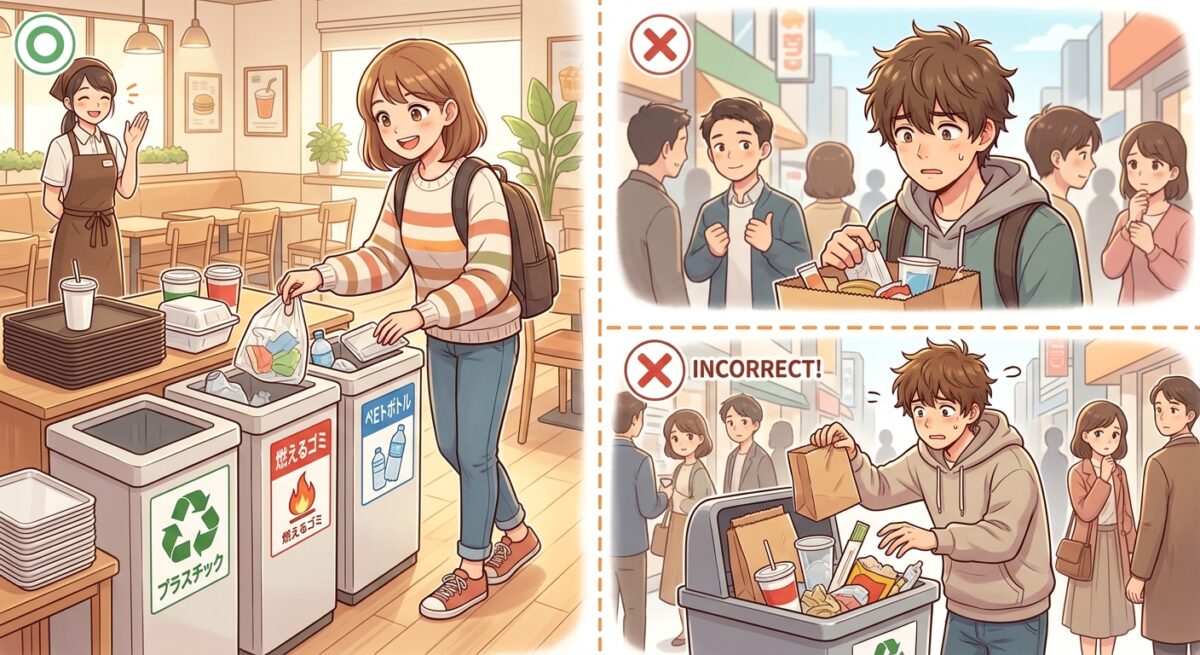
At the station, handle items in this order:
- Leave soup, sauce, or food in the dish unless a food-waste container is clearly shown.
- Pour a drink away only where a drain or leftover drink container is provided.
- Place cups, lids, straws, bottles, and cans according to the labels.
- Return reusable trays, bowls, plates, and cutlery to their marked shelf or stack.
Leftover Drinks Need a Separate Decision
A cup with liquid should not be tipped into an ordinary trash opening. Some return stations have a sink or container for drinks; others want the cup returned as it is. If no liquid-disposal point is visible, keep the liquid in the cup and ask staff or follow the return setup.
The same caution applies to ramen soup and oily sauce. Do not pour them into a bin. Leave them in the dish unless the facility explicitly shows another step.
Drink Containers Are Not All-Purpose Trash Bins
A recycling box beside a vending machine is intended for empty beverage containers, not food wrappers, bento boxes, tissues, batteries, or hotel-room waste. The Japan Soft Drink Association describes these as collection boxes for empty PET bottles, cans, and glass bottles and asks users not to insert containers with drinks left inside.
If you leave the restaurant with small packaging and cannot find an appropriate bin, see our guide to trash in Japan for tourists.
Japanese Labels You May See
| Japanese | Reading | Meaning |
|---|---|---|
| 返却口 | henkyaku-guchi | return opening / return counter |
| 食器返却口 | shokki henkyaku-guchi | dish return |
| 飲み残し | nomi-nokoshi | leftover drinks |
| 燃えるごみ | moeru gomi | burnable waste |
| ペットボトル | petto botoru | PET bottles |
| 缶 | kan | cans |
| びん | bin | glass bottles |
If you need to ask, point to the tray and say: これはどこに返せばいいですか? (Kore wa doko ni kaeseba ii desu ka?) — “Where should I return this?”
Before You Walk Away
- Confirm whether staff clear the table or customers use a return area.
- Keep reusable dishes out of trash openings.
- Use a liquid drain only when it is clearly provided.
- Return the tray to the correct shop or shared station.
- Use pictures and item examples on the bin, not color alone.
- Ask staff if two labels appear to conflict.
Two Common Questions
What if other customers leave trays on the table?
That is a useful clue, but a sign or staff instruction is stronger evidence. The table may be waiting for staff, or those customers may simply have missed the return station.
Should I remove a PET-bottle cap and label in a restaurant?
Only if the local bin shows separate openings or instructions. Household preparation rules do not automatically apply to every restaurant or facility bin.