A seasonal notice at a Japanese workplace can describe a legal procedure, a company rule, an operational request, or an optional social event. Those are not the same. Before changing travel plans, buying a gift, or agreeing to attend, identify which type of notice you received and who can confirm it.
This year-round guide is for foreign employees and longer-term assignees. It helps you prepare for leave, schedule changes, dress guidance, workplace events, gifts, tax-document requests, and severe weather. Exact dates and approval routes vary by employer, worksite, industry, employment arrangement, and year.
Start with four questions
- Is this a legal or contractual procedure, a company rule, an operating instruction, or an optional custom?
- Which document is current: my contract, work rules, company calendar, shift roster, or a dated notice?
- Who decides for my arrangement: my manager, HR, shift leader, dispatch company, client-site contact, or event organiser?
- What is the deadline and what record should I keep?
Classify the message before you act
| Type | Examples | What to verify |
|---|---|---|
| Law or statutory right | Annual paid leave when legal conditions are met | Current official guidance plus the employer's request procedure |
| Contract or company rule | Working days, holidays, leave notices, dress and absence reporting | Employment terms, work rules and company calendar |
| Operational instruction | Shift deadlines, busy-period staffing, remote-work decision or office closure | The latest dated message and authorised contact |
| Optional custom or invitation | Hanami, a social party, private gift collection or informal outing | Whether participation is voluntary, during paid time and connected to evaluation |
A label such as “traditional,” “usual,” or “everyone joins” does not answer these questions. Ask for the current rule and deadline in clear words. If a response feels indirect, use a short confirmation and see our separate guide to indirect communication in Japan and the US. If you’re also weighing whether an evaluation itself was fair or how it was communicated, Why Japan’s look at three employer-side evaluation cases covers that separate question in more depth.
Build your own annual workplace calendar
Do not copy a generic Japanese calendar into your schedule. Add only dates confirmed by your employer, worksite, dispatch company or organiser.
| Period | Possible notices | Your practical check | What varies |
|---|---|---|---|
| January–March | New-year opening, fiscal-year close, transfers, snow procedures | First working day, reporting deadlines, busy dates and weather channel | Fiscal year, industry, region and shift coverage |
| April–May | New hires, transfers, welcome events, Golden Week schedule | Team contacts, handover, actual workdays and leave-request cutoff | Public holidays do not tell you every worksite's operating days |
| June–August | Rain, heat, dress guidance, summer leave, Obon-area schedules | Dress/safety limits, staffing plan, leave approval and emergency contact | Location, customer contact, uniform, shift work and company closure |
| September–November | Typhoons, autumn transfers, drills, health checks, year-end forms | Where alerts appear, booking deadline and required documents | Risk, role, worksite and current-year instructions |
| December | Year-end adjustment, closing work, bonenkai, gifts and holiday closure | Document deadline, last/first workday, event status and client coverage | Employer calendar, payroll process, client operations and event policy |
Set reminders when the employer publishes a date, not when a general culture article says a season begins. A manufacturer, hospital, school, retailer, public office, logistics site and international company can have completely different busy periods.
Check five sources in the right order
- Employment terms: confirm the employer, work location, normal working days and your basic leave framework.
- Work rules and company calendar: check holidays, special leave, attendance, dress, remote work and reporting procedures.
- Current operational notice: use the dated shift roster, HR notice, emergency message or event invitation.
- Your responsible contact: ask the person authorised to answer for your role. A dispatched worker may need both dispatch-company and client-site contacts.
- Official information: use government information for the legal or public-safety layer, not as a substitute for the employer's operational decision.
MHLW provides a multilingual Working Conditions Handbook and consultation information for foreign workers. Use those resources if the explanation you receive about working time, holidays, leave or treatment does not match your documents or remains unclear.
Leave: separate public holidays, company closure and paid leave
Golden Week, summer, Obon and year-end are not one nationwide company vacation schedule. Some offices close; some remain open; some use shifts; and some require workers to request annual paid leave for particular days. Your company calendar and approval procedure are the starting point.
Annual paid leave is a statutory right when the legal conditions are met. MHLW explains that it can apply regardless of labels such as regular, part-time or shift worker, although the number of days and working pattern can differ. Employer-created summer leave, birthday leave or other special leave is a separate question governed by the applicable rules.
A safer leave-request sequence
- Check the company calendar, your remaining leave information and the current staffing or shift plan.
- Find the required system, form, approving person and submission cutoff.
- If work is dispatched or split across organisations, confirm who receives the request and who needs operational notice.
- Submit the request through the official route rather than relying only on a verbal conversation.
- Confirm approval and handover responsibilities before buying non-refundable travel.
A busy period does not erase statutory rights, but timing and operational adjustments can involve legal and workplace procedures. If there is a dispute, use MHLW or Labour Bureau consultation resources instead of treating a colleague's custom as the final legal answer.
Dress for the actual role, not a national Cool Biz uniform
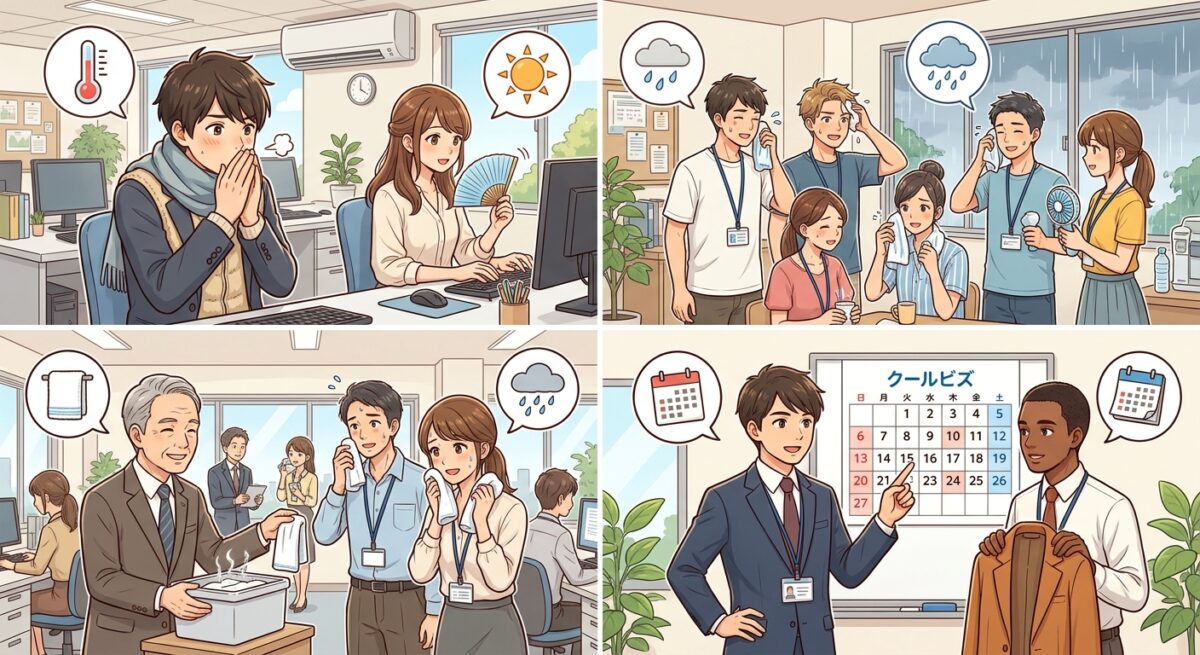
Cool Biz promotes clothing suited to temperature, work style and the situation. It does not create one nationally uniform dress code or permission to ignore safety equipment, hygiene rules, uniforms, customer-facing requirements or formal-event instructions.
| Question | Who or what answers it |
|---|---|
| Can I remove a jacket or tie? | Current workplace dress notice and client/event context |
| Can I wear lighter shoes or short sleeves? | Safety, hygiene, uniform and site rules |
| Does the rule apply while remote? | Video-meeting, customer and remote-work policy |
| When does seasonal clothing change? | Weather, workplace notice and role—not a memorised nationwide date |
Decide whether a workplace event is work or optional
A welcome party, hanami, bonenkai, shinnenkai, outing or private gift collection is not automatically mandatory or automatically irrelevant. Establish its actual status before deciding.
| Check | Why it matters | Safe next step |
|---|---|---|
| Listed as working time or a duty | Attendance, pay and instructions need clarity | Ask the manager or HR for the formal treatment |
| Invitation says optional | A social invitation should not be converted into a hidden rule by guessing | Reply by the stated deadline; no invented excuse is needed |
| Alcohol is served | Health, religion, medication, pregnancy, driving and preference can matter | Decline alcohol directly and choose a non-alcoholic option if attending |
| Pressure or disadvantage is implied | Unwanted pressure may require a workplace consultation route | Keep the message and consult HR, a designated desk or a Labour Bureau resource |
Domestic, multinational, traditional and start-up labels do not reliably predict the answer. The team's current invitation, working-time treatment and company policy are stronger evidence than a company stereotype.
Keep gifts and seasonal greetings proportionate
Personal ochugen or oseibo is not a requirement for every employee. Client gifts, supplier gifts, public-sector contacts and internal collections may be restricted by compliance rules. Do not buy an expensive item or collect money before checking who may give, receive or approve it.
For product choice, allergies, group sharing, value, refusal and return gifts, use our separate practical guide to giving gifts in Japan. Here, the workplace decision is simply: confirm the policy, recipient, budget authority and voluntary nature first.
Use a communication sequence for typhoons, heavy rain and snow
JMA warnings and risk information describe public danger; they do not decide your individual attendance, remote-work or paid-leave treatment. Transport status also does not automatically answer the employer-policy question.
- Before disruption: save the official emergency channel, manager or shift contact, reporting cutoff and remote-work procedure.
- When risk rises: check JMA information, local safety information, transport operators and the employer's current message.
- If travel is unsafe or impossible: contact the authorised person before the deadline. State your location, transport status, safety issue and whether remote work is possible.
- Do not improvise policy: ask how the absence, delay, shift change or remote work will be recorded.
- Keep the update: save the reply and continue monitoring the channel specified by the employer.
For transport-specific preparation and disruption checks, see our seasonal guide to train travel in Japan. If immediate safety and ordinary attendance instructions conflict, protect life and follow emergency authorities while notifying work as soon as safely possible.
Do not reuse last year's tax or document deadline
Year-end adjustment forms, required evidence, electronic procedures and tax rules can change. Use the employer's current-year payroll notice and the current National Tax Agency materials. If a family, residence or income situation is unclear, ask payroll what document is required rather than copying a colleague's answer.
The same date discipline applies to health checks, training and disaster drills: use the current booking notice and determine whether attendance is a work requirement, a role-specific requirement or an optional programme.
Short Japanese questions and responses
| Japanese | Romanization | English |
|---|---|---|
| この行事は勤務時間内ですか? | Kono gyōji wa kinmu jikan-nai desu ka? | Is this event during working hours? |
| 参加は任意ですか? | Sanka wa nin'i desu ka? | Is participation optional? |
| お酒は飲めませんが、参加しても大丈夫ですか? | Osake wa nomemasen ga, sanka shite mo daijōbu desu ka? | I do not drink alcohol. Is it okay for me to participate? |
| 今回は参加を見送ります。 | Konkai wa sanka o miokurimasu. | I will not participate this time. |
| 台風の場合、出社判断はどこで確認できますか? | Taifū no baai, shussha handan wa doko de kakunin dekimasu ka? | Where can I check the attendance decision in case of a typhoon? |
| 休暇申請の締め切りを教えてください。 | Kyūka shinsei no shimekiri o oshiete kudasai. | Please tell me the leave-request deadline. |
These phrases request facts; they do not decide whether an event is legally work, whether leave is approved or how an emergency absence is recorded. Follow the reply through the official process.
Your year-round workplace checklist
- I have the current company calendar, work rules and emergency contact route.
- I know which organisation approves leave and receives absence notices for my employment arrangement.
- I distinguish public holidays, company closure, statutory paid leave and employer-created special leave.
- I check busy periods and handover needs before making travel commitments.
- I use the current dress or safety notice instead of assuming one Cool Biz rule.
- I confirm whether each event is work, expected training or an optional invitation.
- I can decline alcohol or an optional event without inventing a cultural rule.
- I check gift and collection policies before spending money.
- I know where weather, transport and employer updates will appear.
- I use current-year payroll and tax-document instructions.
- I save approvals and important operational replies.
The useful seasonal skill is not memorising a list of Japanese customs. It is knowing which source controls the decision, when the information is updated and who can confirm the next action for your role.
Official references
- MHLW: Information on labour standards for foreign workers
- MHLW: Annual paid leave information for workers
- MHLW: Model Rules of Employment
- MHLW: Prevention of workplace harassment
- Ministry of the Environment: Cool Biz guidance
- Japan Meteorological Agency: Weather warnings and risk information
- National Tax Agency: Withholding and year-end-adjustment information