💡 Quick Answer
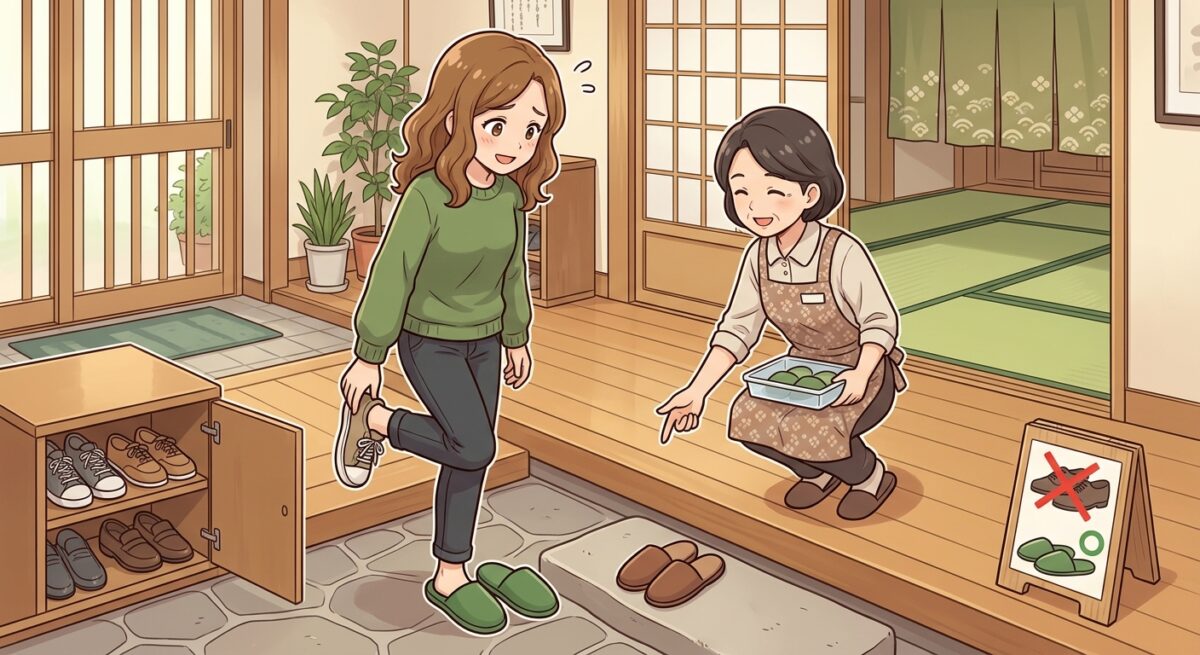
Visitors in Japan are often surprised by how often shoe removal appears outside private homes, including some traditional restaurants, ryokan, temples, public baths, clinics, and fitting rooms.
Japan’s rich culture includes many customs that visitors quickly notice, and one of the most important is shoe etiquette. Many travelers expect to remove their shoes in private homes or temple buildings, but the custom can also appear in public or semi-public places.
Understanding where and why to remove your shoes helps you avoid awkward moments and shows respect for Japanese ideas of cleanliness, indoor space, and shared comfort.
The Cultural Roots of Shoe Removal
⚠️ Avoid This
Never wear outdoor shoes on tatami mats, raised indoor floors, or inside changing areas where shoes are clearly meant to be removed.
The practice of taking off shoes before entering certain indoor spaces is deeply rooted in Japanese daily life. Traditionally, homes had raised floors to separate the clean indoor area from the dirtier outside ground. This separation became especially important because people often sat, ate, and slept close to the floor on tatami mats or futon bedding.
That idea still influences many spaces today. The entrance area, often called a genkan, creates a clear boundary between outside shoes and the clean indoor area. Even when the building is public, this boundary may still appear in traditional or hygiene-sensitive settings.
What Surprises Foreigners: Unexpected Shoe Removal Zones
For many foreigners, removing shoes is mainly associated with homes or religious sites. In Japan, however, you may also encounter shoe removal at traditional restaurants, ryokan, public baths, some clinics, fitting rooms, community halls, or certain cultural facilities.
This can feel confusing at first because the rule is not always the same everywhere. A modern restaurant may allow shoes, while a nearby tatami-style restaurant may ask you to remove them. A large hospital may not require slippers, while a smaller clinic might. The best approach is to look for signs, shoe shelves, lockers, slippers, or what local customers are doing.
Japanese View: It's Just Common Sense
From a Japanese perspective, these rules often feel natural rather than strict. The distinction between outdoor and indoor space is clear, and keeping shared spaces clean is a basic form of consideration. Removing shoes is not only about dirt. It also shows respect for the space and for the people who use it after you.
Where You'll Encounter Shoe Rules in Public
Homes are the most obvious place, but visitors may also encounter shoe removal rules in the following public or semi-public settings:
🌏 Japan vs Other Countries
In many countries, shoes are worn in most indoor public spaces. In Japan, some places clearly separate outdoor shoes from clean indoor areas.
- Traditional restaurants: Restaurants with tatami seating, private rooms, or raised floors may ask customers to remove shoes at the entrance or before entering the seating area.
- Temples and shrine buildings: You may need to remove shoes when entering certain halls, prayer areas, or traditional wooden buildings. Outdoor shrine grounds usually do not require this.
- Ryokan: Traditional Japanese inns usually require guests to remove shoes at the entrance and use indoor slippers or go in socks depending on the area.
- Onsen and sento: At hot springs and public baths, shoes are removed before entering the changing area. Shoe lockers are usually provided near the entrance.
- Some clinics: Smaller clinics or older medical facilities may ask visitors to change into slippers. Larger hospitals often do not, so follow the signs and local practice.
- Changing rooms in clothing stores: Some fitting rooms ask customers to remove shoes before stepping inside, especially to protect clean floors or clothing.
- Museums, historic houses, and cultural facilities: Shoe removal may be required in traditional buildings, tatami rooms, or preserved historical interiors.
- Community centers and activity spaces: Places used for martial arts, tea ceremony, children’s activities, or local events may have shoe rules depending on the room.
✅ Tip
Look for a genkan, shoe lockers, slippers, signs, or a line of shoes near the entrance. These are strong clues that you should remove your shoes.
Practical Tips for Navigating Shoe Etiquette
Shoe etiquette may seem complicated at first, but it becomes easier once you know what to watch for. Here are practical tips to help you adapt smoothly:
- Observe and follow: The easiest method is to watch what other people are doing. If local customers remove shoes or change into slippers, do the same.
- Look for a genkan: A sunken entrance area usually means outdoor shoes should stop there. Step out of your shoes before entering the raised indoor floor.
- Wear easy-to-remove shoes: Slip-on shoes are very useful in Japan. Complicated boots or tight laces can become inconvenient if you visit several shoe-removal places in one day.
- Mind your socks: Your socks may be visible more often than you expect. Clean socks without holes are a small but important detail.
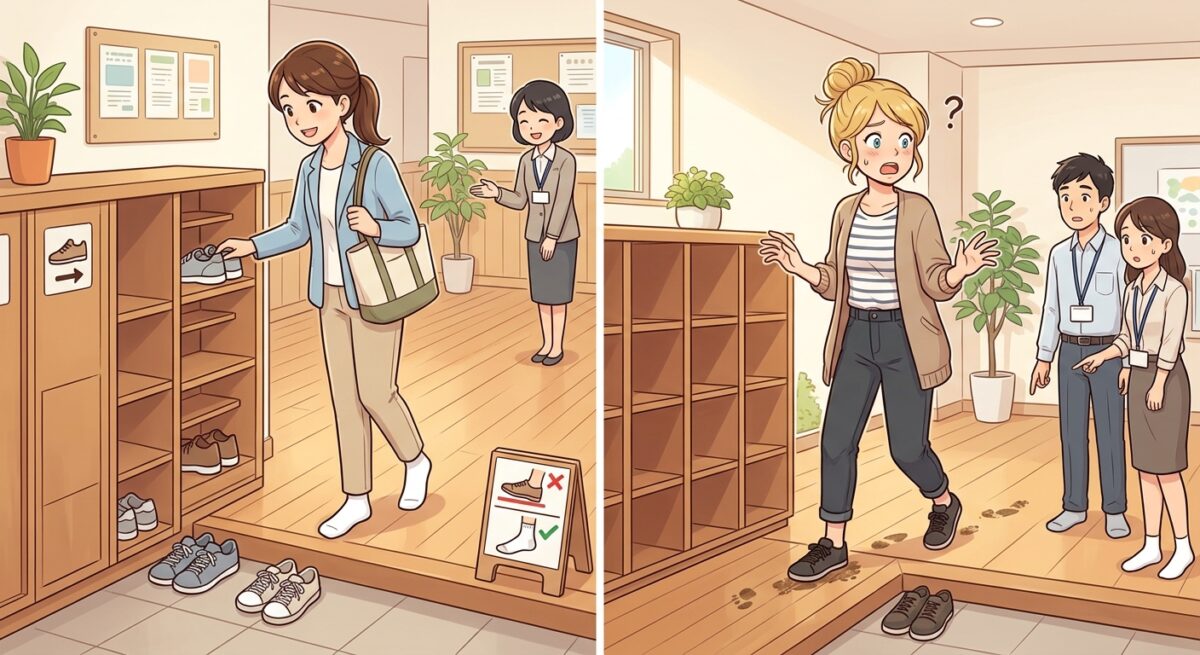
- Do not step on clean areas with outdoor shoes: Avoid placing outdoor shoes on raised floors, tatami, fitting-room platforms, or clean mats.
- Ask politely if unsure: If you are confused, you can point to your shoes and ask, Kutsu o nugimasu ka? meaning “Should I take off my shoes?”
Understanding Slippers and Their Use
Once your outdoor shoes are off, you may be offered slippers. These are for indoor use only, and different slippers may be used for different areas.
- Toilet slippers: If you see a separate pair of slippers near a restroom, use them only inside the toilet area. Change back into the regular indoor slippers, or return to socks, when you leave. Forgetting to change back is a very common mistake.
- No slippers on tatami: Slippers are generally for hard indoor floors. Do not wear slippers on tatami mats. Step onto tatami in socks or bare feet, depending on the setting.
- Indoor slippers are not outdoor shoes: Do not wear provided slippers outside, even briefly. They should stay within the clean indoor area.
- Shared vs. personal slippers: Some places provide shared slippers near the entrance, while ryokan or hotels may provide a pair for your own use during your stay.
Frequently Asked Questions
Q: Do I need to carry my shoes around after taking them off?
A: Usually, no. Most places provide shoe lockers, shelves, or a designated area near the entrance. In small establishments, staff may guide you if shoes need to be moved.
Q: What if I forget to take my shoes off?
A: Do not panic. Someone may politely point it out, or you may notice other people’s shoes and correct yourself. A simple Sumimasen, meaning “Excuse me” or “Sorry,” is usually enough.
Q: Are sandals or flip-flops acceptable indoors?
A: If they were worn outside, they count as outdoor footwear and should still be removed in shoe-removal areas. Indoor sandals or slippers are different and should be used only in the appropriate indoor zones.
Q: Should I remove shoes at every temple or shrine?
A: No. Outdoor grounds do not require shoe removal. You may need to remove shoes only when entering certain halls, traditional buildings, or designated indoor areas. Follow signs and local practice.
Navigating Japan’s public shoe rules might seem confusing at first, but with a little awareness and observation, it quickly becomes natural. This custom reflects Japan’s emphasis on cleanliness, respect, and the boundary between outside and inside. By following the cues around you, you can move through restaurants, inns, baths, clinics, and cultural spaces with much more confidence.
📝 Key Takeaways
- Japan’s shoe rules extend beyond homes to some public and semi-public places.
- Look for genkan areas, shoe lockers, slippers, signs, or what local people are doing.
- Never wear outdoor shoes on tatami mats or raised clean indoor floors.
- Use toilet slippers only inside the restroom area, and remember to change back afterward.
🚀 Want to Learn More?
Discover more about Japanese etiquette to make your stay smoother!
