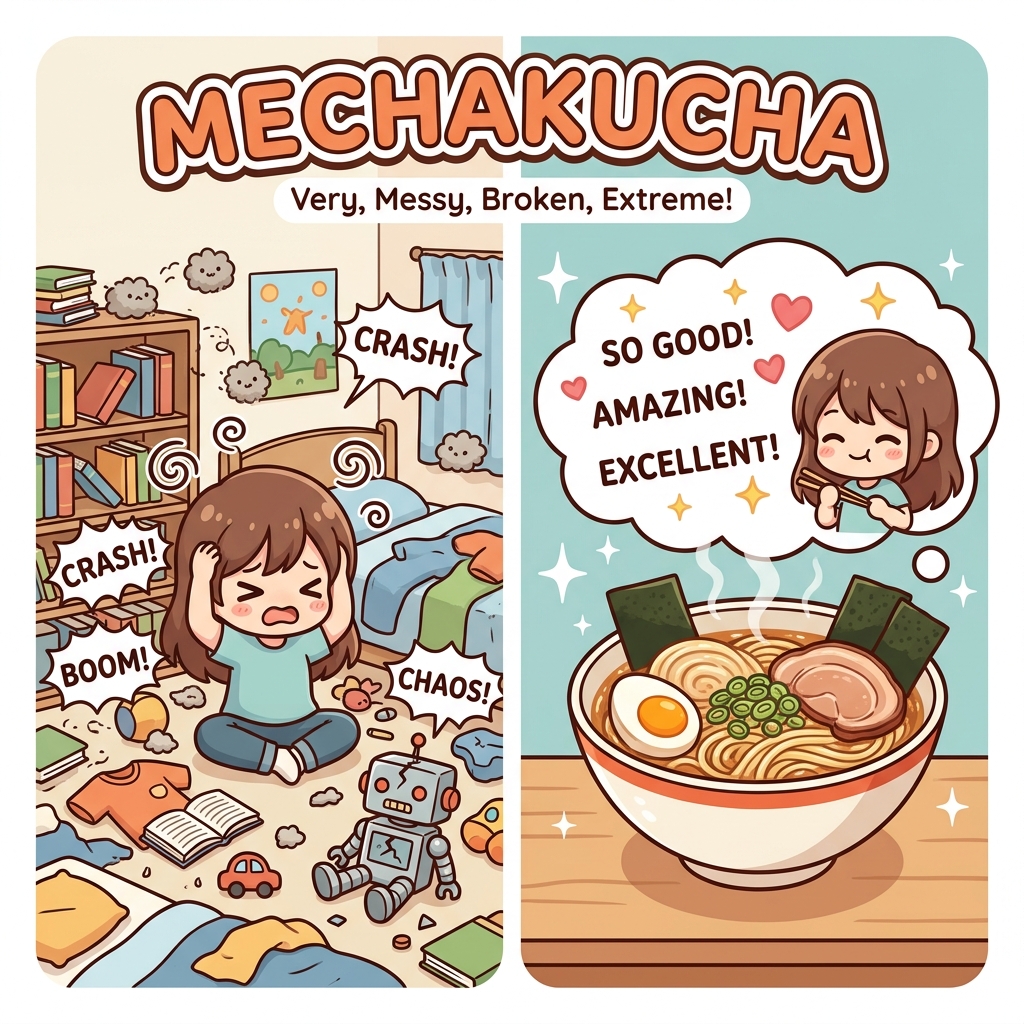
Imagine one Japanese word that can describe both a chaotic mess and something incredibly delicious. That word is めちゃくちゃ (mechakucha). For learners of Japanese, understanding this word is important because it appears very often in casual conversation. It can mean “a mess,” “completely ruined,” or “extremely,” depending on the context.
めちゃくちゃ (mechakucha) is a casual expressive word. It is very useful, but it is also strong and informal. Once you understand how it works, you can use it to describe messy situations, strong emotions, and extreme qualities more naturally.
What めちゃくちゃ (mechakucha) Really Feels Like
At its core, めちゃくちゃ (mechakucha) gives a feeling of something being pushed to an extreme. When it describes a physical state, it often means that something is messy, disordered, broken, or ruined. It is not just “a little messy.” It suggests a stronger level of disorder or damage.
However, めちゃくちゃ can also work as a strong intensifier, similar to “extremely,” “super,” or “incredibly.” In this use, it can be positive or negative. For example, めちゃくちゃ美味しい means “incredibly delicious,” while めちゃくちゃ疲れた means “extremely tired.”
How It Works in Context: Chaos vs. Emphasis
The key to understanding めちゃくちゃ (mechakucha) is context. The meaning changes depending on what comes after it or what it describes.
Describing Chaos and Disorder
めちゃくちゃ (mechakucha) can describe things that are messy, broken, ruined, or in a state of disorder.
- Physical Mess: 部屋がめちゃくちゃ (heya ga mechakucha - the room is a mess/disaster).
- Broken/Damaged: おもちゃがめちゃくちゃになった (omocha ga mechakucha ni natta - the toy got completely broken or ruined).
- Ruined Plans: 計画がめちゃくちゃになった (keikaku ga mechakucha ni natta - the plan was completely ruined).
As an Extreme Intensifier
めちゃくちゃ (mechakucha) is also very common as a casual intensifier. In this use, it means “extremely,” “really,” “super,” or “incredibly.” It can emphasize both good and bad things.
- Positive Emphasis: めちゃくちゃ美味しい (mechakucha oishii - incredibly delicious), めちゃくちゃ面白い (mechakucha omoshiroi - extremely interesting/funny), めちゃくちゃ楽しい (mechakucha tanoshii - super fun).
- Negative Emphasis: めちゃくちゃ難しい (mechakucha muzukashii - extremely difficult), めちゃくちゃ疲れた (mechakucha tsukareta - incredibly tired).
This dual use is what makes めちゃくちゃ so common in everyday Japanese. It can describe disorder, but it can also simply make a feeling or quality much stronger.
Listen to めちゃくちゃ (mechakucha) in Real Sentences
Play the audio and listen to how the examples sound in Japanese.
Japanese: 部屋がめちゃくちゃに散らかっているから、掃除しなきゃ。
English: My room is an absolute mess, so I have to clean it.
Japanese: このラーメン、めちゃくちゃ美味しい!また食べたいな。
English: This ramen is incredibly delicious! I want to eat it again.
Natural Usage Scenes
You will hear めちゃくちゃ (mechakucha) in many casual situations where speakers want to express something strongly:
- A friend praising a new restaurant: 「あのカフェ、めちゃくちゃおしゃれだよ!」 (Ano kafe, mechakucha oshare da yo! - That cafe is incredibly stylish!)
- Complaining about a difficult exam: 「テストがめちゃくちゃ難しかった…」 (Tesuto ga mechakucha muzukashikatta... - The test was extremely difficult...)
- Describing a room after moving: 「引っ越しで部屋がめちゃくちゃだよ。」 (Hikkoshi de heya ga mechakucha da yo. - My room is a total mess from moving.)
- Expressing joy after a fun event: 「昨日のパーティー、めちゃくちゃ楽しかったね!」 (Kinou no paatii, mechakucha tanoshikatta ne! - Yesterday's party was super fun, wasn't it!)
These examples show why めちゃくちゃ is useful. It lets you express strong feelings in a natural, conversational way.
A Common Learner Mistake & Usage Tip
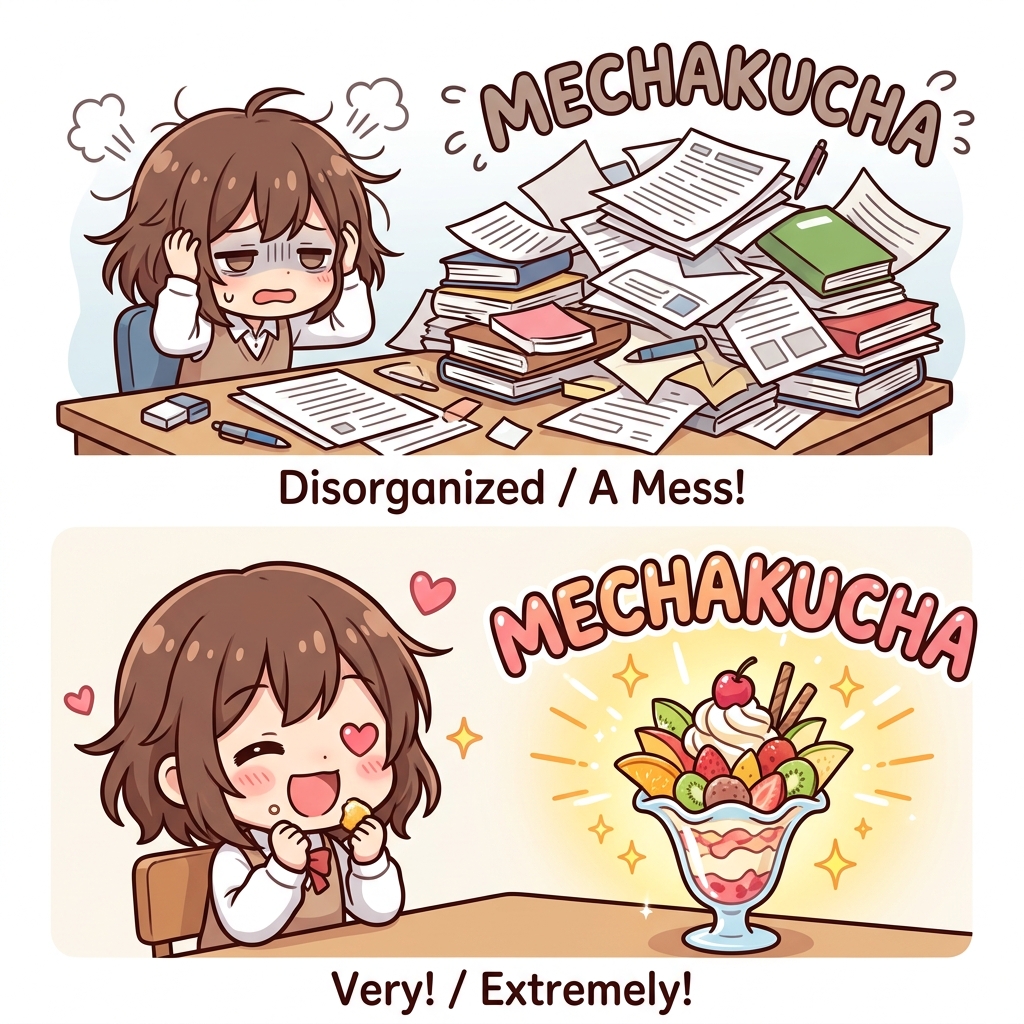
Many learners first understand めちゃくちゃ (mechakucha) only as “messy” or “broken.” That meaning is important, but it is not the whole story. In casual Japanese, めちゃくちゃ is also very commonly used to mean “extremely” or “super.”
For example, if someone says このラーメン、めちゃくちゃ美味しい, they are not saying the ramen is messy. They are saying it is incredibly delicious. The word after めちゃくちゃ tells you which meaning is intended.
Usage Tip: Listen for the Context!
If めちゃくちゃ is used with words like 美味しい, 楽しい, 面白い, or 難しい, it usually works as an intensifier. If it describes a room, plan, object, or situation, it may mean messy, ruined, or chaotic. Context is everything.
Related Expressions
| Expression | Meaning | Nuance |
|---|---|---|
| ぐちゃぐちゃ (guchagucha) | Messy, mushy, jumbled | Often suggests a physical mess, wet mess, or mixed-up state. |
| めちゃめちゃ (mechamecha) | Extremely, messy | Very similar to めちゃくちゃ and often interchangeable in casual speech. |
| とても (totemo) | Very | A more neutral and safer intensifier than めちゃくちゃ. |
| 非常に (hijou ni) | Extremely, very | More formal and suitable for business or written Japanese. |
Frequently Asked Questions
Can めちゃくちゃ (mechakucha) be used in formal situations?
Usually, no. めちゃくちゃ (mechakucha) is very common in casual conversation, but it is informal. In business writing, formal presentations, or polite professional communication, words like 非常に (hijou ni - extremely), とても (totemo - very), or 大変 (taihen - very) are safer and more appropriate.
Is めちゃくちゃ (mechakucha) only used with adjectives?
No. めちゃくちゃ (mechakucha) can work with adjectives, verbs, nouns, and whole situations. With adjectives, it often means “extremely,” as in めちゃくちゃ美味しい. With verbs or results, it can mean completely or badly, as in めちゃくちゃに壊れた. With nouns or situations, it can describe a mess or disaster, as in 部屋がめちゃくちゃ.