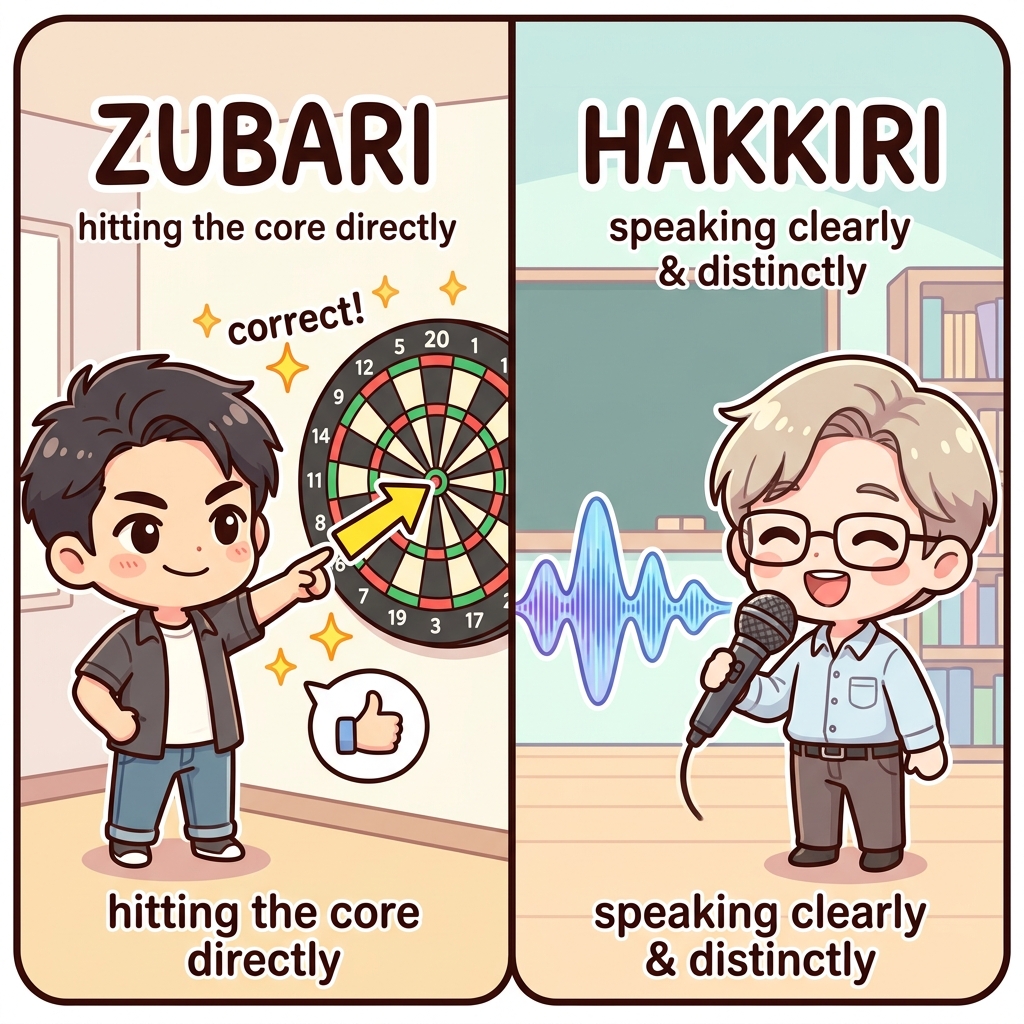
Avoid awkward misunderstandings! Imagine you are presenting a solution in a Japanese meeting. Do you need to speak はっきり (hakkiri), so everyone can understand you clearly, or do you need to identify the core issue ずばり (zubari), with direct precision? This guide explains the important difference between ずばり and はっきり, so you can express yourself more naturally and accurately.
Both words can relate to directness or clarity, but they work in different ways. はっきり focuses on clarity and lack of ambiguity. ずばり focuses more on saying something directly and getting to the heart of the matter. Understanding this difference will help your Japanese sound more precise.
Two Similar Sounds, Different Impressions
ずばり (zubari) is an expressive adverb used when someone says something directly, clearly, and to the point. It often gives the feeling of “exactly,” “straight to the point,” or “hitting the nail on the head.” It is especially common when identifying the core of a problem, giving a direct answer, or saying something without softening it too much.
はっきり (hakkiri), on the other hand, describes something that is clear, distinct, or unambiguous. It can be used for speech, vision, memory, decisions, opinions, or situations. For example, you can speak はっきり, see something はっきり, remember something はっきり, or state your opinion はっきり.
The Scene Behind Each Expression
Use ずばり (zubari) when you want to go straight to the important point. For example, if someone identifies the real cause of a problem, gives the exact answer, or says something very direct, ずばり can fit naturally. It often carries a sense of impact, as if the speaker has cut through unnecessary details and reached the core.
Use はっきり (hakkiri) when the main idea is clarity. You can say はっきり話してください (hakkiri hanashite kudasai - Please speak clearly), 富士山がはっきり見える (Fujisan ga hakkiri mieru - Mt. Fuji is clearly visible), or はっきり決める (hakkiri kimeru - to decide clearly/firmly). It is broader and more neutral than ずばり.
Direct to the Point or Simply Clear?
Use ずばり (zubari) when someone gets straight to the core of a matter or says something very directly. Use はっきり (hakkiri) when the focus is general clarity, such as clear speech, clear vision, a clear decision, or an unambiguous statement.
How Japanese Speakers Choose Between Them
The choice between ずばり (zubari) and はっきり (hakkiri) depends on what kind of “directness” or “clarity” you mean. If you want to say that someone’s explanation was easy to understand, はっきり is usually natural. If you want to say that someone identified the exact core issue, ずばり may be stronger and more precise.
For example, はっきり問題点を言います means “I will state the problem clearly.” This sounds like the speaker wants to avoid ambiguity. ずばり問題点を言います sounds more like “I will say the problem directly / get straight to the point.” It can feel sharper and more forceful, so it should be used carefully in formal or sensitive situations.
Common Pitfall:
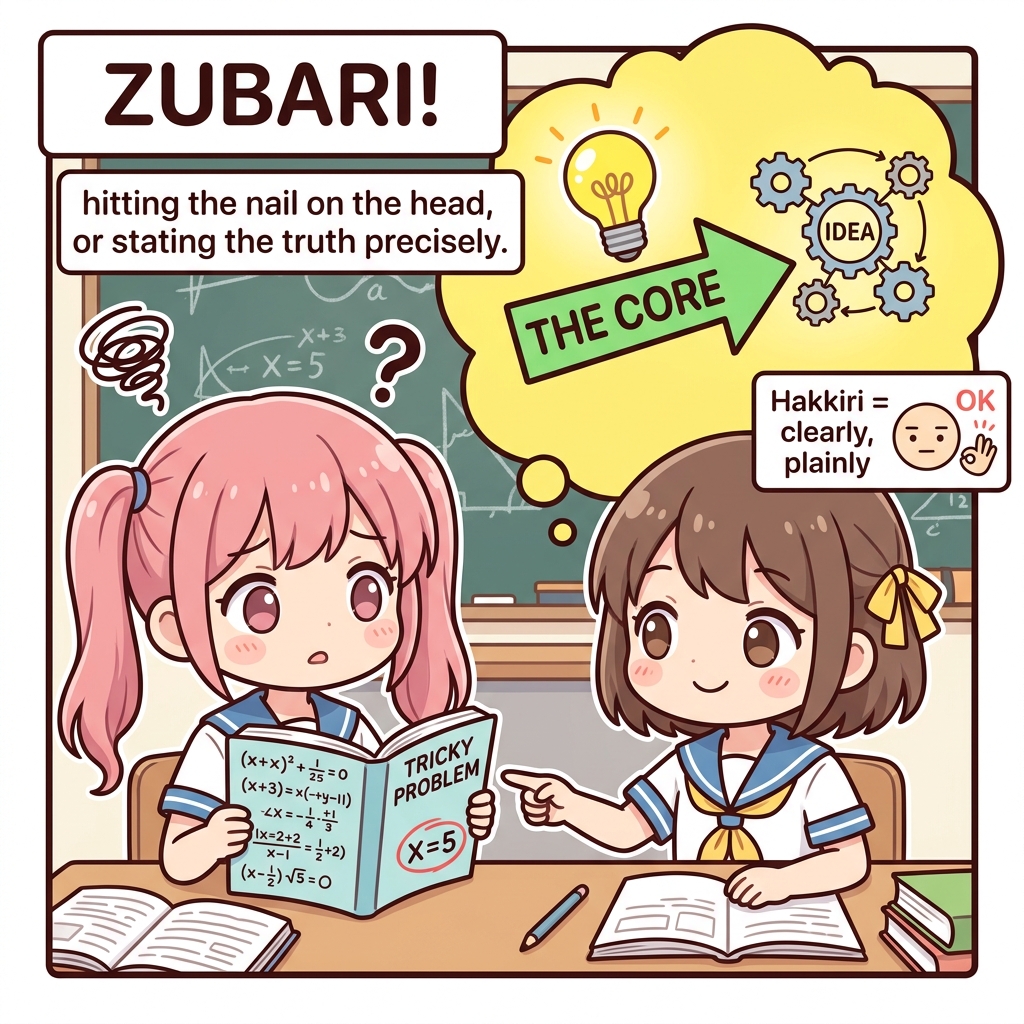
Do not use はっきり (hakkiri) when you specifically mean “straight to the core” or “exactly on point.” はっきり means clear, but it does not always have the sharp, pinpoint feeling of ずばり. Also remember that ずばり言います can sound quite direct, so it may feel strong in delicate conversations.
Small Nuance, Big Difference
The difference can be understood as “pinpoint directness” versus “general clarity.” ずばり is like cutting straight to the heart of the matter. はっきり is like making something clear and easy to understand. Both are useful, but they are not interchangeable.
Practice the Difference with Audio
Play the audio and listen to how the examples sound in Japanese.
Japanese: 彼の説明は、まさに問題の核心をずばり言い当てていた。
English: His explanation got straight to the heart of the problem.
Japanese: 彼の話ははっきりしていて、とても分かりやすかった。
English: His explanation was clear and very easy to understand.
Quick Practice with Real Context
Think about whether you want to express sharp precision or simple clarity. When someone identifies the exact core issue, ずばり is often a good choice. When something is easy to hear, see, understand, decide, or explain, はっきり is usually more natural.
For example, if a manager says the main reason a project failed, ずばり may fit. If a speaker uses a loud and clear voice, はっきり is the better word.
Related Expressions
| Expression | Meaning |
|---|---|
| 的確に (tekikaku ni) | Accurately, appropriately, to the point |
| 明確に (meikaku ni) | Clearly, explicitly, unambiguously |
| ストレートに (sutoreeto ni) | Straightforwardly, directly |
Frequently Asked Questions
Can ずばり (zubari) be used for visual clarity?
Usually, no. ずばり (zubari) is mainly used for direct statements, accurate guesses, clear answers, or identifying the core of an issue. It is not normally used to describe seeing something clearly. For visual clarity, はっきり見える (hakkiri mieru - can be seen clearly) is natural.
Is one more polite than the other?
Neither word is automatically polite or impolite. Politeness depends on the full sentence and situation. However, ずばり can sound very direct, so it may feel strong in formal, sensitive, or hierarchical situations. はっきり is broader and often more neutral, but even はっきり言う can sound direct depending on the context.