
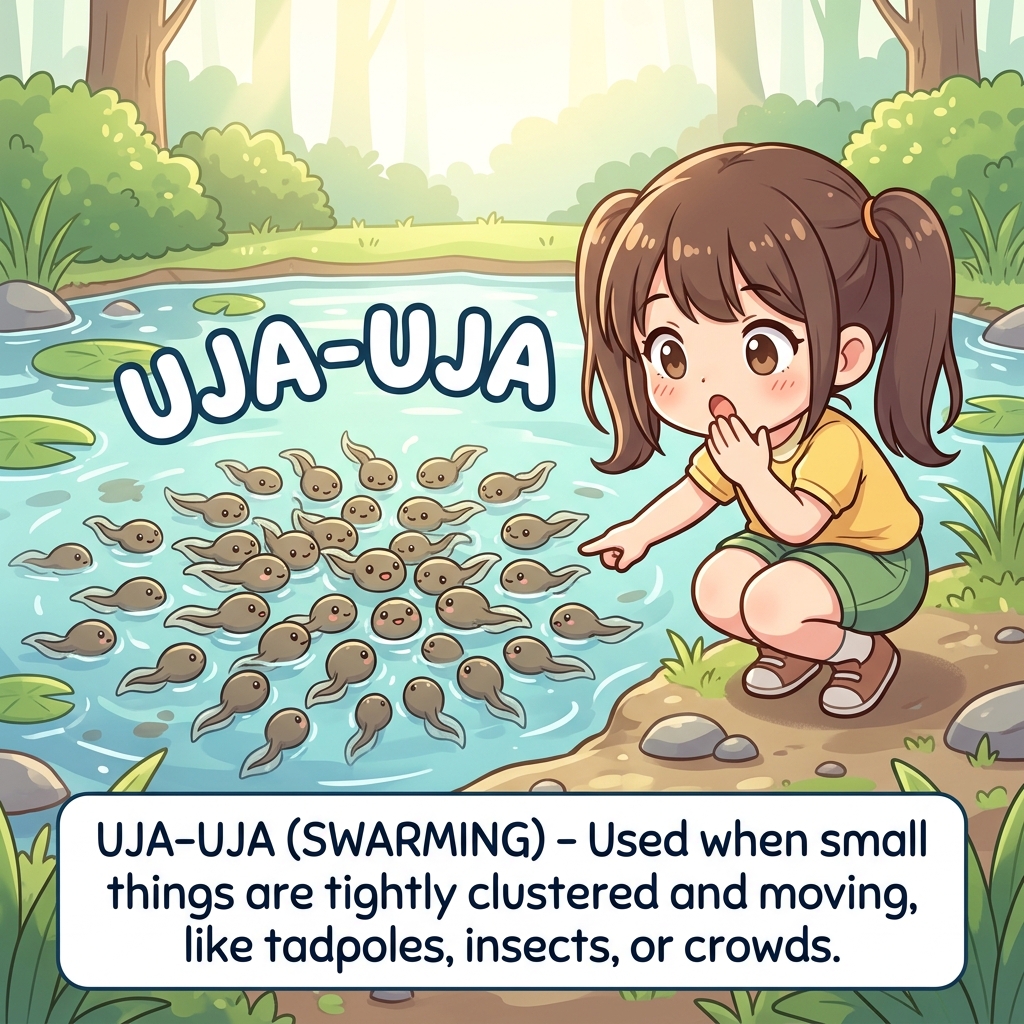
Imagine you are trying to describe a pond full of tadpoles, a dirty corner with many insects, or a crowded event space where people are packed together. Your first thought might be to use a general word like たくさん (takusan), meaning “many.” While that is correct, it does not always capture the feeling of a dense, overwhelming mass. This is where うじゃうじゃ (uja-uja) becomes useful.
うじゃうじゃ (uja-uja) describes many small living things, objects, or sometimes people gathered densely in one place. It often suggests a scene that feels overwhelming, chaotic, or slightly unpleasant. Instead of simply saying “there are many,” it gives the listener a vivid image of something teeming, swarming, or packed together.
What This Word Really Feels Like
At its core, うじゃうじゃ (uja-uja) conveys the feeling of something being present in large numbers and close together. Think of a mass of small things moving, wriggling, or filling a space. The focus is not just quantity, but density. The scene feels crowded, busy, and visually overwhelming.
For example, if you see a puddle full of mosquito larvae, a log covered with ants, or a dirty area with many insects, うじゃうじゃ fits very naturally. It suggests not only that there are many of them, but also that the sight may feel a little uncomfortable or unpleasant.
How It Works in Context
うじゃうじゃ (uja-uja) is often used with small creatures such as insects, worms, larvae, tadpoles, or small fish. It can also be used for people in a crowded place, but this usage can sound negative or slightly rude, because it compares the crowd to a dense mass. For that reason, it is better used when the speaker wants to express discomfort, irritation, or a feeling of being overwhelmed.
Listen to うじゃうじゃ (uja-uja) in Real Sentences
Play the audio and listen to how the examples sound in Japanese.
Japanese: 水たまりにボウフラがうじゃうじゃいる。
English: There are mosquito larvae teeming in the puddle.
Japanese: デパートの催事場は人でうじゃうじゃだ。
English: The department store’s event space is packed with people.
As you can hear in the examples, うじゃうじゃ (uja-uja) adds a strong visual and emotional layer. It is not a neutral way to say “many.” It suggests that the amount or density feels noticeable, messy, uncomfortable, or overwhelming.
Natural Usage Scenes
You will often encounter うじゃうじゃ (uja-uja) in descriptions of:
- Nature scenes: Ponds or stagnant water full of tadpoles, mosquito larvae, or small fish. A log covered with ants or termites.
- Unpleasant situations: A dirty room with cockroaches, a dumpster with flies, or a place where many small creatures gather.
- Crowded urban events: A festival, concert, sale, or event space where people are packed together and the speaker feels overwhelmed or uncomfortable.
For example, if you say 人でうじゃうじゃだ (hito de uja-uja da), you are not simply saying “there are many people.” You are suggesting that the place feels uncomfortably crowded, chaotic, or too packed.
A Common Learner Mistake
Don’t Use It as a Neutral Word for “Many”
A common mistake is to use うじゃうじゃ (uja-uja) whenever you want to say “there are many.” In many situations, たくさんいる (takusan iru) is safer and more neutral. うじゃうじゃ adds the feeling of density, disorder, or discomfort. It is perfect for a pond full of larvae or an unpleasantly crowded place, but it may sound too negative if you only mean “many people” in a normal way.
How to Remember It
To remember うじゃうじゃ (uja-uja), picture many small things packed together and moving in one place. The scene should feel dense, busy, and a little uncomfortable. Instead of thinking only “many,” think “too many in one place.” That emotional image will help you use the word more naturally.
When “Many” Starts to Feel Uncomfortable
うじゃうじゃ (uja-uja) often carries a negative or uncomfortable nuance. When used for people, it can sound a little rude or dismissive, so use it carefully. It is best for situations where the crowd or group feels overwhelming rather than simply lively or enjoyable.
Related Expressions
While うじゃうじゃ (uja-uja) has its own specific nuance, these related expressions can help you understand the difference:
| Expression | Meaning | Nuance |
|---|---|---|
| ぎゅうぎゅう (gyuugyuu) | Packed tightly, crammed | Focuses on physical tightness, often in a crowded or uncomfortable space. |
| ごちゃごちゃ (gochagocha) | Messy, jumbled, cluttered | Focuses on disorder or things being mixed together messily. |
| わんさか (wansaka) | In great numbers, abundantly | Often more neutral or positive than うじゃうじゃ. |
Frequently Asked Questions
Can うじゃうじゃ (uja-uja) be used for large animals?
Usually, うじゃうじゃ (uja-uja) is used for small creatures, small objects, or people in a crowded place. It does not usually fit large animals like elephants or bears, because the word gives the image of many things packed together like a swarm or dense mass.
Is うじゃうじゃ (uja-uja) always negative?
It is not always extremely negative, but it usually has an uncomfortable or overwhelming nuance. For insects or larvae, it can sound unpleasant or even gross. For people, it can imply that the place is too crowded or chaotic. If you want a neutral or positive way to say “many,” expressions like たくさん (takusan) or 大勢 (oozei) are usually safer.