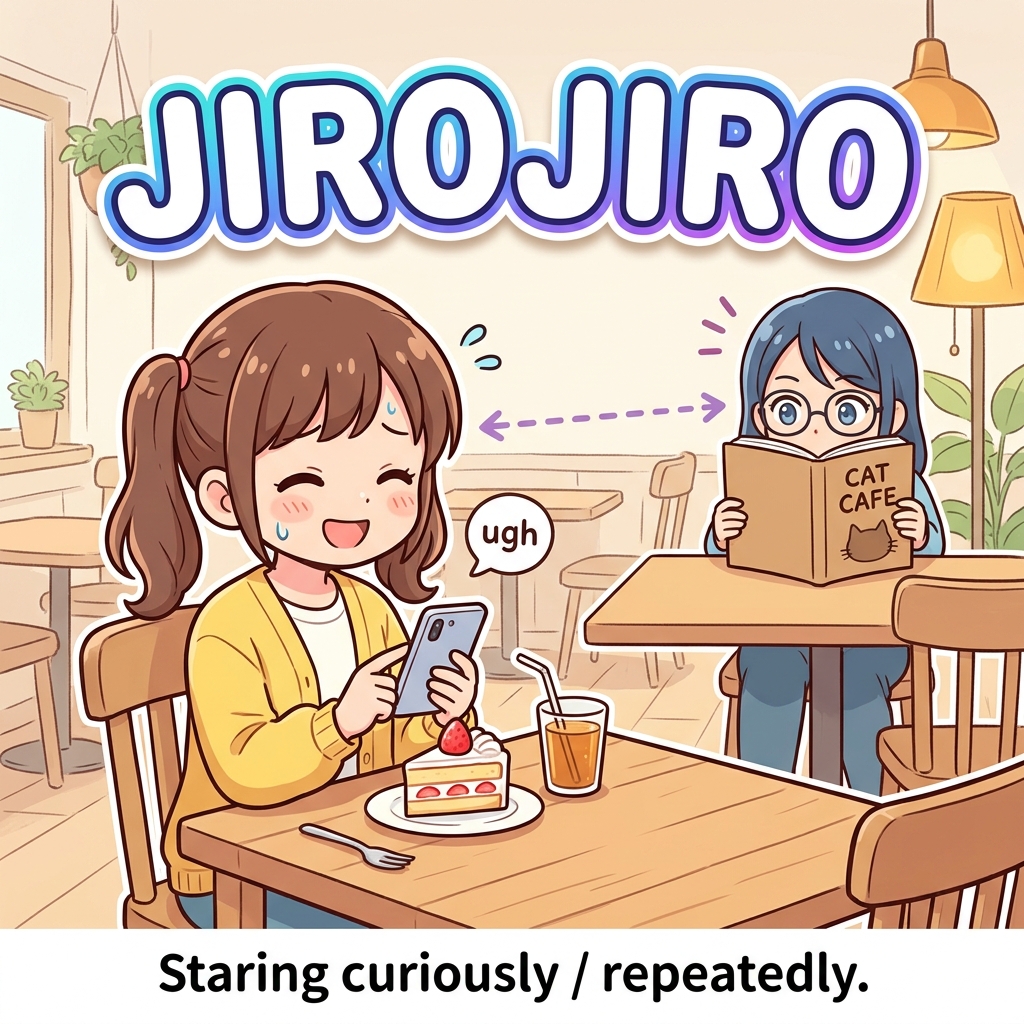
Imagine you're in Japan, and someone is looking at you. Is it a friendly glance, or something more? Understanding the subtle nuances of how Japanese describes 'looking' can save you from social faux pas and deepen your grasp of cultural cues. One such crucial word is じろじろ (jirojiro), an onomatopoeia that goes far beyond simply 'looking.' It describes a gaze that often carries a negative connotation, making others feel uncomfortable or scrutinized.
What This Word Really Feels Like
At its core, じろじろ (jirojiro) describes the act of looking repeatedly and carefully. However, it's not a neutral observation. Think of it as a 'stare' – one that's often filled with curiosity, suspicion, or even judgment. It implies a prolonged, intrusive gaze, as if the person is sizing you up or examining you in detail. This isn't the polite, fleeting glance you might exchange with a stranger; it's a look that lingers, creating a palpable sense of tension and discomfort for the person being observed. It's often used when someone is looking at something or someone they find unusual, out of place, or simply want to scrutinize without much regard for the other person's feelings.
How It Works in Context
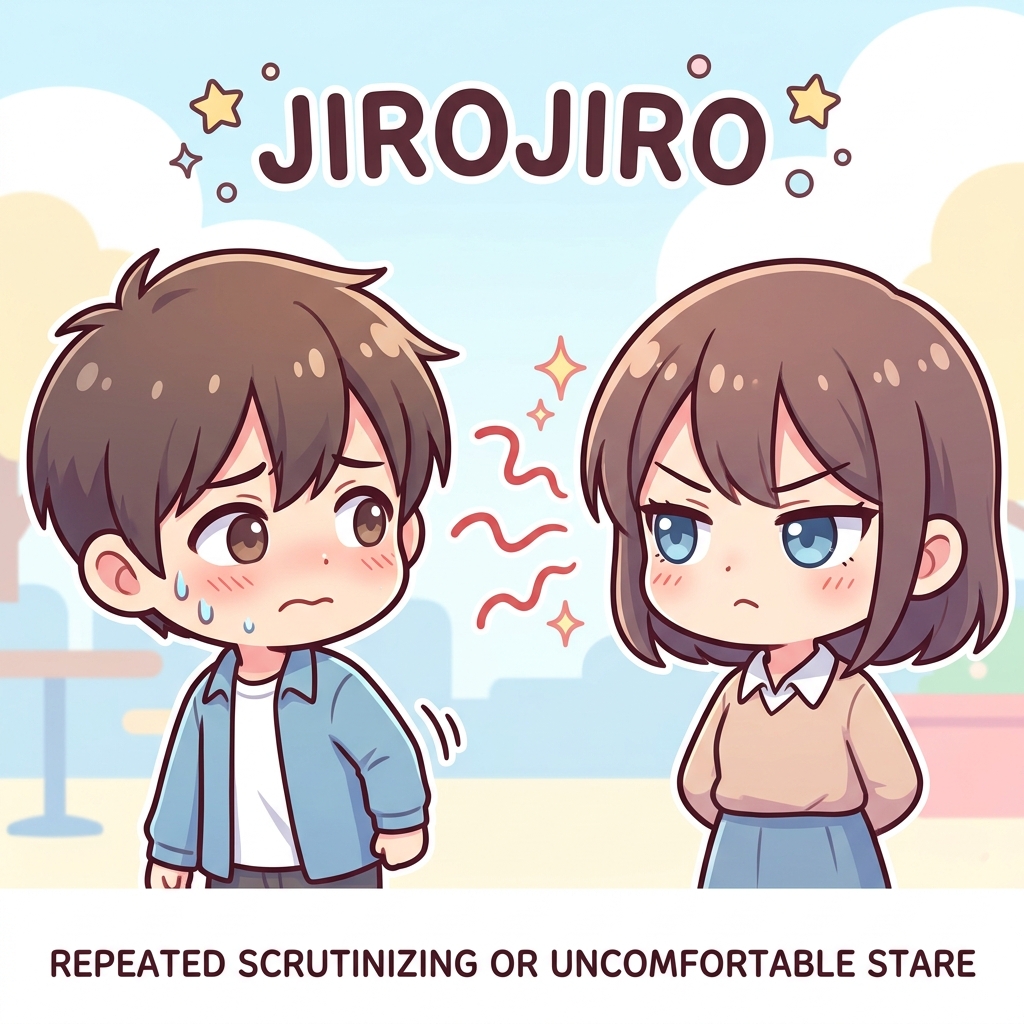
The power of じろじろ (jirojiro) lies in its ability to convey an emotional impact. When you hear or use this word, it immediately signals that the act of looking is causing unease. It's the kind of look that makes you want to check if your fly is open or if you have something on your face. It's not just about the visual act; it's about the emotional response it provokes. For instance, if a character in an anime is described as being looked at じろじろ (jirojiro), you instantly understand they're feeling awkward or judged, not just observed. This is a key insight for foreign learners, as a simple translation of 'stare' might not fully capture the depth of the discomfort and social impropriety implied.
Natural Usage Scenes
You'll typically encounter じろじろ (jirojiro) in social interactions, especially in public settings where someone's appearance or actions might draw unwanted attention.
- Public Transport: A person staring at a foreigner on a train.
- Shopping: A shop assistant scrutinizing a customer they suspect of shoplifting.
- Social Gatherings: Someone openly judging another's outfit or behavior.
- Unusual Situations: People staring at a performer or an odd sight, but in a way that makes the subject feel like an exhibit.
It's crucial to remember that this word almost always implies a negative or at least an awkward feeling. It's rarely used to describe a positive or admiring gaze.
A Common Learner Mistake
Many learners initially equate じろじろ (jirojiro) with simply 'to look' or 'to stare,' missing the critical nuance of discomfort and judgment. They might wonder why a character in a story seems offended by 'just looking.' The mistake is overlooking the inherent negative connotation. Using じろじろ (jirojiro) to describe a polite or neutral observation would sound unnatural and could even be misinterpreted as rude. For example, saying 'I じろじろ looked at the beautiful painting' would be strange; it implies you were scrutinizing it in an uncomfortable way, rather than admiring it.
Avoid This Mistake!
Don't use じろじろ (jirojiro) when you mean to observe something politely or neutrally. It carries a strong sense of making others uneasy. If you want to say you looked carefully but respectfully, use expressions like 'よく見る' (yoku miru - to look carefully) or '観察する' (kansatsu suru - to observe).
How to Remember It
To solidify your understanding of じろじろ (jirojiro), associate it with the feeling of being under a microscope, or having 'all eyes on you' in an uncomfortable way. The repeated 'jiro' sound itself can evoke a sense of a persistent, unwavering gaze. Think of it as a 'judgmental stare' or a 'scrutinizing gaze' rather than just a 'look.' When you encounter it, remember the tension, the discomfort, and the unease it brings. This will help you not only understand its usage but also avoid using it inappropriately yourself.
Usage Tip:
Native speakers often use 'じろじろ見る' (jirojiro miru) to describe a gaze that makes them uneasy. If you feel someone is staring at you uncomfortably, you might say 'じろじろ見ないでください' (jirojiro minaide kudasai - Please don't stare at me like that). It's a direct way to express your discomfort.
Related Expressions
While じろじろ (jirojiro) is specific, here are some related terms to help you differentiate:
| Japanese | Romaji | Meaning/Nuance |
|---|---|---|
| じっと | jitto | Staring fixedly, often with concentration or patience. Can be neutral or positive. |
| ちらちら | chirachira | Glancing repeatedly, furtively, or fluttering. Light, quick glances. |
| きょろきょろ | kyorokyoro | Looking around restlessly, searching for something or someone. |
Hear じろじろ (jirojiro) in Context
Play the audio and listen to how the examples sound in Japanese.
Japanese: 電車の中で、隣の人が私をじろじろ見ていて不快だった。
English: On the train, the person next to me was staring at me uncomfortably.
Japanese: 店員が新しい客をじろじろと品定めするように見ていた。
English: The shop assistant was scrutinizing the new customer as if sizing them up.
Frequently Asked Questions
Can じろじろ (jirojiro) ever be used positively?
Almost never. じろじろ (jirojiro) inherently carries a negative or uncomfortable connotation. It describes a gaze that is intrusive, scrutinizing, or judgmental, making the person being looked at feel uneasy. For positive or neutral careful observation, other expressions are used.
What's the difference between じろじろ (jirojiro) and じっと (jitto)?
While both involve staring, じろじろ (jirojiro) implies a repeated, intrusive, and often judgmental gaze that causes discomfort. じっと (jitto), on the other hand, describes staring fixedly or patiently, often with concentration or stillness, and can be neutral or even positive (e.g., watching a child sleep peacefully). The key distinction is the emotional impact on the observed party.
Mastering じろじろ (jirojiro) is a significant step in understanding the emotional depth of Japanese onomatopoeia and social interactions. By recognizing its negative nuance, you'll avoid misinterpretations and gain a more authentic feel for the language.