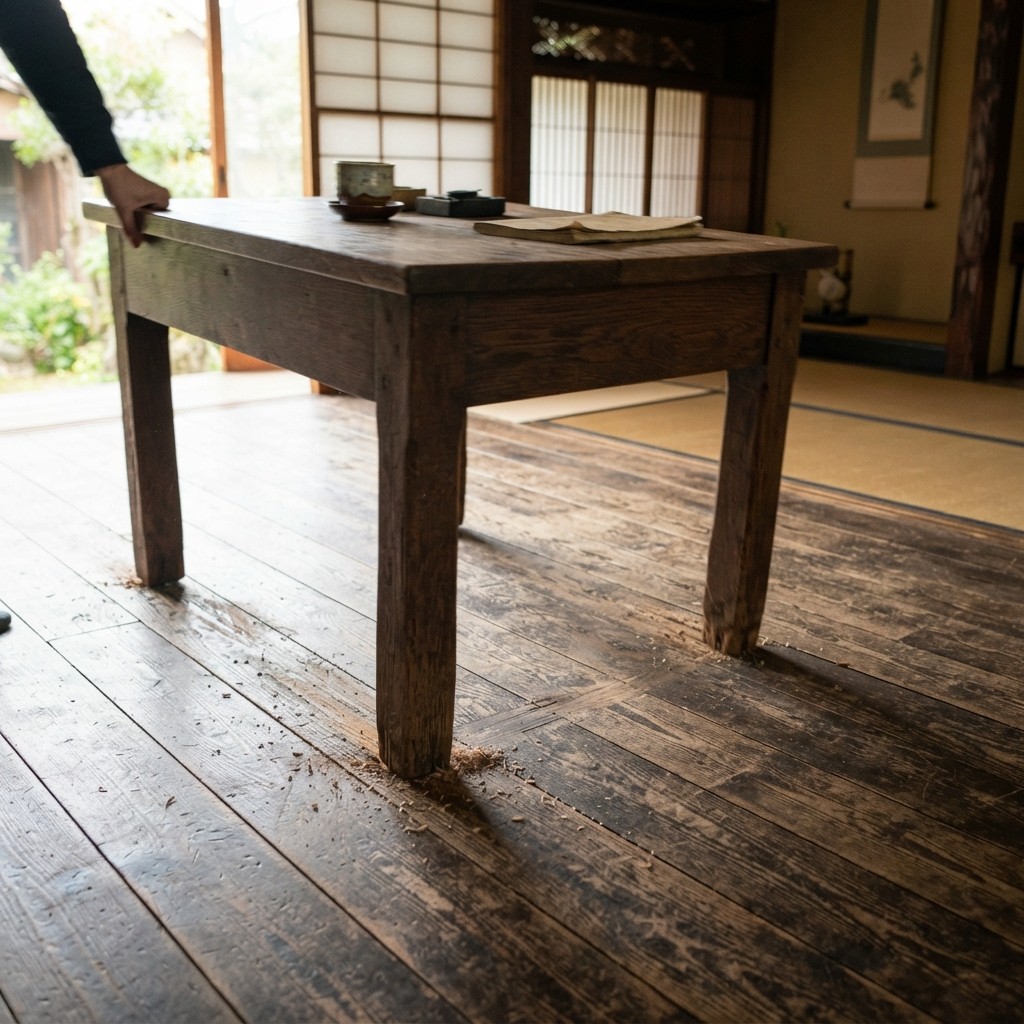
がーっ (gaa), also written in katakana as ガーッ, imitates a loud, rough grinding or scraping noise: the sound of something hard being dragged or rubbed against something else. Think of a heavy desk dragged across a floor. This page explains where the word fits, how to build sentences with it, and which other words to use for scenes it does not describe.
A quick note on sources: がーっ is a casual sound word, and it has no entry in デジタル大辞泉 or 精選版 日本国語大辞典 (checked on Kotobank). The meaning below follows JMdict, a widely used Japanese-English dictionary, which lists ガーッと as an onomatopoeic adverb meaning "with a grinding noise." Uses we could not confirm are kept out of this page.
What This Word Really Sounds Like
がーっ (gaa) is a harsh noise with friction in it. It is not a single knock or bang; the long vowel stretches the sound out, so it suits a noise that lasts while something keeps moving and scraping.
- Furniture on a floor: a heavy desk or chair dragged so that it scrapes the floor.
- A grinding noise: something hard grinding or rubbing roughly against another surface.

How to Use It in a Sentence
You will usually see がーっ in two patterns:
- ガーッと + verb: describes how an action sounds. For example, 机をガーッと引きずる means dragging a desk so that it makes a loud scraping noise.
- ガーッという音: names the noise itself. For example, ガーッという音がした means there was a loud grinding or scraping noise.
Because it is a sound word, it fits casual conversation, fiction, and manga better than formal writing.
Try Saying がーっ (gaa) Naturally
Play the audio and listen to how the examples sound in Japanese.
Japanese: 重い机を床の上でガーッと引きずった。
English: I dragged the heavy desk across the floor with a loud scraping noise.
Japanese: 椅子を引いたら、ガーッという音がした。
English: When I pulled the chair back, it made a loud scraping noise.
Choosing the Right Word: がーっ and Similar Sounds
Many scenes that feel "forceful" in English call for a different Japanese word. These four are easy to confuse:
- がーっ (gaa): a loud, rough grinding or scraping noise that lasts, such as furniture dragged across a floor.
- がりがり (garigari): repeated scratching, scraping, or crunching of something hard, such as claws scratching a board or crunching something hard between the teeth.
- がつん (gatsun): a single hard, heavy impact, when hard objects collide with force. Use a word like this, not がーっ, for one hard knock.
- ごくごく (gokugoku): the sound of gulping a drink. Use this, not がーっ, for drinking water quickly, as in 冷たい水をごくごく飲む.
Ask Yourself: Is Something Scraping?
Before you use がーっ (gaa), check whether the scene really has a long, rough friction noise. If it is one hard knock, a word such as がつん fits better. If someone is gulping a drink, use ごくごく.
A Common Learner Mistake
A frequent mistake is using がーっ (gaa) as a general "forceful" word, for slamming a desk or gulping a drink. A sentence like 机をがーっと叩いた suggests a scraping noise, which does not match a hit. For a single hard impact, a word such as がつん fits better, and 水をごくごく飲んだ is the natural way to describe gulping water.
What We Could Not Confirm
Some learner resources also use ガーッと for doing something quickly and vigorously, or connect it with anger or growling. We could not confirm these uses in a dictionary, so this page does not teach them. If you meet them in manga or conversation, treat them as casual extensions rather than the core meaning.
How to Remember It
Picture moving day: a heavy desk dragged across the floor makes a long, rough "gaaa" before it stops. The long vowel is the dragging; the small っ is the sudden stop. If a scene has no scraping or grinding, look for a different word.
Frequently Asked Questions
Should I write がーっ or ガーッ?
Both appear. JMdict lists ガーッと as the main form, with がーっと and があっと as other spellings. Katakana is common for sound effects, so you will often see ガーッ.
Can がーっ describe drinking or hitting something?
We found no dictionary support for those uses. For gulping a drink, use ごくごく; for a single hard impact, a word such as がつん fits better.
Sources: JMdict entry ガーッと ("with a grinding noise"); デジタル大辞泉 and 精選版 日本国語大辞典 on Kotobank for がつん, ごくごく, and がりがり. がーっ itself has no entry in デジタル大辞泉.