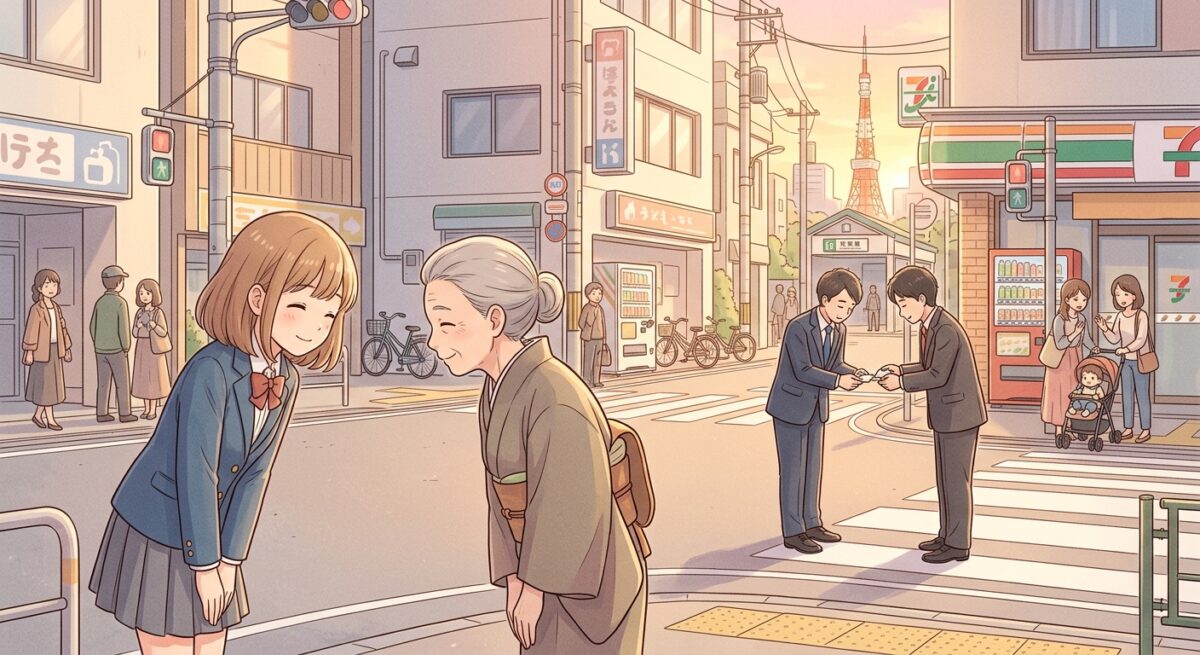
Bowing is one of the first Japanese customs many visitors notice. You may see it at a hotel desk, after a purchase, during an introduction, or when someone says thank you or sorry. The gesture can look highly structured, but visitors do not need to master a rulebook before using it politely.
For most everyday travel situations, a small nod or light bow with polite words is enough. The right response depends on the place, relationship, and level of formality. This guide helps you decide what to do without treating every interaction as a formal ceremony.
Quick Answer
Use a small nod or light bow for everyday greetings, thanks, and minor apologies. A clearer bow may suit a formal introduction or strong thanks. Visitors rarely need a deep bow unless the situation is clearly serious or ceremonial. When in doubt, follow the other person’s lead and any instructions at the location.
A Quick Decision Guide
| Situation | Usually enough for a visitor | What to avoid |
|---|---|---|
| Shop, cafe, hotel, or directions | A small nod plus “thank you” | Trying to match a staff member’s service bow exactly |
| Minor mistake or passing through | A small bow with sumimasen | Turning a small mistake into a dramatic apology |
| Formal introduction or meeting | Pause, give a calm bow, and follow the host’s lead | Starting a handshake without noticing the other person’s gesture |
| Serious apology or major gratitude | A clearer, slower bow may be appropriate | Using a deep bow as a routine greeting |
| Shrine, temple, school, or ceremony | Follow posted guidance or the person in charge | Assuming one ritual applies at every location |
What Bowing Communicates in Japan
A bow can communicate greeting, thanks, apology, respect, acknowledgment, a request, or farewell. Its meaning comes from the words, timing, and situation rather than depth alone. A quick nod to a cashier and a formal bow at a meeting are not the same social action.
Visitors often find this difficult because much of the context is learned through observation. There is no single gesture that fits every person and place. That does not mean you must guess perfectly: noticing the situation and responding modestly is usually more useful than performing a technically exact bow.
A Practical Rule
Start small. A natural nod can become a clearer bow if the setting is formal, but an exaggerated bow can make an ordinary interaction feel more serious than intended.
How Deep Should You Bow?
Travel guides sometimes describe formal bow classifications and exact angles. Those labels can be useful in professional training, but most travelers do not need to calculate an angle. A situation-based approach is easier and less likely to create an unnatural response.
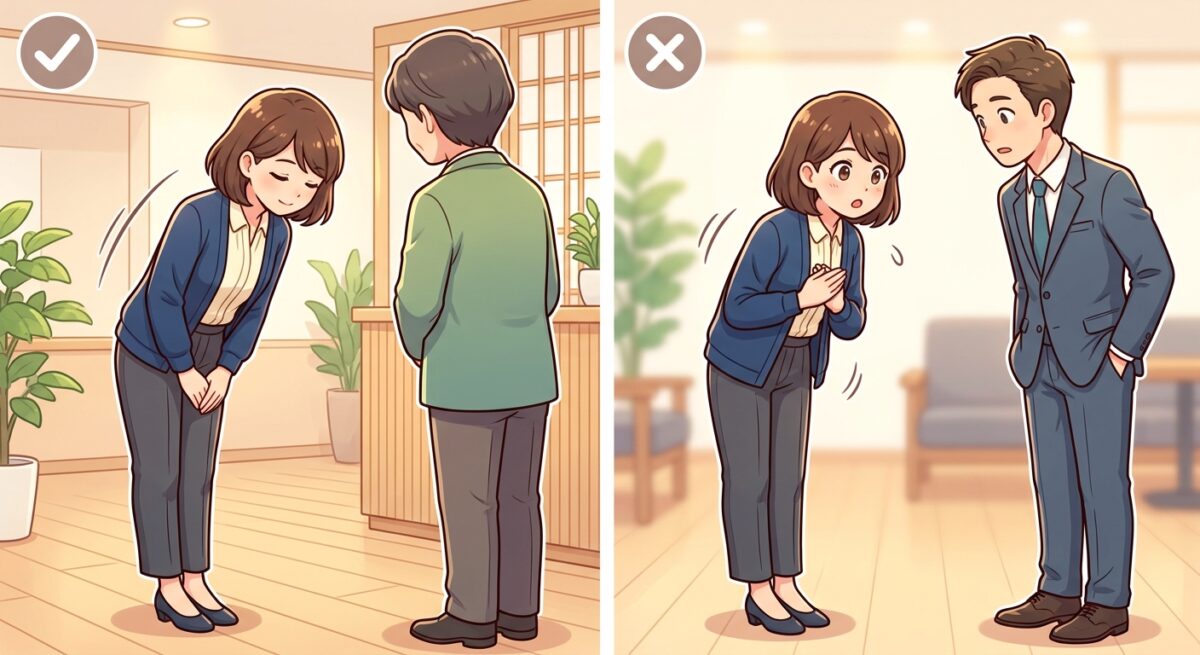
- Small nod or light bow: everyday thanks, a brief greeting, receiving help, or a minor apology.
- Clearer bow: a formal introduction, a school or workplace visit, strong gratitude, or a situation where the host is clearly being formal.
- Deep bow: a serious apology, major gratitude, or a formal ceremony. Most visitors will rarely need this level during ordinary sightseeing.
Depth is not the only signal. A calm posture, suitable words, and good timing matter too. If your hands are full, a head nod and polite words are a practical alternative.
How to Bow in Common Travel Situations
At Shops, Restaurants, and Hotels
Staff may bow as part of customer service. You can answer with a small nod or a quiet arigatō gozaimasu. You do not need to bow after every small action or match a staff member’s depth.
If you ask for directions, luggage storage, or other help, a small bow with sumimasen or onegaishimasu can make the request feel polite. If staff are busy, clear words and a calm manner are enough.
When Saying Thank You
Use a light bow for everyday help, such as receiving directions, getting assistance with a ticket machine, or having a lost item returned. If someone has gone well beyond ordinary service, you can make the bow a little clearer without turning it into a formal performance.
When Apologizing
For a small mistake—bumping into someone, blocking a path, or misunderstanding a queue—a small bow with sumimasen is usually sufficient. A deeper bow belongs to a more serious or formal apology and is not required for every inconvenience.
At Shrines and Temples
Shrines and temples are not interchangeable. JNTO describes a common shrine prayer sequence with two bows, two claps, a prayer, and one final bow, while its temple guidance says there is no need to clap. Actual layouts and instructions can vary, so follow posted guidance and staff or attendants at the location.
A visitor does not need to imitate every person nearby. Moving calmly, avoiding disruption, and checking the site’s instructions are safer than assuming one ritual applies everywhere.
At Schools, Workplaces, and Formal Meetings
These situations may be more formal than sightseeing. Pause at the introduction and follow the host’s lead. A calm, visible bow is usually more appropriate than several nervous bows. For related expectations inside a home, see our guide to Japanese home etiquette for visitors.
Why Visitors Get Confused
The difficulty is not a lack of goodwill. Visitors may be trying to solve several questions at once: Who bows first? How far should I bend? Do I need to return a service bow? Is a handshake more natural? These are common uncertainties because bowing can carry several meanings without a long verbal explanation.
- “I must match the other person exactly.” Not usually. A guest does not need to copy a staff member’s customer-service bow.
- “Deeper is always more respectful.” Depth also signals seriousness and formality. Too deep can be mismatched in a casual setting.
- “I should keep bowing until the other person stops.” One natural response is normally enough for an everyday interaction.
- “Bowing only means apology.” It can also mean greeting, thanks, acknowledgment, a request, or farewell.
- “A visitor must know every rule.” JNTO specifically advises that non-Japanese visitors do not need to learn every bowing rule outside very formal situations.
For more context on communication that is expressed without direct wording, read our guide to indirect communication in Japan and the US.
Bow or Handshake?
In many everyday US settings, a handshake, smile, wave, or verbal greeting may be more familiar than bowing. In Japan, a bow or nod commonly handles the greeting without physical contact. These are tendencies, not rules for every person, region, generation, or workplace.
| What happens | Safe response |
|---|---|
| The other person bows | Return a light bow or nod. |
| The other person offers a hand | Shake hands normally. |
| You both start different gestures | Smile, adjust, and continue; it does not need a second apology. |
| You are unsure in a casual setting | Use a small nod and polite words. |
International business and tourism settings may combine both gestures. Watch the individual in front of you instead of assuming nationality determines their preference.
Useful Japanese Phrases
- ありがとうございます — Arigatō gozaimasu — Thank you very much.
- すみません — Sumimasen — Excuse me / I’m sorry.
- お願いします — Onegaishimasu — Please / I appreciate your help.
- 失礼します — Shitsurei shimasu — Excuse me. Often used when entering or leaving a formal room or situation.
You do not need perfect pronunciation to be polite. Use the phrase that fits the situation, speak clearly, and keep the bow modest.
A Visitor Checklist
- Start with a nod or light bow in ordinary travel situations.
- Add a clear phrase such as arigatō gozaimasu or sumimasen.
- Do not try to match a service bow exactly.
- Use a deeper bow only when the situation is clearly serious or formal.
- At a shrine, temple, school, workplace, or ceremony, follow local instructions.
- If a handshake and bow overlap, adjust naturally and continue.
Frequently Asked Questions
Do foreign visitors have to bow in Japan?
No. JNTO says visitors do not need to learn every rule except in very formal situations. A small nod or light bow is a useful, respectful response in many daily interactions.
Should I bow to shop or hotel staff?
You may return the greeting with a small nod or light bow, but you do not need to match a staff member’s service etiquette. Polite thanks are also appropriate.
Is it rude to use only a small bow?
Not in most everyday travel settings. A deep bow may communicate greater seriousness, so using it for every small exchange can feel less natural.
Should I clap at a temple?
JNTO distinguishes shrine and temple practice: clapping appears in its common shrine prayer sequence, while its temple guidance says clapping is not needed. Follow the instructions at the specific site.
Conclusion
Bowing in Japan is not a test of exact angles. For visitors, it is a flexible way to acknowledge another person, add warmth to thanks, or show that an apology is sincere. A small bow with suitable words will cover most everyday situations.
Use a clearer bow when the setting is formal, reserve deep bows for genuinely serious moments, and let local instructions guide you at cultural and institutional sites. The goal is not perfect imitation; it is a calm response that fits the moment.
Key Takeaways
- A small nod or light bow is enough in most everyday visitor situations.
- Depth signals formality and seriousness; it is not a universal measure of politeness.
- Use words and context together with the gesture.
- Visitors do not need to match staff bows or memorize every formal classification.
- Shrines, temples, workplaces, and ceremonies may have location-specific instructions.
Official References
- JNTO: Understanding and Mastering Japanese Manners and Etiquette
- JNTO: Custom & Manners
- JNTO: Shrine and Temple Traditions
Official sources checked July 2026. This article gives general visitor guidance; posted instructions and staff guidance at each location take priority.