The machine that puts a bag on your umbrella for you
At a building entrance in Japan on a rainy day, I ran into something I hadn't seen before: a metal box with a hole in the top, a picture of an umbrella, and two small illustrated steps -- put the umbrella in, then pull it back out. I did, and the umbrella came back out wrapped in a long plastic bag, without me touching a bag at all.
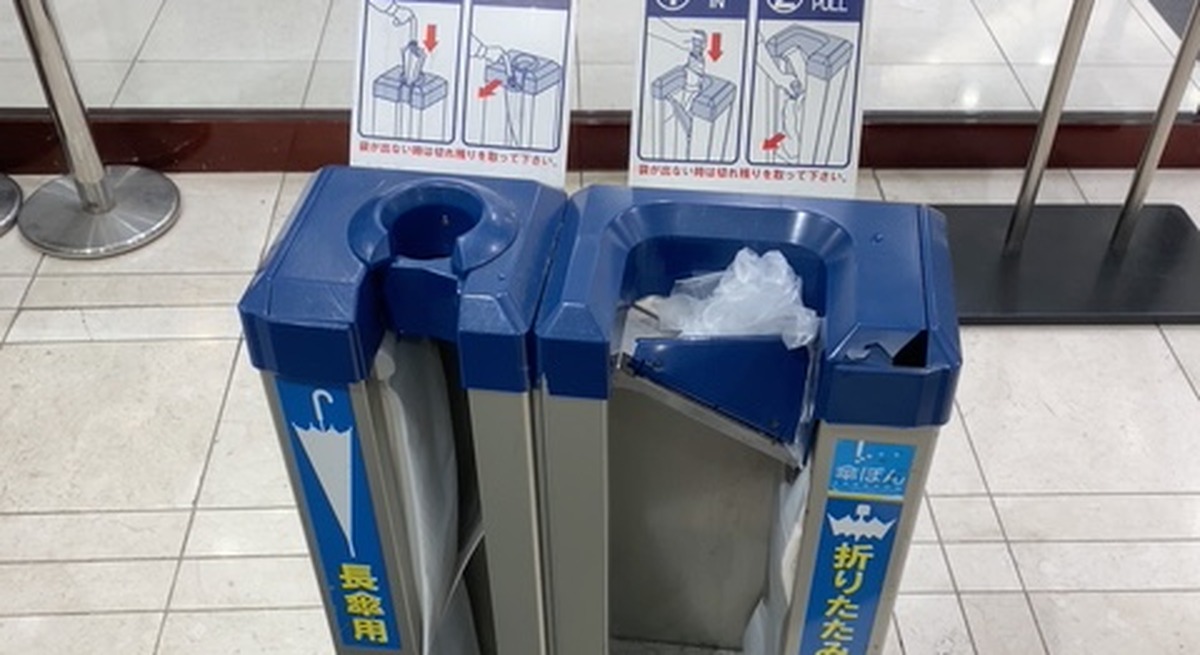
The machine from the story above: push a folded umbrella into the hole, then pull it straight back out -- it comes out already wrapped in a bag.
That single machine is the reason I started paying attention, but it isn't the only answer Japan has to the same small problem. Over more than one rainy-day visit, I photographed three different systems in different buildings, all solving the same thing in different ways: what to do with a dripping umbrella before it drips all over someone's floor. This is a look at all three, based on what I actually saw and shot -- not a claim that these are the only three that exist.
Personal note: I'm working from photos and one short video, not a diary entry, so I'm not going to guess at exact dates or which building was which. What I can say with confidence is what the photos and video actually show.
Why a wet umbrella is a bigger deal indoors than it looks
A folded umbrella straight off the street is, functionally, a dripping object. Indoors, that turns into a few concrete problems rather than just a minor inconvenience: water pooling on hard floors is a slip hazard, wet floors near entrances need repeated mopping through a rainy day, and in stores specifically, rainwater can end up on merchandise, displays, or shopping bags if a wet umbrella brushes against them. None of the three systems below are just aesthetic touches -- they're all direct responses to that same short list of problems.
Method 1: The bag you pull on yourself
The simplest version is a long, narrow plastic sleeve -- an umbrella bag, or "kasa bukuro" (傘袋) in Japanese -- that you take yourself and slide over a folded umbrella before walking in. In the version I photographed, a small stand held rolled bags on hooks, with a metal ring partway up the pole to help hold the umbrella steady while you pull a bag on with your free hand. I also saw a second, boxier version at a different entrance: an enclosed dispenser with a sign asking visitors to bag their umbrella before entering, and bags visible inside through a hinged lid.
There's no machine involved and nothing to operate -- you take a bag, use it, and carry your bagged umbrella inside. It's the version most visitors are likely to recognize, since it's the most common style at department stores, hotels, and larger commercial buildings, though I can't say it's present at every entrance in Japan; plenty of smaller places have nothing at all, or a shared umbrella stand instead.
The tradeoff is the one you'd expect: it's a single-use plastic bag, used once and then either carried around dripping inside your bag or thrown away once you leave. It's simple and it works, but it isn't reusable, and after use, the bag still has to be dealt with according to the facility's or local area's waste rules.
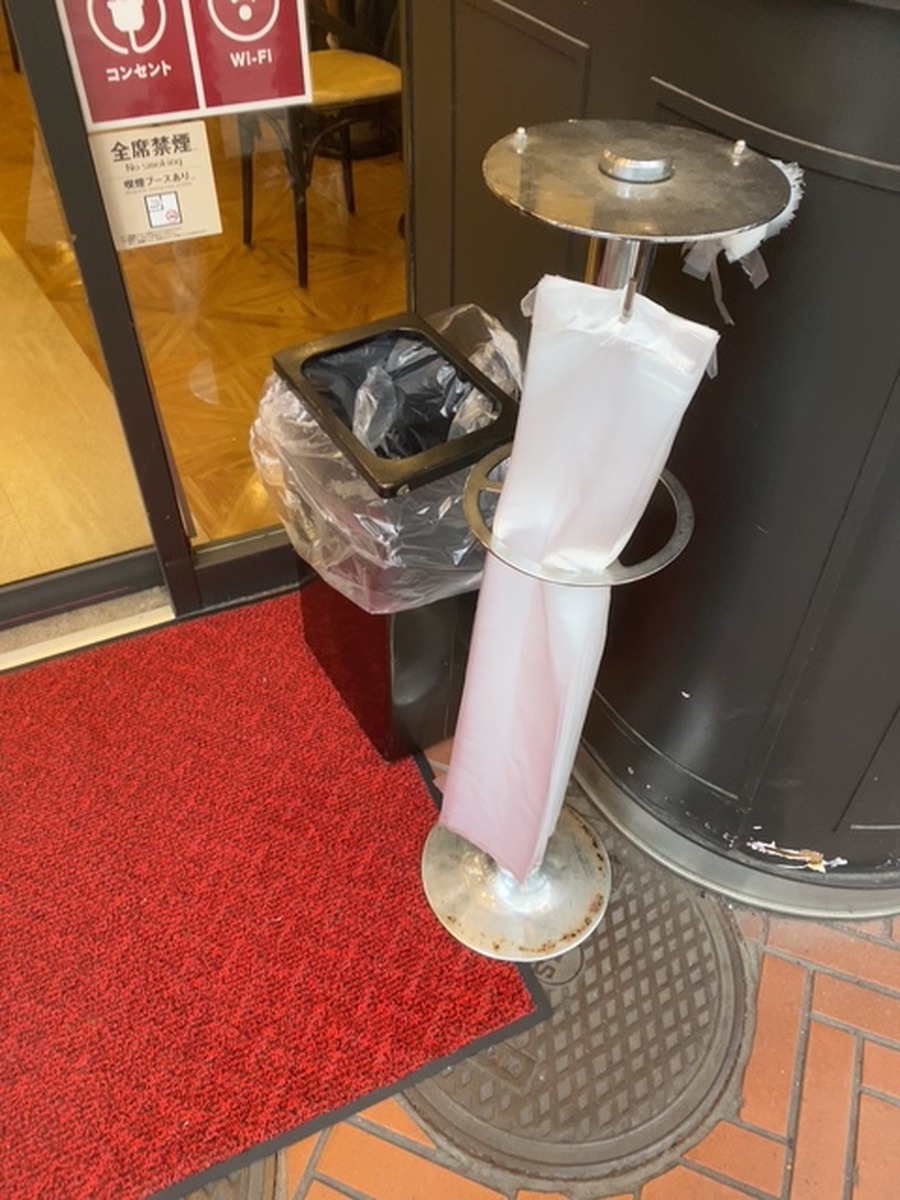
One of the simplest solutions: slide the folded wet umbrella into a long plastic sleeve before going inside.
Method 2: Shaking the water off instead
The second system skips the bag entirely. It's a small wheeled stand holding two padded, absorbent panels set in a V shape -- you slide your closed umbrella down between the two panels and shake it firmly a few times, and the panels pull the water off. The unit I photographed had its own sign, labeled "傘ふり場" (kasa furiba, literally "umbrella-shaking spot"), with an illustration showing exactly that motion: umbrella held between the panels, shaken side to side.
This isn't one single branded product -- searching around, I found at least three different manufacturers selling similar V-shaped, shake-to-dry devices under different names (傘ぱっぱ, 傘ふるふる, しずくり~ん among them), so it's more accurate to describe this as a product category than one specific machine. What they share is the core idea: no bag, no plastic, and no electricity -- you shake, the absorbent material takes the water, and you walk in with a still-wet-but-no-longer-dripping umbrella.
Some versions of this type, such as Kasa Pappa, are designed to work without disposable umbrella bags or absorbent-mat consumables, according to that product's own manufacturer. Japan's Ministry of Environment hosts a Decokatsu case study in which the manufacturer presents this type of device as a way to reduce disposable-umbrella-bag use -- which is a genuinely different environmental profile from either of the other two methods here, and it's worth sitting with for a moment given how unglamorous the device itself looks.
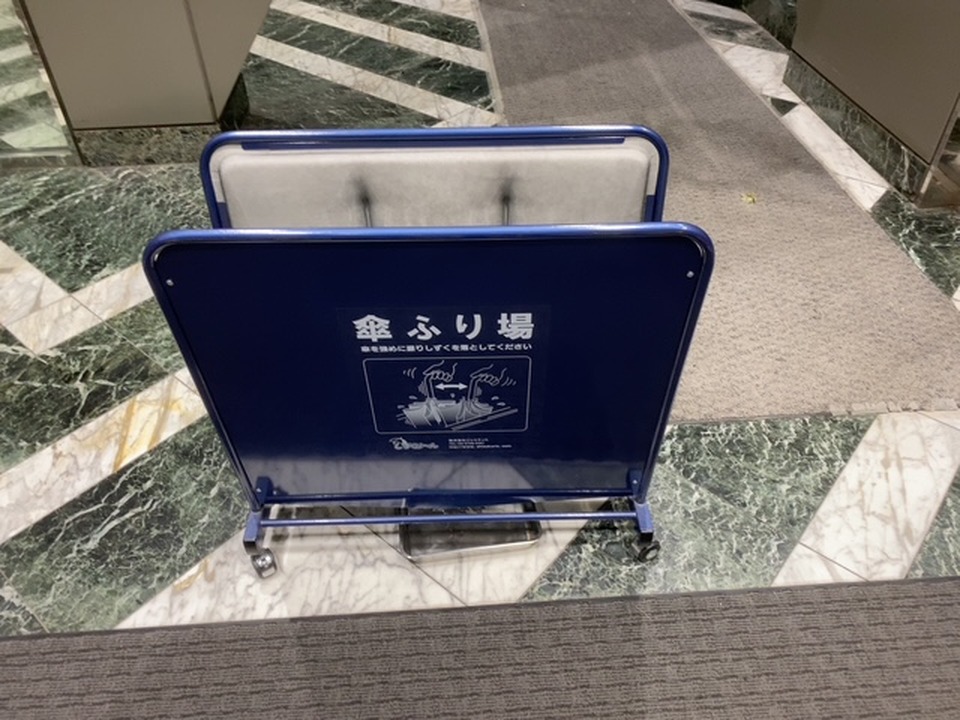
This type removes water without using a disposable umbrella bag.
Method 3: The machine that bags it for you
Then there's the one that got me curious enough to write this. Set into the machine's blue plastic top is a round hole, sized for a closed umbrella, with a small illustrated sign directly above it showing two steps: a hand pushing an umbrella down into the hole, then a hand pulling it back out. The units I saw had two separate slots side by side -- one marked for long umbrellas, one for folding umbrellas -- each running the same two-step process independently.
I didn't operate every device I photographed, but I did film this one, and the video shows exactly what the sign promises: a folded umbrella goes into the hole, and coming back out, it's already wrapped in a long plastic bag, no hands-on bagging required. That's the moment that made this feel different from the first two methods -- there's no sleeve to pull on and no shaking to do, just insert and pull.
How it actually works, and why "automatic" isn't quite right
My own first impression, watching it happen, was that the machine "automatically" bagged the umbrella the instant it went in. Checking that impression against the manufacturer directly changed how I'd describe it. The machine is a real product called "傘ぽん" (Kasapon), made by Niikura Scales Co., Ltd. (新倉計量器株式会社), and the company's own instructions for it are as simple as the sign suggested: insert the umbrella from the top, then pull it straight back out toward you. There's no button, no lever, and -- specifically confirmed on the manufacturer's own product page -- no power supply at all; it's built to run with no electricity, which the maker points to as a safety feature (no risk of an electrical fault) as much as a convenience one.
So the more accurate description is mechanical rather than automatic: a pre-loaded roll of bags is positioned so that pulling the umbrella back out through the mechanism is what applies the bag, in one motion, without you separately picking up or opening anything. It feels automatic because there's no visible bag-handling step for the user, but there's no motor and no electronics doing the work -- it's closer to how a roll of plastic wrap dispenses in a single pull than to a powered machine. According to the manufacturer, the bags themselves are a patented design with a strip meant to keep the bag from sliding off, they're made of a polyethylene that can go out with regular burnable trash, and the company lists installations at department stores including Takashimaya, Isetan Mitsukoshi, Sogo & Seibu, and several others as of this check -- so this isn't a one-off novelty; it's a fairly established piece of retail infrastructure that happens to be genuinely fun to watch the first time.
Bags versus no bags: an environmental side note
Lined up next to each other, methods 1 and 3 both solve the problem with a single-use plastic bag, while method 2 solves it with no consumable at all -- just a reusable absorbent panel and some elbow grease. That's a real difference, and it's the reason Japan's Ministry of Environment hosts a Decokatsu case study in which the manufacturer presents this type of device as a way to cut disposable-bag use. What I can't responsibly claim is that method 2 is simply "the environmentally friendly one" in every respect -- I don't have a fair comparison of, say, the manufacturing footprint of a wheeled absorbent-panel unit versus a bag dispenser, or how each performs at very high foot-traffic entrances where speed matters more. What's fair to say is narrower and better supported: one of these three approaches uses zero plastic per umbrella, and Japan's own environmental campaign treats that specifically as worth encouraging.
What stood out most, seeing all three together
None of these three systems, on their own, is a big deal. A plastic sleeve is about as low-tech as it gets, and a padded V-shaped shaking stand isn't much more complex. What struck me was seeing all three exist as competing answers to a genuinely tiny problem: one folded, dripping umbrella. Somewhere along the way, that small daily annoyance was worth solving well enough that at least three different approaches -- a bag you apply yourself, a device that removes the water instead, and a mechanism that bags it for you -- all found their way into everyday buildings. It's not that any one of them is impressive by itself; it's that the problem was considered worth this much variety of solution at all.
What to do if you see one of these
- You see a stand with hanging or boxed plastic bags: take one, slide it over your folded umbrella, and carry the umbrella in bagged. No special technique needed.
- You see a wheeled unit with two padded panels in a V shape and a sign showing a shaking motion: slide your closed umbrella between the panels and shake it firmly a few times, then carry the umbrella in as-is -- no bag needed for this one.
- You see a box with a round hole in the top and a two-step illustrated sign: push your closed umbrella down into the hole, then pull it straight back out -- the bag applies itself as you pull, so there's nothing to hold open or position by hand.
- You don't see any of these at an entrance: that's normal too -- not every building has one, and plenty of places rely on a shared umbrella stand or nothing in particular. None of these three is a rule you're expected to follow; if a building offers one, it's there to help keep rainwater off the floor, not a requirement.
- General rule regardless of which system: these all exist to protect the floor and the people walking on it, so if a building has gone to the trouble of providing one, it's a small courtesy worth using rather than skipping. For more on how Japan's weather shapes small everyday routines like this one, Why Japan's guide to seasonal train travel covers what else changes when the rainy season arrives.