Can I use the toilet, and do I need to buy something?
You're walking around in Japan, you need a restroom, and a convenience store is right there. Two questions usually show up at the same time: is it actually okay to use their restroom, and if you do, do you need to buy something on the way out? The short version is worth saying up front, because the honest answer isn't a strict rule either way.
The short answer
Whether a store's restroom is open to customers at all is a store-by-store decision, not a nationwide law. None of the four major chains I checked states that customers must make a purchase in order to use an available restroom. What follows is a mix of what I've personally noticed as a practical habit, and what those chains actually say when asked.
What I've noticed
My own practice, when a convenience store's restroom is available and I use it, is to buy something small afterward -- a drink, a snack, something cheap -- rather than walking out having used the restroom and bought nothing. That's not because I think it's required. It's just how it feels to me: a small, low-effort way of not treating the store purely as a free restroom stop. Personal note: this is a habit and a feeling I've developed, not a rule I was ever told to follow, and I don't assume everyone shares it.
Why some people buy something afterward
Running a restroom costs a store something -- cleaning, supplies, water, the space itself -- even though nobody's handing over a "restroom fee." Buying a small item afterward is one way some people, myself included, choose to acknowledge that without making a big deal of it. It's closer to a habit of consideration than an obligation: the chains I checked do not state that a purchase is required, as the next section covers.
What the chains themselves actually say
I looked into whether Lawson, FamilyMart, 7-Eleven, or MiniStop treat a purchase as required, and none of the four states that they do. As of this check:
- Lawson's own spokesperson stated directly that neither speaking to staff beforehand nor making a purchase is a required condition of using the restroom, and that there's no operational practice of asking restroom users to buy something afterward. Lawson has kept its restrooms open since 1997 and frames them partly as a form of public infrastructure, including as an emergency resource during disasters.
- FamilyMart's official position is that restrooms are "basically available for customer use," without a stated purchase requirement.
- 7-Eleven's head office has described the restroom as "part of the service," and stated that a customer not buying anything is "not immediately a problem." Some individual 7-Eleven stores do ask customers to notify staff before using the restroom, but this is described as a store-level crime-prevention and hygiene measure (to deter theft of unpaid merchandise or supplies), not a purchase-linked request.
- MiniStop's own FAQ page states, in its own wording, "please feel free to use it," while also noting that some stores are structurally unable to offer a restroom at all.
None of the four describes a purchase requirement. Where signs asking customers to speak to staff exist, that appears to be a store-level or franchise-owner decision rather than a company-wide rule.
Restroom access varies a lot by store
Because restroom access is largely a store-by-store call, what you'll actually find varies by chain, individual store, location, and even time of day. In dense city-center areas especially, some stores don't offer a public-facing restroom at all, often for space or building reasons rather than policy. Common situations you might run into:
- A sign saying the restroom is for customers only.
- A sign asking you to speak to staff before using it.
- No visible restroom or signage at all, meaning it likely isn't offered at that store.
- A restroom temporarily unavailable for cleaning, maintenance, or other short-term reasons.
Whatever is posted at that specific store is the thing to follow -- general assumptions from one visit or one country don't reliably carry over to the next store.
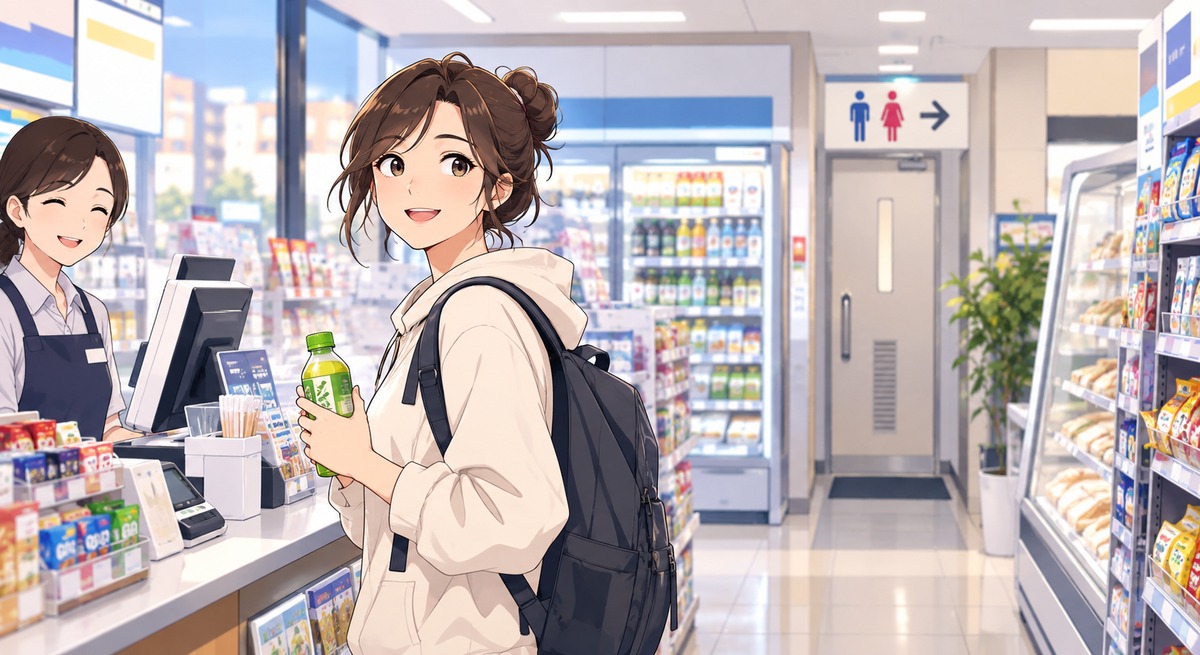
When to ask staff first
If you're walking in specifically to use the restroom rather than to shop, a short heads-up to staff is a reasonable habit, especially at a store where a sign requests it. If you need to ask, a simple phrase is:
- English: "Can I use the restroom?"
- Japanese: トイレを使ってもいいですか? (Toire o tsukatte mo ii desu ka?)
Asking isn't required everywhere, but it costs nothing and avoids any awkwardness at a store that does expect it.
When the restroom isn't available
Sometimes there simply isn't a customer restroom, or it's closed when you need it. In that case, the practical options are the same ones locals use: train stations, larger commercial buildings, and department stores in Japan commonly have public restrooms that don't involve asking anyone, and parks often have public facilities as well. These aren't a replacement for convenience-store restrooms specifically, just other normal options that exist alongside them.
If you want to buy something, keep it small
If you do want to buy something afterward as a courtesy, the point isn't to pay for the restroom -- there's no official price for it, and no chain expects one. A drink, a small snack, or a pack of gum covers the gesture. There's no reason to buy something expensive or something you don't actually want; an unnecessary purchase doesn't make the gesture more meaningful, it just spends more money than the situation calls for.
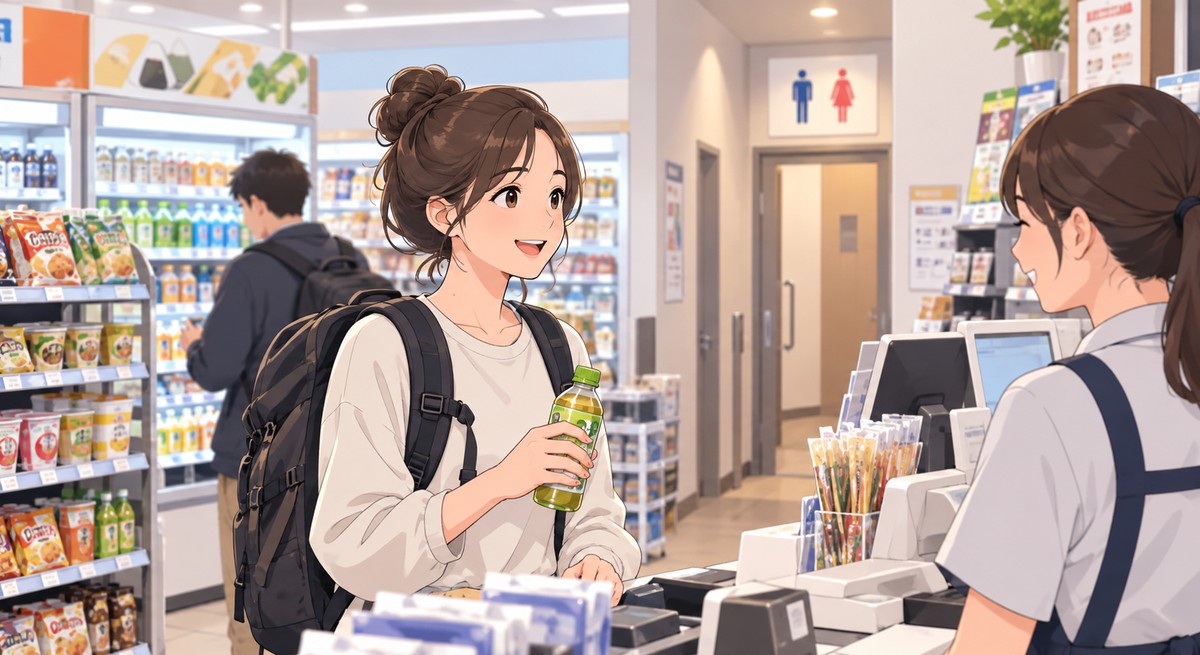
Some visitors buy a small drink or snack afterward as a personal courtesy -- not because any chain requires it.
What not to assume
A few things worth not carrying with you as fixed rules: that every convenience store in Japan has a restroom, that buying something is legally or officially required anywhere, that a store without a visible restroom is being unusually strict, or that declining to buy something after using the restroom is rude. None of that holds up against what the chains themselves say -- it's closer to a personal courtesy some people practice than a standard everyone is expected to follow.
Quick checklist
- Restroom available with no sign or requirement: use it, no purchase needed.
- Sign says "customers only" or asks you to speak to staff: follow it, or ask before using the restroom.
- No restroom or signage visible: it likely isn't offered there -- try a train station, department store, or park instead.
- Restroom temporarily unavailable: that's normal, not a rejection aimed at you specifically.
- Want to show a small courtesy afterward: a drink or a cheap snack is enough -- buying something is a personal option, not something the chains I checked require. For more on how convenience stores in Japan work day to day, Why Japan's guide to convenience store food covers the buying and eating side of the same stores.