If you walk into a Japanese supermarket in the evening, you may notice small colored stickers appearing on bento boxes, prepared side dishes, and sushi trays, each marking the item down from its original price. In some stores, items may be marked down further later in the day if stock is still left. It looks like a system, and in a sense it is -- but it is not a nationwide schedule you can set your watch to.
Short answer
Many Japanese supermarkets mark down some prepared foods later in the day, as their selling window for that item gets shorter. There is no universal markdown time. The timing, the size of the discount, and whether a discount appears at all depend on the specific store, its closing time, how much stock is left, the day of the week, and even the weather -- not a fixed clock hour that applies everywhere.
What gets discounted
Among the products visitors may see marked down later in the day are:
- Bento (boxed meals)
- Prepared side dishes / deli items (惣菜, sozai) -- fried foods, salads, simmered dishes
- Sushi
- Bakery items made fresh that day
- Some fresh fish and meat, depending on the store
This article focuses on bento, prepared dishes, and sushi, since they're what most visitors notice first. Not every product category is discounted the same way, and a complete list of what always gets marked down would be misleading -- what's discounted on a given evening depends on what didn't sell that day, which changes store by store and day by day.
What the stickers actually mean
A few terms are worth recognizing on sight:
- 値引き (nebiki): markdown or discount, the general term
- ○%引き: "○% off"
- 半額 (hangaku): half price
- ○円引き: a fixed-yen reduction, such as 100円引き ("100 yen off"), rather than a percentage
Seeing a sticker with a specific percentage or 半額 tells you the current discount on that specific item at that moment -- it doesn't tell you what discount, if any, will appear on a different item, at a different store, or later that same evening.
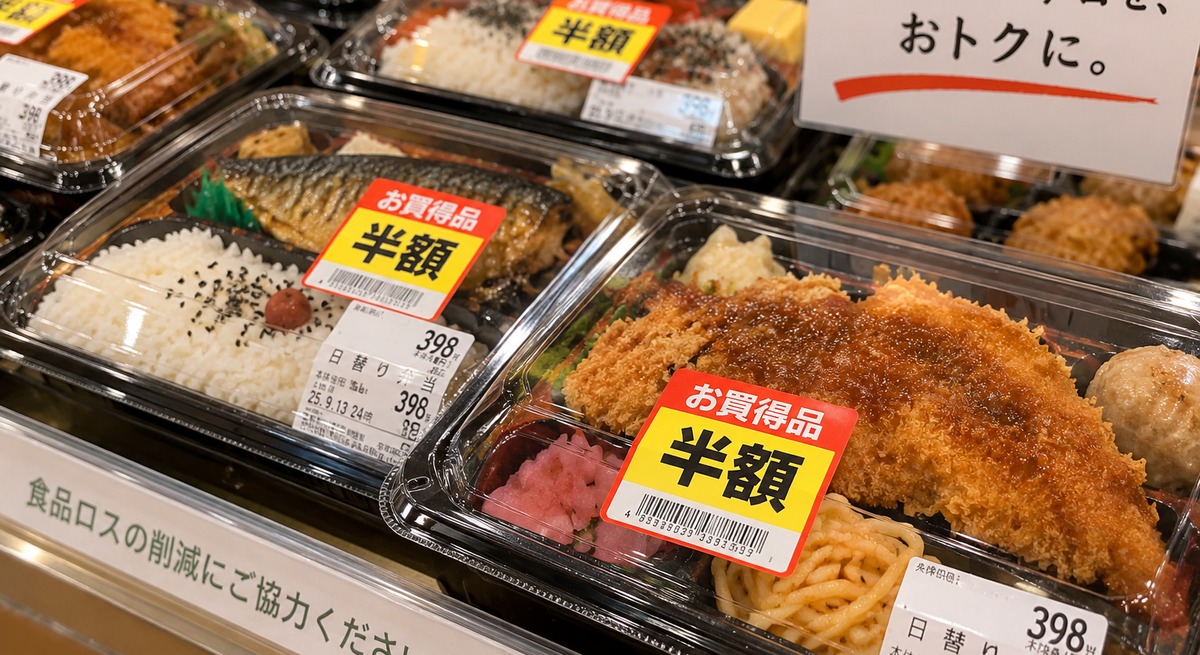
AI-generated image, not a photo of a real store. Discount stickers like these mark down specific items at specific stores -- not a fixed schedule everywhere.
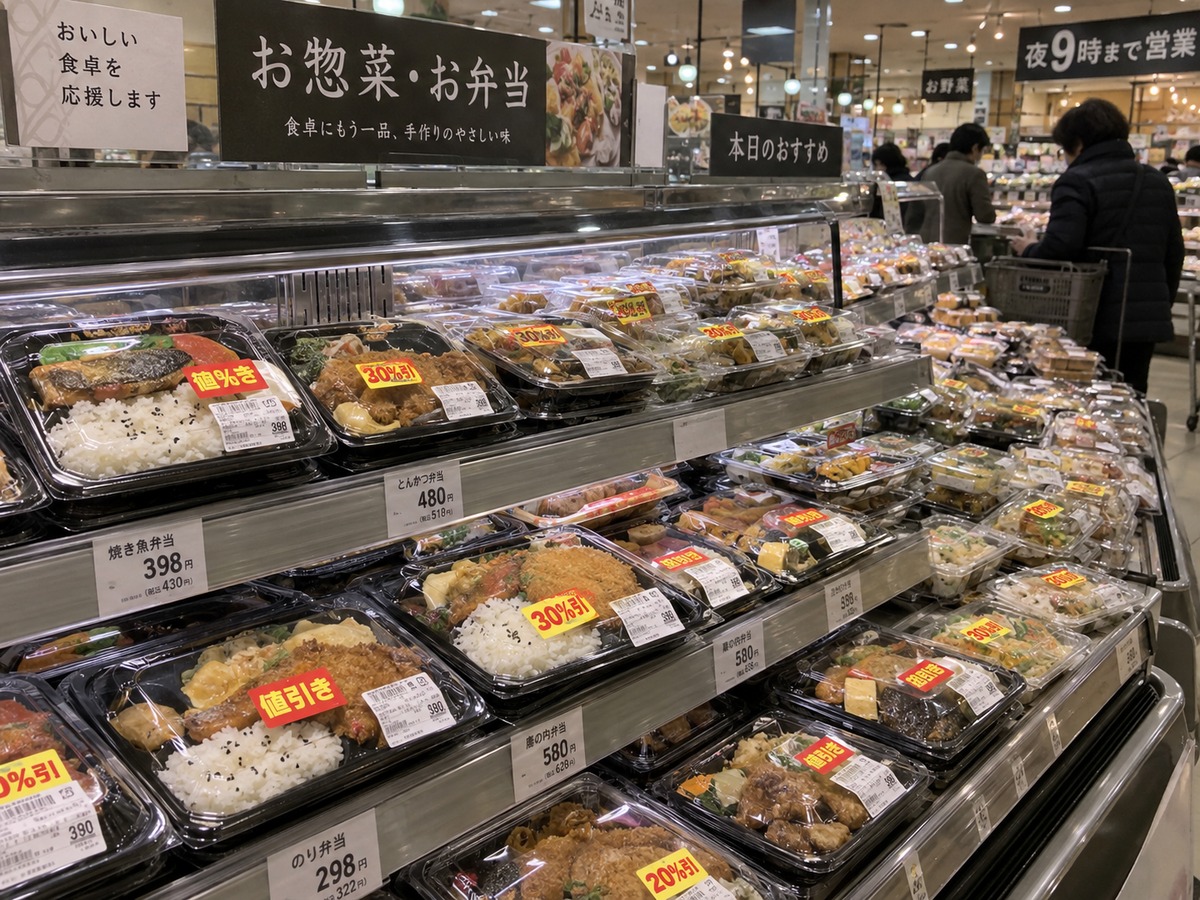
AI-generated image, not a photo of a real store. Supermarkets often reduce prepared foods later in the day, although timing and discount rates vary by store.
When markdowns actually happen
This is the part most worth getting right: markdown timing is not decided by the clock alone. According to a small-business guidance resource used across Japan's retail industry (J-Net21, run by Japan's SME support organization), store staff estimate how much of a perishable item they're likely to sell using point-of-sale sales history plus outside factors like nearby events and even temperature. Discounting too late, after that day's sales peak has already passed, is described as a common mistake, precisely because it means offering a bigger discount to fewer remaining customers.
In other words, a store isn't waiting for 7pm or two hours before closing as a rule. It's watching how much stock is left against how much it expects to sell before the store closes, and adjusting price to move that inventory before it has to be thrown away. A store that closes at 9pm, a 24-hour store, and a store that closes at 11pm will naturally reach that decision point at different times, even on the same evening, even within the same chain.
One real example of this being formalized: Aeon Retail, working with IBM Japan, built an AI pricing system for its prepared-foods department that suggests a discount rate to staff based on that item's past sales performance, the day's weather, and store traffic, then prints the price sticker automatically once a staff member scans the barcode and enters the remaining shelf count. Aeon Retail reports the system cut its loss rate by more than 10% since introducing it. This is one specific chain's own system, not a description of how all supermarkets set prices -- most stores, including many that don't use anything like it, still mark down prepared foods based on staff judgment of that day's stock and sales.
Why supermarkets do this
Markdown pricing serves two purposes at once, and it's worth understanding both.
- Moving inventory before it has to be thrown away: highly perishable foods such as bento and prepared dishes are typical examples of foods labeled with a use-by date (消費期限), while foods that deteriorate more slowly are generally labeled with a best-before date (賞味期限). Stores also set their own internal 販売期限 (sales deadline), earlier than the printed date, to make sure a customer still has enough time to eat the item safely after buying it.
- A quieter, related effort -- reducing food loss: Japan's Consumer Affairs Agency, along with the Ministry of Agriculture, Forestry and Fisheries and the Ministry of the Environment, has promoted a related but different practice since 2021 called てまえどり ("front-shelf picking"): encouraging shoppers to take the item closest to its sales deadline from the front of the shelf, at its regular price, rather than reaching further back for a later-dated one. It's aimed mainly at daily-restocked shelves like bread and prepared foods. Unlike a discount sticker, てまえどり doesn't change the price -- it just asks shoppers to choose the soon-to-expire item on its own, unmarked-down merits.
Not every supermarket runs a formal food-loss program, and a markdown sticker doesn't always mean the store is participating in one -- sometimes it's simply standard inventory management. Buying a discounted item is a reasonable, welcome choice, but it isn't automatically an environmental good deed on its own.
Author's note: this article is about supermarkets specifically, because their prepared-food sections tend to be larger and their markdown habits more visible. That doesn't mean convenience stores never discount food -- FamilyMart, for one, has its own nationwide discount-sticker program on bento and rice balls. For more on convenience-store food itself, Why Japan's guide to convenience store food covers buying, heating, eating, and disposing of it -- a related but separate topic from the supermarket markdowns covered here.
Is it worth waiting for a bigger discount?
This is the real trade-off, and it cuts both ways.
- Go earlier: you'll generally have a wider selection, but the item you want may still be full price.
- Go later, closer to closing: you may encounter deeper markdowns on whatever is still left, but the selection will usually be smaller and there is no guarantee of a larger discount.
- Either way: there's no guarantee a specific item will ever get marked down. A store may sell out of it, stop discounting for the night, or apply a smaller discount than you were hoping for.
A simple visitor guide
- If you want the widest choice: go earlier in the day and accept a smaller discount, or none at all.
- If you want a chance at a deeper markdown: check the prepared-food section later in the day, but expect fewer options by then.
- If you see something you actually want at a discount: buy it, rather than assuming it will still be there, or become cheaper, if you wait.
- Don't wait around for staff to apply a discount, follow an employee who's re-stickering shelves, or ask staff to mark something down for you -- discount timing is an internal store decision, not something requested at the register.
A note on food safety
A discounted price doesn't mean a food-safety compromise -- it reflects the store managing a short sales window, not a quality problem. Once you've bought it, treat it the same as any other prepared food: follow any printed storage instructions, eat it by the printed use-by time, and refrigerate it if you're not eating it right away.
Why this matters for visitors
For a traveler, an evening stop at a Japanese supermarket's prepared-food section can mean a cheaper dinner than a restaurant, a look at what people actually eat day-to-day, and food that's easy to bring back to a hotel room. It's a genuinely useful habit -- just not a trick, a schedule, or a guarantee. Go in expecting variety and the possibility of a discount, not a specific percentage at a specific hour, and you'll get the most out of it either way.
Sources
- Consumer Affairs Agency (消費者庁), てまえどり campaign announcement: caa.go.jp
- National Supermarket Association of Japan (一般社団法人全国スーパーマーケット協会): super.or.jp
- J-Net21, POS-based food-waste reduction guidance: j-net21.smrj.go.jp
- IBM Japan / Aeon Retail joint press release on "AIカカク": jp.newsroom.ibm.com
- FamilyMart press release on its discount-sticker program: family.co.jp
- Ministry of Agriculture, Forestry and Fisheries (MAFF), on the food-industry "3分の1ルール": maff.go.jp