You may hear maji in anime, YouTube comments, LINE chats, or casual conversation with Japanese friends. It often means “seriously?” or “for real?”, but the important point is tone. Maji is very casual, so it can sound natural with close friends and too rough in polite situations.
Before copying this slang, check who you are talking to and how casual the situation is.
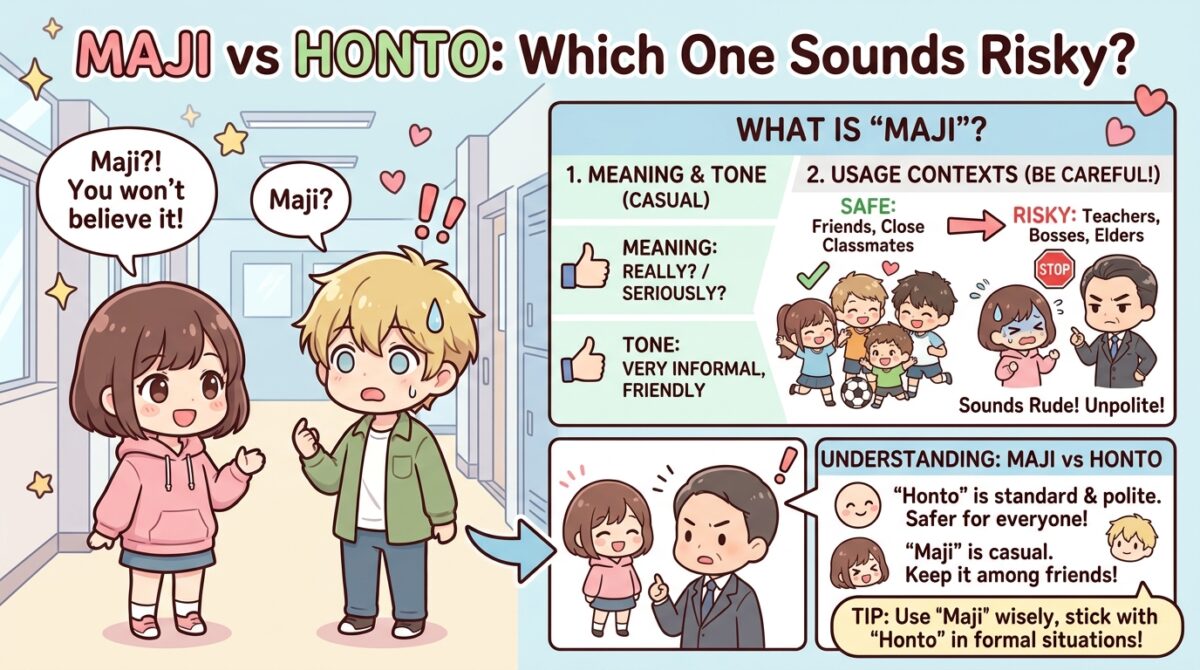
Quick Answer: What Does Maji Mean?
Key point: Maji is a casual slang word for strong surprise, disbelief, or emphasis.
Before you use it: The word itself is easy to understand, but the social tone is not always safe.
まじ (maji) is a very casual Japanese slang word that can mean “Seriously?”, “Really?”, “No way!”, or “For real!” depending on the situation. It is common among friends, classmates, close coworkers, and in casual online spaces.
Compared with ほんと (honto), maji feels more direct and emotional. That is why it can sound natural in a relaxed conversation, but awkward or rude with strangers, teachers, bosses, customers, or anyone you should speak to politely.
Maji vs. Honto: The Core Difference
Both まじ (maji) and ほんと (honto) can be translated as “really,” but they do not feel the same in Japanese. Honto is broader and safer. Maji is more casual, more emotional, and more slang-like.
| Point | maji | honto |
|---|---|---|
| Core meaning | Seriously? / For real? / Really? with a strong casual feeling | Really / true / actually |
| Nuance | Direct, emotional, slangy, sometimes rough | Softer, more neutral, easier to use |
| Common context | Friends, casual chats, SNS, reactions to surprising news | Everyday conversation, confirmation, agreement, polite forms |
| Risk level | Higher if the relationship is not close | Lower, especially when softened politely |
| Learner safety | Use only in clearly casual situations. | Use this when you are unsure. |
When this can sound wrong: Avoid maji with strangers, superiors, clients, teachers, formal writing, or any situation where polite Japanese is expected. If you are not sure, use honto, hontou desu ka, or another neutral phrase instead.
| Point | まじ (maji) | ほんと (honto) |
|---|---|---|
| Formality Level | Very casual. It often sounds like a quick slang reaction. | Casual to neutral. It can also be made polite with です/ます, such as ほんとですか? |
| Usage Context | Close friends, classmates, peers, family, or very relaxed settings. | Friends, acquaintances, and many everyday situations. Safer when the relationship is not very close. |
| Emotional Tone | Strong surprise, disbelief, excitement, or emphasis. | General confirmation, surprise, agreement, or sincerity. |
| Implied Relationship | Suggests closeness and informality. | Can keep a little more distance and politeness. |
| Origin | Often explained as a slang form connected to 真面目 (majime), meaning serious. | Shortened form of 本当 (hontou), meaning truth or reality. |
When Maji Sounds Natural
Maji works best when the mood is casual and the speaker is reacting honestly in the moment. It is not a word for careful formal speech. It is closer to something you say quickly when you are surprised, impressed, doubtful, or strongly agreeing with someone.
Situation: A casual conversation between close friends
Japanese: 「え、まじで?あの店もう閉まっちゃったの?」
English: “Wait, seriously? That store already closed down?”
Why it works: The speaker is reacting to surprising news in a relaxed conversation, so the casual tone fits.
Expressing Surprise or Disbelief
This is one of the most common uses of maji. When a friend tells you something unexpected, maji? or maji de? can sound like “Seriously?” or “Are you for real?”
Example: Your friend tells you they just won concert tickets.
Reaction: 「まじで?すごいじゃん!」 (Maji de? Sugoi jan!) - "Seriously?! That's amazing!"
Emphasizing a Point
Maji can also make a statement sound stronger. In this use, it is close to “seriously” or “really” in casual English.
Example: Describing how busy you are to a classmate.
Statement: 「今週、まじで忙しいんだ。」 (Konshuu, maji de isogashii n da.) - "This week, I'm seriously busy."
In Casual Conversations and Chats
You will often see maji in LINE messages, SNS comments, casual videos, and everyday conversation between people who are comfortable with each other. It helps show emotion, but that same directness is the reason learners should be careful with it.
Who Uses Maji?
Maji is common in casual speech, especially among younger people, students, and friends. Adults may also use it in relaxed settings, but it still keeps a slang-like feeling. In a workplace, classroom, or service situation, it depends heavily on the relationship and atmosphere.
For Japanese learners, the safest rule is simple: use maji only when you would also feel comfortable using very casual English like “for real?” with that person.
Polite Alternatives and Safer Ways to Say “Really?”
If you are not sure whether maji is appropriate, these expressions are usually safer:
- ほんと (honto) / 本当に (hontou ni): A common and flexible way to say “really” or “truly.” It can be casual, but it is less rough than maji.
- 本当ですか? (hontou desu ka?): A polite way to say “Really?” or “Is that true?” Useful with teachers, coworkers, customers, or people you do not know well.
- そうなんですか (sou nan desu ka): A polite and calm response meaning “Oh, is that so?” It is useful when you want to show interest without sounding too casual.
- 驚きました (odorokimashita): A polite way to say “I was surprised.” This is better when you want to express surprise in a respectful tone.
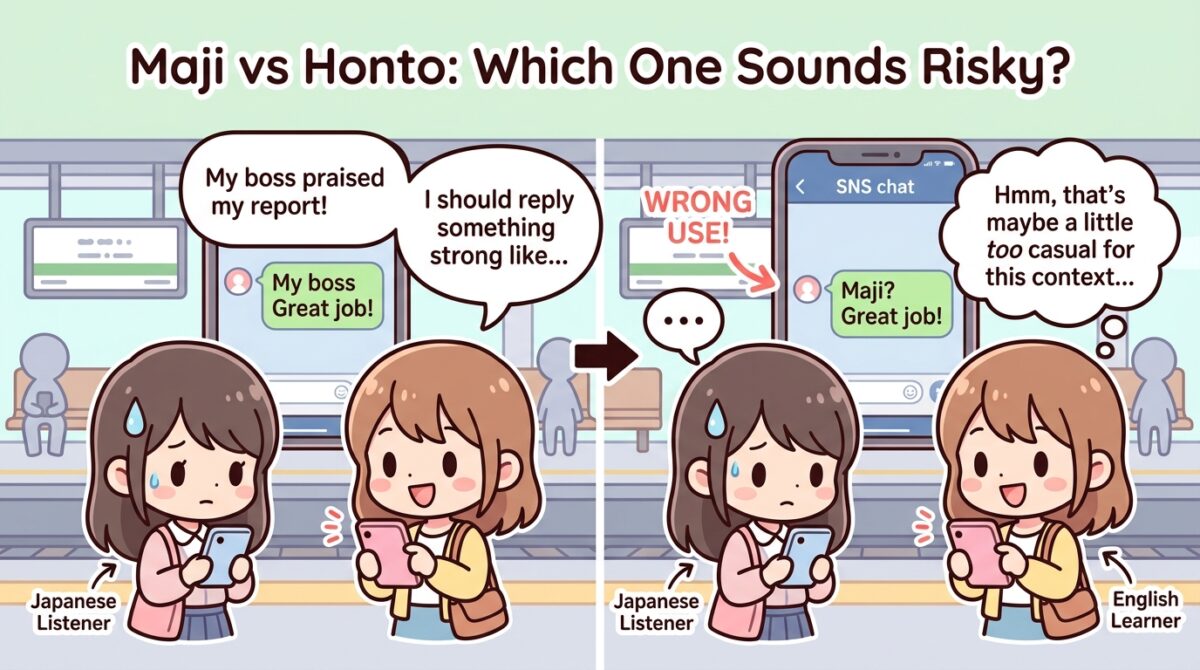
Common learner mistake: Ken, an American student in Tokyo, was excited to tell his part-time job supervisor about a surprisingly good sales result for the day. He approached her excitedly and blurted out, 「店長、今日の売上、まじで最高でした!」 (Tenchou, kyou no uriage, maji de saikou deshita!). He meant "Manager, today's sales were seriously the best!"
Why it sounded awkward: The feeling was positive, but maji was too casual for speaking to a manager. In a workplace hierarchy, that one word can make an otherwise good sentence sound careless.
Better: 「店長、今日の売上は本当に素晴らしかったです!」 (Tenchou, kyou no uriage wa hontou ni subarashikatta desu!) or 「店長、本日売上が大変好調でした!」 (Tenchou, honjitsu uriage ga taihen kouchou deshita!) for a more formal business expression.
Real-Life Example Scenarios
Situation: Two close friends, Haruka and Kenji, are chatting on LINE after hearing about a mutual friend's sudden trip overseas.
Japanese: ハルカ: ねぇ、タカシが来週からヨーロッパに行くって!
ケンジ: まじで?!聞いてないんだけど!
English: Haruka: Hey, Takashi is going to Europe starting next week!
Kenji: Seriously?! I hadn't heard anything!
Why it works: This is a casual conversation between close friends on a messaging app. Kenji's "maji de?!" matches his surprise and sounds natural in that relationship.
Risky situation: A university student, Akira, is presenting his research project to his professor and a panel of evaluators. He wants to emphasize a key finding.
Japanese: 「このデータは、まじで重要な発見だと思います。」
English: "I believe this data is a seriously important finding."
Why it may sound risky: In an academic presentation, maji de sounds too casual. A more suitable expression would be 非常に (hijou ni), 大変 (taihen), or 本当に (hontou ni), depending on the sentence.
Listen to the Japanese Example
Text: まじでこれ全部一人で食べたの?
English: Did you really eat all of this by yourself?
Text: この映画、まじで感動したよ!
English: This movie really moved me!
TTS Examples for Listening Practice
Listen to how "maji" sounds in short, natural expressions:
Japanese: まじかよ!
English: No way!
Japanese: まじで言ってる?
English: Are you serious?
Maji in SNS and Texting
Maji is very common in Japanese texting and social media. You may see it written in hiragana as まじ, in katakana as マジ, or with extra punctuation when someone is surprised.
In casual chats, it can feel completely normal. In official emails, business messages, customer service, or formal posts, it usually feels too rough. Online Japanese still has social distance, so the same rule applies: the closer and more casual the relationship, the safer maji becomes.
Summary: How to Use Maji Safely
Maji is useful because it sounds natural in real casual Japanese. It can express surprise, disbelief, excitement, or strong emphasis in a short way. But it is also very informal, so learners should not use it as a general replacement for “really.”
When speaking with close friends, maji? can sound natural. When speaking with teachers, bosses, customers, strangers, or anyone you should respect, choose honto, hontou desu ka, or another polite expression instead.
If you are:
- a beginner: remember that maji is casual slang, not a neutral word for “really.”
- a traveler: use hontou desu ka? when the relationship is unclear.
- working in Japan: avoid maji in business situations unless the atmosphere is clearly relaxed and informal.
FAQ
What does maji mean?
Maji means “seriously?”, “really?”, “for real?”, or “seriously” depending on the sentence. It is casual slang, so the relationship and situation matter.
Can Japanese learners use maji?
Yes, but only in casual situations with people you know well. If you are not sure, use honto or hontou desu ka instead.
When does maji sound natural?
It sounds natural in casual reactions, SNS comments, LINE chats, and relaxed conversations with friends or peers.
Is maji okay in formal settings?
Usually no. In formal settings, maji can sound too casual or rough. Use a neutral or polite expression instead.
What is a safer alternative to maji?
A safer alternative is honto in casual situations or hontou desu ka? in polite situations.