Scope: This page covers お疲れ様 and its polite forms across work, school, clubs, and shared tasks. For the shortened お疲れ used in casual messages, use the separate texting guide.
You heard this phrase in Japan. But what does otsukaresama really mean? The translation may look simple, but the real challenge is tone. お疲れ様 can mean “good work,” “thanks for your effort,” “see you after work,” or simply a warm acknowledgment after someone has done something. It is common in workplaces, schools, clubs, and casual conversations, but the best wording depends on relationship, timing, and politeness level.
Why “good job” is too narrow
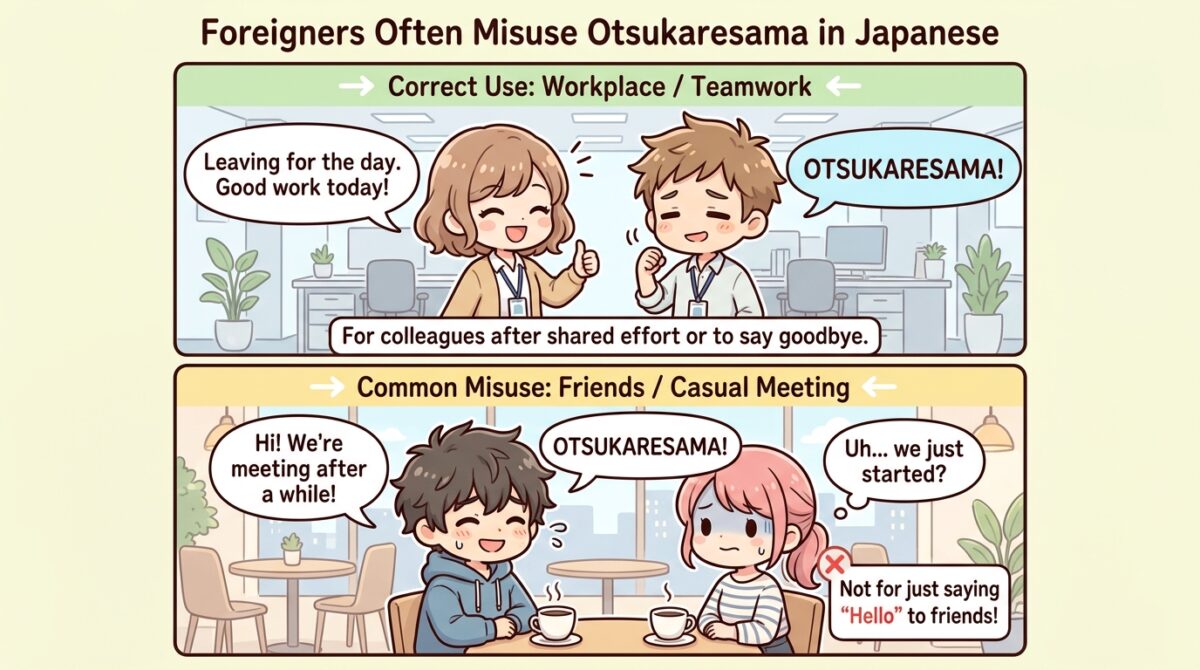
A foreign learner hears otsukaresama and translates it only as “good job.” Then they use it after almost anything, even when no effort or shared activity is involved.
The Japanese listener may understand the intention, but the phrase can feel slightly out of place if there is no work, effort, task, practice, meeting, or shared context behind it.
Safer: Use お疲れ様です in many workplace or polite situations, and use お疲れ様 more casually with friends, classmates, coworkers, or people you are close to.
Keep reading before you use it in a chat, at school, or at work.

Choose the form before the translation
Otsukaresama, written in Japanese as お疲れ様, is one of the most useful everyday Japanese expressions. It acknowledges someone’s effort, time, work, or participation. Depending on the situation, it can feel like “good work,” “thanks for your effort,” “you must be tired,” “thanks for today,” or even a friendly workplace greeting.
The key is that お疲れ様 is not just a direct translation of one English phrase. It works best when there is some sense of effort, completion, shared work, practice, responsibility, or time spent together.
Three moments that create shared-effort context
Here are natural conversation-style examples to help you understand how this kind of expression feels in real situations.
- Leaving the office: A: お先に失礼します。 (Osaki ni shitsurei shimasu. — “I’ll head out first.”) B: お疲れ様です。 (Otsukaresama desu. — “Thanks for your work today.”) This is the standard exchange when someone leaves before others.
- When a meeting ends: 皆さん、お疲れ様でした。 (Minasan, otsukaresama deshita. — “Thank you all for your work today.”) でした fits because the meeting is over.
- Opening a message to a coworker: お疲れ様です。明日の資料の件ですが… (Otsukaresama desu. Ashita no shiryō no ken desu ga… — “Hi, about tomorrow’s materials…”) Common inside a company; do not open emails to clients this way.
The shared-effort feeling behind お疲れ様
お疲れ様 literally relates to tiredness or effort, but in real life it is much warmer and broader than “you are tired.” It is used to recognize that someone has done something, spent time, participated, helped, worked, practiced, or finished a task.
For learners, the safest first step is to understand the feeling behind the phrase rather than translating it word for word. The same expression can sound friendly, polite, professional, or too casual depending on the form you choose.
お疲れ様 vs. お疲れ様です vs. お疲れ様でした
These forms are closely related, but the tone changes.
- お疲れ様: Casual and friendly. Often used with friends, classmates, close coworkers, or people of equal or lower status.
- お疲れ様です: Polite and very common in workplaces. Often used as a greeting, acknowledgment, or message opener/closer among coworkers.
- お疲れ様でした: Polite and often used after something has finished, such as a meeting, event, shift, class, or project.
After work, practice, or a shared task
お疲れ様 sounds natural when there is effort, work, practice, travel, help, participation, or completion involved. It is often used after work, after a class, after club activities, after a meeting, after a performance, after a long day, or when someone has helped with something.
In casual chats, it can also be used warmly to recognize someone’s hard day. In workplaces, the polite form お疲れ様です is extremely common, but you should still be careful with customers or people outside your organization.
When no effort or relationship is shared
The phrase is useful, but it is not perfect for every situation. Be especially careful in these cases:
- With customers or clients: お疲れ様です is usually for people inside the same workplace or group. For customers, ありがとうございます or いつもありがとうございます is often safer.
- With very high-status people: Some workplaces use it normally with superiors, but in very formal settings, a more respectful phrase may be better.
- When no effort is involved: If nothing was done, completed, or shared, the phrase may feel random.
- When translating directly from English: Do not use it every time you want to say “good job.” Japanese has different expressions depending on the situation.
- Do not swap in ご苦労様: ご苦労様(です) is generally heard as something a superior says to someone below them. To a manager or senior, use お疲れ様です.
What changes between coworkers, managers, and clients
In Japanese workplaces, お疲れ様です is one of the most common phrases. Coworkers may use it when arriving, leaving, starting a message, ending a message, passing someone in the office, or acknowledging work. However, it is mainly an in-group workplace phrase.
For clients, customers, or people outside your company, it is usually safer to choose expressions such as ありがとうございます, お世話になっております, or a specific thank-you depending on the situation.
Relationship-based examples
Situation: Two coworkers finish a long meeting.
Japanese: お疲れ様でした。今日の会議、長かったですね。
English: Good work today. That meeting was long, wasn’t it?
Why it works: The meeting is finished, both people shared the effort, and the polite form fits a workplace situation.
Situation: Two friends finish club practice.
Japanese: 今日の練習きつかったね。お疲れ様。
English: Practice was tough today. Nice work.
Why it works: The speakers are close, and the phrase naturally acknowledges shared effort.
Risky situation: A learner says お疲れ様 to a customer after the customer buys something.
Why it may sound risky: The customer is not usually treated as an in-group coworker or teammate. In this situation, ありがとうございます or ありがとうございました is much safer.
Hear the politeness difference
Text: 今日も一日よく頑張ったね、お疲れ様。
English: You worked hard all day today, good job.
Text: 遅くまでお疲れ様、無理しないでね。
English: Thanks for working so late, don't overdo it.
Do not turn it into an automatic greeting
Do not use it as a universal translation of “good job,” “hello,” or “thank you.” The safest choice depends on effort, relationship, timing, and whether the listener is inside or outside your group.
When talking to customers or clients, a clear thank-you is often safer than お疲れ様です.
When thanks is clearer than お疲れ様
- ありがとうございます: Use this when you simply want to say “thank you.”
- ありがとうございました: Use this after someone helped you or after a service is completed.
- お世話になっております: Use this in business emails or formal communication with people outside your company.
- お疲れ様です: Use this politely with coworkers or people in the same group.
- お疲れ様でした: Use this after a meeting, event, shift, class, practice, or task has ended.