Scope: This page is about マジで as an emotional reaction or adverb in texts and group chats. For choosing between the words マジ and 本当, use the separate comparison guide.
You saw this word in a group chat. But is majide safe to use? The translation may look simple, but the tone is the real problem. マジで (majide) can sound natural when reacting to a friend's news, confirming casual plans, expressing enthusiasm in a group chat, or showing lighthearted disbelief. However, it can sound awkward or rude with strangers, superiors, clients, formal writing, or any situation where polite Japanese is expected.
マジで adds an openly casual stance
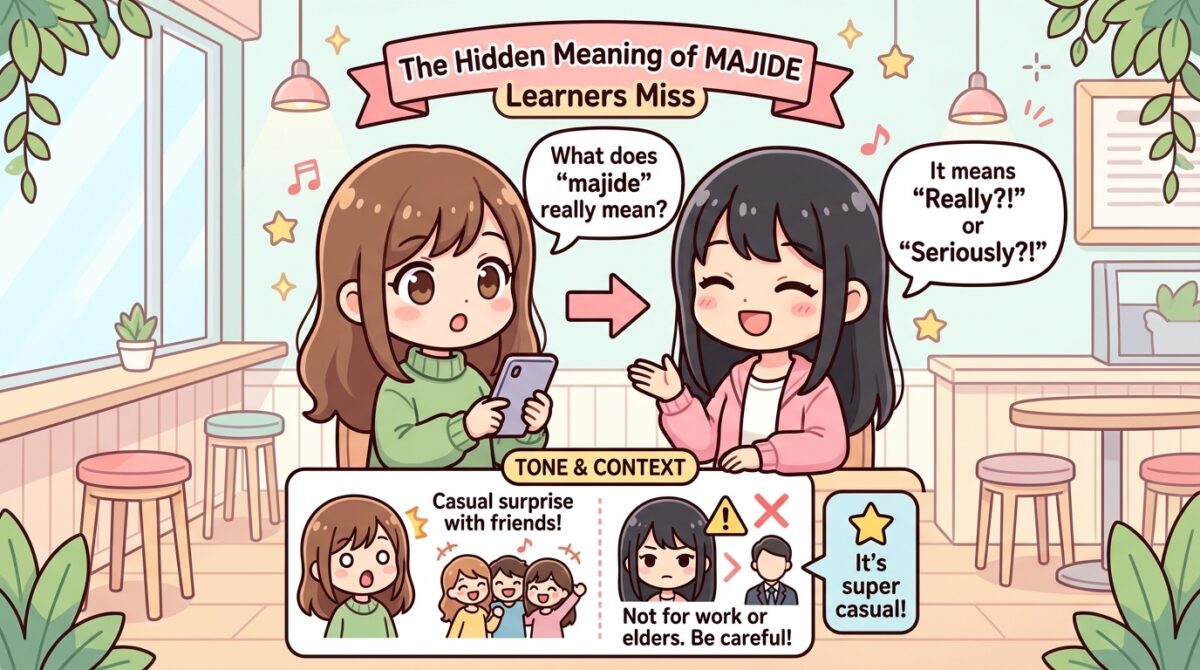
The key point: majide (マジで) is a casual reaction or emphasis meaning “really,” “seriously,” “for real,” or “no way.” It adds emotion to what the speaker says, but tone and relationship matter.
Reaction, disbelief, and emphasis
In short, マジで (majide) is highly casual Japanese slang for “really,” “seriously,” “for real,” “no way,” or “totally.” It is useful for expressing surprise, strong agreement, disbelief, excitement, or casual emphasis with people you are close to.
However, it is not a polite confirmation phrase. In formal settings or when talking to someone above you, マジで can sound too rough, too direct, or even challenging.
Before you say it: Avoid it with strangers, superiors, clients, formal writing, or any situation where polite Japanese is expected. If you are unsure, use a neutral expression instead. It can make people uncomfortable if the relationship is not close.
Why the same translation can sound stronger
While majide is often translated as “really” or “seriously,” its real meaning depends on emotion and social distance. It is not just about the literal meaning; it also signals a casual, familiar tone.
| Situation | Safer use | Risky use |
|---|---|---|
| With close friends | Reacting to a friend's news, confirming plans, expressing enthusiasm in a group chat, or showing lighthearted disbelief. | Still check tone; jokes can sound sharper than intended. |
| With boss, teacher, or client | Use a neutral or polite expression instead. | マジで can sound too casual, blunt, or challenging. |
| Online or SNS | Works best when the audience understands casual slang. | Can be misread without facial expression or relationship context. |
| Formal situations | Avoid slang and use polite wording. | Usually too casual for serious or professional communication. |
Majide is often used to:
- express genuine surprise or disbelief in a friendly way
- show strong agreement, like “I totally agree”
- emphasize a point casually, like “really” or “seriously”
- confirm casual plans or intentions with a close peer
The nuance shifts heavily with context and implied tone, even in text. Foreign learners sometimes use it too intensely, making it sound like an interrogation rather than casual enthusiasm.
Relationship matters more than a fixed age rule
Majide is mainly used in casual Japanese, especially in relaxed peer-to-peer settings. It appears often in SNS, LINE chats, Instagram DMs, X posts, casual conversations, manga, videos, and everyday speech among friends or classmates.
It comes from マジ, meaning “serious” or “real,” and became a common casual expression in youth language and online communication.
Group-chat context, punctuation, and intensity
Close peers who already speak casually
To sound natural and friendly, use it in casual contexts where the listener understands your tone.
Situation: Group chat among friends discussing weekend plans or reactions to news.
Japanese: A: 明日のイベント、マジで行く? B: マジで行く!楽しみ!
English: A: Are you totally going to tomorrow's event? B: I'm totally going! Can't wait!
Why it works: The speakers are close, the topic is casual, and the phrase shows friendly enthusiasm.
- Reacting to exciting news from a friend: マジで!? すごいじゃん! — “No way!? That's awesome!”
- Expressing strong agreement with a peer: それマジでわかる! — “I totally get that!”
- Confirming casual plans with friends: 明日のランチ、マジでいいよ! — “Tomorrow's lunch is totally fine!”
- Adding casual emphasis: マジで美味しいから食べてみて! — “It's seriously delicious, so try it!”
When texting, pairing majide with emojis like 😂, ✨, or 🥺 can soften its intensity or clarify your emotion.
Requests, customer contact, and formal confirmation
Avoid マジで in formal settings, with superiors, with clients, in business writing, or when you want to sound calm and polite. In those cases, choose 本当に, 本当ですか, 確かに, or a more complete polite sentence.
A reaction is not a polite verification question
Risky situation: A new intern is asking a senior colleague about a deadline for a task at work via Slack.
Japanese: A: 山田さん、この資料の提出、マジで今日までですか?
B: え、はい、今日までですけど…?
Common learner mistake
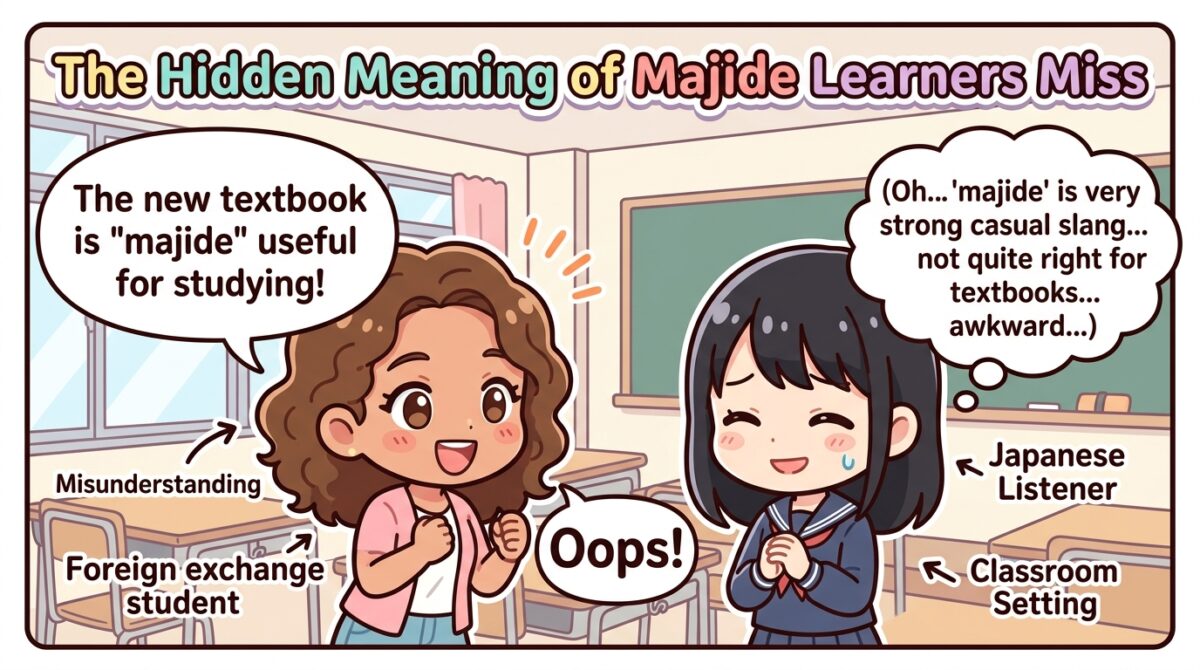
Using マジで in a formal or workplace context can sound overly direct or even rude. The grammar may be correct, but the social tone can be wrong.
English: A: Yamada-san, is this document submission seriously due today?
B: Uh, yes, it's due today...?
Why it may sound risky: With a senior colleague, マジで can sound overly casual and may imply disbelief or challenge. A more polite phrasing would be safer.
Hear surprise without overreading the translation
Text: マジでこのケーキ、めっちゃ美味しいね!
English: This cake is seriously super delicious!
Text: マジでこの映画、すごく面白いよ。
English: This movie is really very interesting.
Do not use マジで as a universal filler
Many learners understand majide as “really,” then use it too often. The problem is that マジで? can sound like surprise, disbelief, challenge, or strong emotion depending on voice and context.
When you are not close to the listener, a calmer phrase is usually safer.
本当ですか and specific confirmation questions
When majide feels too casual or risky, use these safer alternatives:
- 本当に? (hontō ni?)
- When to use it: For “Really?” or “Is that true?” in a more standard way.
- Why it sounds safer: It is less slangy than マジで and works in a wider range of situations.
- 本当ですか? (hontō desu ka?)
- When to use it: When you want to ask “Really?” more politely.
- Why it sounds safer: It is more appropriate with teachers, coworkers, or people you do not know well.
- そうですね! (sō desu ne!)
- When to use it: For “That's right” or “I agree” in a polite way.
- Why it sounds safer: It carries no strong slang feeling and sounds polite.
- すごい! (sugoi!)
- When to use it: For “Amazing!” or “Wow!” when reacting to something impressive.
- Why it sounds safer: It expresses excitement without the roughness that マジで can sometimes have.
- 確かに (tashika ni)
- When to use it: For “True,” “Indeed,” or “That makes sense” when agreeing with a point.
- Why it sounds safer: It sounds calmer and more thoughtful than マジで.