Scope: This is a comparison of two social-structure labels, not a general slang-safety template. The decision is whether you mean ranking among students, an organised faction, or simply relationships in a group.
You may have seen this term in manga, dramas, SNS posts, or discussions about Japanese school life. スクールカースト (school caste) is not just a simple translation of “cliques.” It usually refers to an unspoken social ranking inside a class or school, so the tone can feel sharp, sensitive, or critical depending on the situation.
First decide: hierarchy or faction?
スクールカースト (school caste) refers to an informal social hierarchy among students, especially in a class or school environment. It describes how students may be treated as “higher” or “lower” in the group based on popularity, appearance, confidence, friend groups, club status, or social influence.
It is understandable in casual conversation, SNS, manga, dramas, and social commentary, but it can sound too blunt or sensitive in formal situations.

Key point: This article compares how スクールカースト and 派閥 (habatsu) feel in real Japanese conversations.
Before you use it: The tricky part is not only the meaning, but also whether the topic is too direct for the person you are talking to.
Keep reading before you use it in a chat, school discussion, or workplace conversation.
What is スクールカースト (School Caste)?
スクールカースト (school caste) refers to the unspoken social hierarchy or pecking order within a Japanese school class or student body. It describes how students may be perceived as belonging to different social “levels,” which can affect friendships, group dynamics, confidence, bullying, exclusion, and classroom atmosphere.
It is widely understood, but it is not a light, harmless word in every situation. The term can sound analytical, critical, or emotionally loaded because it points to inequality inside student relationships.
Safe usage note: Avoid using it casually with strangers, teachers, superiors, clients, or in formal writing unless you are clearly discussing the concept itself. If you are unsure, use a more neutral expression such as 学校内の人間関係 or 生徒同士の関係.
How an unspoken student ranking works
Why the label can feel critical
スクールカースト is a Japanese borrowed-style expression used to describe informal social stratification in schools, especially middle schools and high schools. It suggests that students may be unconsciously or consciously ranked by factors such as popularity, appearance, communication skills, athletic ability, club activity, confidence, romantic status, or the influence of their friend group.
The word often carries a negative or critical nuance. It does not simply mean “friend group.” It suggests that some groups or students have more social power than others, and that this ranking may affect how people are treated.
Where the term appears—and who may be hurt by it
This term is commonly used by students, young adults, parents, educators, journalists, and online commentators when discussing school life and youth culture. You may see or hear it in:
- casual conversations among friends about school life
- SNS posts or online discussions about classroom dynamics
- manga, dramas, videos, and essays about student relationships
- commentary about bullying, exclusion, popularity, or social pressure
Because the topic can be sensitive, the safest approach is to use it when the conversation is clearly about social structure or school problems, not as a casual label for individual people.
School ranking is not the same as a faction
Ranking versus faction at a glance
Both スクールカースト and 派閥 (habatsu) can relate to groups and power, but they are not the same. スクールカースト describes a perceived ranking across the school or class. 派閥 describes a faction, clique, or group, often formed around shared interests, influence, loyalty, or conflict.
| Point | スクールカースト (School Caste) | 派閥 (Habatsu) |
|---|---|---|
| Core meaning | An unspoken social ranking or hierarchy among students | A faction, clique, or group within a larger community |
| Focus | Overall social position: who is treated as “high,” “low,” popular, ignored, or excluded | Group division: who belongs to which side, clique, or faction |
| Nuance | Often critical, sensitive, and linked to school pressure or inequality | Can be neutral or negative depending on context; often suggests internal politics |
| Common context | School life, youth culture, bullying, popularity, classroom dynamics | Schools, workplaces, politics, clubs, organizations, friend groups |
| Learner safety | Use carefully because it can sound blunt or heavy | Also use carefully, especially in workplaces, because it can imply politics or division |
Example with 派閥: 部活の中に派閥ができて、ちょっと気まずい。 (Bukatsu no naka ni habatsu ga dekite, chotto kimazui. — “Factions have formed in the club, and it’s a bit awkward.”)
What changes in commentary and private messages
On social media and in casual messages, スクールカースト is often used when people talk about memories of school, classroom status, bullying, popularity, or the uncomfortable feeling of being ranked by others.
- Casual online discussions: commenting on posts or videos about school life
- Personal chats: discussing past school experiences with close friends
- Social commentary: talking about pressure, exclusion, or youth culture
Even online, be careful when using it about real people. Calling someone “top caste” or “bottom caste” can sound cruel, judgmental, or insensitive.
Use the label only when ranking is the point
Sensitivity matters more than formality alone
As a rule of thumb:
- Safer contexts: casual conversations with close friends, informal online discussions, manga/drama commentary, or careful discussion of school social issues
- Avoid contexts: with strangers, teachers, superiors, clients, job interviews, formal presentations, or academic writing where neutral wording is expected
Why neither label belongs in casual workplace diagnosis
Not recommended as casual wording. スクールカースト is school-specific and emotionally loaded. In professional settings, it is better to use neutral expressions such as 学校内の人間関係, 生徒同士の関係, グループ間の関係, or 暗黙の序列, depending on the nuance you need.
Common learner mistake: A foreign exchange student, Ken, heard his Japanese friends use スクールカースト to describe their high school. Thinking it was a neutral sociological term, he later used it in a conversation with his host family's elderly grandmother to explain why some students seemed isolated. The grandmother looked a bit surprised and uncomfortable because the term felt too blunt and modern for that interaction.
Better: Ken could have said, 「学校内で、生徒同士の人間関係によってグループが分かれているように見えました。」 (“Within the school, it seemed like students were divided into groups based on their relationships.”)
Hierarchy, clique, and faction examples
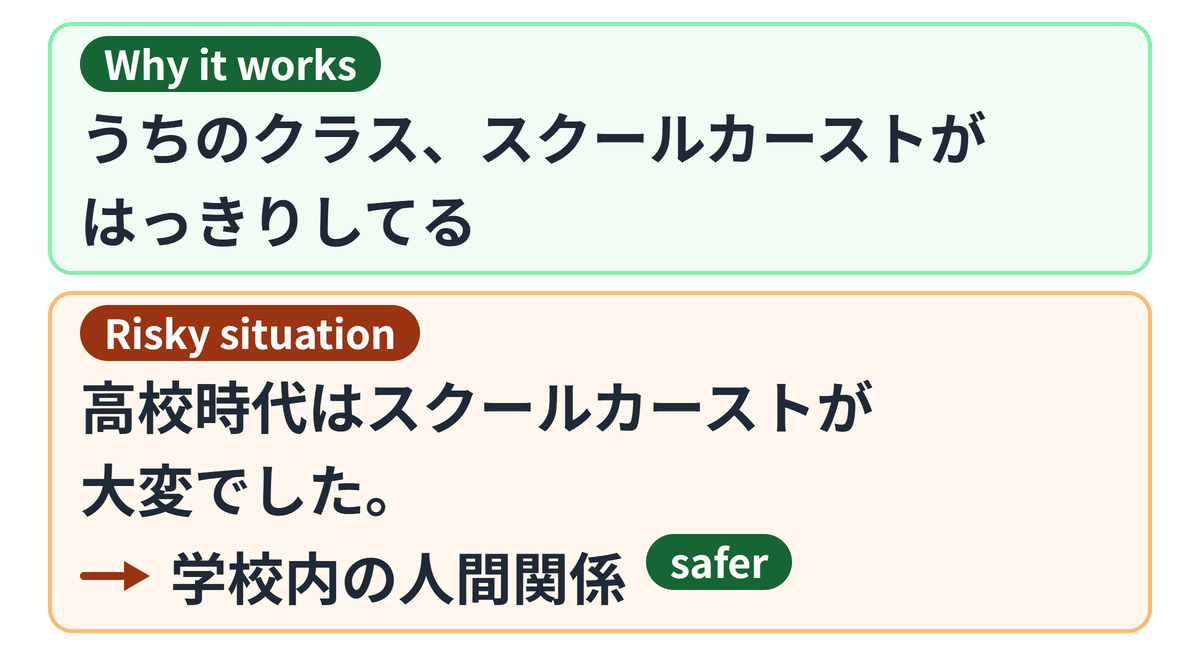
Situation: Two high school friends are chatting after school about their class atmosphere.
Japanese: 「うちのクラス、スクールカーストがはっきりしてるから、グループ移動しにくいんだよね。」
English: "In my class, the school-caste system is pretty clear, so it's hard to switch groups."
Why it works: It works because the relationship is casual and the speakers are discussing a shared school-life observation.
Risky situation: A foreign intern, Lisa, is talking to her Japanese manager about her past experiences in a Japanese high school during an informal team lunch.
Japanese: Lisa: 「高校時代はスクールカーストが大変でした。」
English: Lisa: "High school was tough because of the school-caste system."
Why it may sound risky: The manager will probably understand the meaning, but the topic and wording may feel too casual, personal, or heavy for a superior. A softer expression such as 学校内の人間関係 would usually be safer.
Hear a neutral explanation
Text: 「スクールカースト」って、やっぱりあるんだね。
English: So, "school caste" really does exist, doesn't it?
Text: 私たちの学校にもスクールカーストってあったよね。
English: There was a school caste even in our school, right?
Describe the relationship without ranking people
When you need to talk about social structures or groups in a Japanese school but want to avoid the bluntness of スクールカースト, consider these more neutral alternatives:
- 学校内の人間関係 (gakkō nai no ningen kankei)
- When to use it: When you want to talk generally about relationships and social ties within a school.
- Why it sounds safer: It avoids the loaded “caste” image and simply means “human relationships within the school.”
- 生徒同士の関係 (seito dōshi no kankei)
- When to use it: When describing relationships among students in a neutral way.
- Why it sounds safer: It does not imply a rigid ranking or accuse anyone directly.
- グループ間の関係 (gurūpu kan no kankei)
- When to use it: When talking about relationships between groups or cliques.
- Why it sounds safer: It focuses on group dynamics rather than ranking people.
- 暗黙の序列 (anmoku no joretsu)
- When to use it: When you need to discuss an unspoken hierarchy in a more analytical way.
- Why it sounds safer: It is more formal and less slangy, though it can still sound serious.
Why “clique” is only a partial translation
There is no perfect one-word English equivalent for スクールカースト. The best translation depends on context:
- “school caste system” is direct and close to the Japanese expression.
- “social hierarchy in school” sounds more neutral and explanatory.
- “pecking order in school” captures the informal ranking nuance.
- “cliques” can describe groups, but it does not fully capture the hierarchy implied by スクールカースト.
When translating for readers who do not know Japanese school culture, it is often better to explain the concept instead of using only one English word.
Questions about hierarchy and factions
What does スクールカースト mean?
スクールカースト means an informal social hierarchy or ranking among students in a school or class. It often describes popularity, group status, exclusion, and social pressure.
Is スクールカースト the same as 派閥?
No. スクールカースト focuses on social ranking, while 派閥 means a faction, clique, or group. A school may have 派閥, but スクールカースト suggests a broader hierarchy.
Can Japanese learners use スクールカースト?
Yes, but learners should use it carefully. It is best for casual discussion or social commentary, not for polite conversation with teachers, superiors, clients, or people you do not know well.
Is スクールカースト offensive?
The word itself is not automatically offensive, but it can sound blunt or judgmental because it refers to ranking people socially. Avoid using it to label real individuals.
What is a safer Japanese phrase than スクールカースト?
Safer alternatives include 学校内の人間関係, 生徒同士の関係, グループ間の関係, and 暗黙の序列. Choose the phrase depending on how direct or formal you want to sound.