Scope: This page answers one decision: whether 陰キャ can neutrally describe an introvert. It usually cannot; the safer wording depends on the trait you actually mean.
You may have seen this word in anime, school conversations, SNS posts, or Japanese comments. But is in-kya safe to use? 陰キャ (in-kya) is casual slang often used to describe someone who seems quiet, socially awkward, gloomy, introverted, or not part of the “popular/outgoing” crowd. However, it can easily sound judgmental or rude if you use it about another person.
Why “introvert” is an unsafe one-word translation
A foreign learner sees in-kya online and thinks it simply means “introvert.” Then they call someone 陰キャ in a casual chat.
The Japanese listener may pause or laugh awkwardly because 陰キャ can sound like a social label, not a neutral personality word. Depending on the tone, it may imply that someone is gloomy, unpopular, awkward, or socially low-status.
Safer: Use neutral words like おとなしい人 or 内向的な人 when you do not want to sound judgmental.
Check the real usage examples before you copy this slang.

Treat 陰キャ as a social label, not a personality type
In-kya, written as 陰キャ, is a casual Japanese slang term often used to describe a quiet, reserved, socially awkward, gloomy, or non-outgoing type of person. It is often contrasted with 陽キャ (you-kya), meaning an outgoing, bright, socially active type.
The important point is that 陰キャ is not a clean translation of “introvert.” Introvert can be neutral, but 陰キャ often carries social judgment. It can be playful when used about yourself or among close friends, but it can sound rude when used to label someone else.
The image attached to 陰キャ
陰キャ is made from 陰, meaning shadow or negative/dark side in this context, and キャ, shortened from キャラクター or “character.” It describes a person’s social image or vibe, especially compared with more outgoing people.
In everyday use, it can suggest someone is quiet, shy, socially awkward, low-energy, not flashy, not popular, or not good at group interaction. However, the exact feeling depends heavily on tone and relationship.
For learners, the safest first step is to understand the social nuance rather than translating it directly as “introvert.” The same word can sound like a joke in one conversation and an insult in another.
A label and a personality description are not equivalent
Introvert is usually a neutral personality term. It simply describes someone who may prefer quiet time, smaller groups, or less social stimulation.
陰キャ, on the other hand, often carries a social ranking or image. It can imply that someone is not part of the bright, popular, outgoing group. That is why it can sound harsher than “introvert.”
| Expression | Basic meaning | Risk |
|---|---|---|
| 陰キャ | A quiet, gloomy, awkward, or non-outgoing social type | Can sound judgmental or insulting |
| introvert | A person who tends to prefer quieter or less socially intense situations | Usually neutral |
| おとなしい人 | A quiet or reserved person | Much safer and more neutral |
| 内向的な人 | An introverted person | Neutral and suitable for explanation |
Self-deprecation and close-group joking
陰キャ sounds most natural in casual conversations, online comments, memes, school-life discussions, or self-deprecating jokes among people who understand the tone. It is often used when talking about social roles, school groups, online personality, or the contrast between quiet and outgoing people.
It can be especially common among younger speakers, but that does not mean it is always safe. Calling another person 陰キャ directly can feel rude, even if you mean it casually.
Do not assign the label to someone else
Be careful when using 陰キャ about real people. It can reduce a person to a stereotype and may sound like you are judging their social status. Avoid it with strangers, teachers, superiors, clients, coworkers you are not close to, and in formal writing.
Self-use can be softer, especially when joking, such as “I used to be kind of in-kya.” But even then, tone matters.
Hear the judgment in context
Text: 彼ってちょっと陰キャなとこあるよね。
English: He's a bit of an 'in-kya,' isn't he?
Note: This first line labels someone else as 陰キャ. As explained above, that can sound unkind when it is about a real person. The next line, where the speaker talks about themselves, is the safer way to use it.
Text: 昔は私も陰キャだったんだよ。
English: I used to be an 'in-kya' too, you know.
Self-label, quotation, and risky labeling
Situation: A person jokes about their own school days with a close friend.
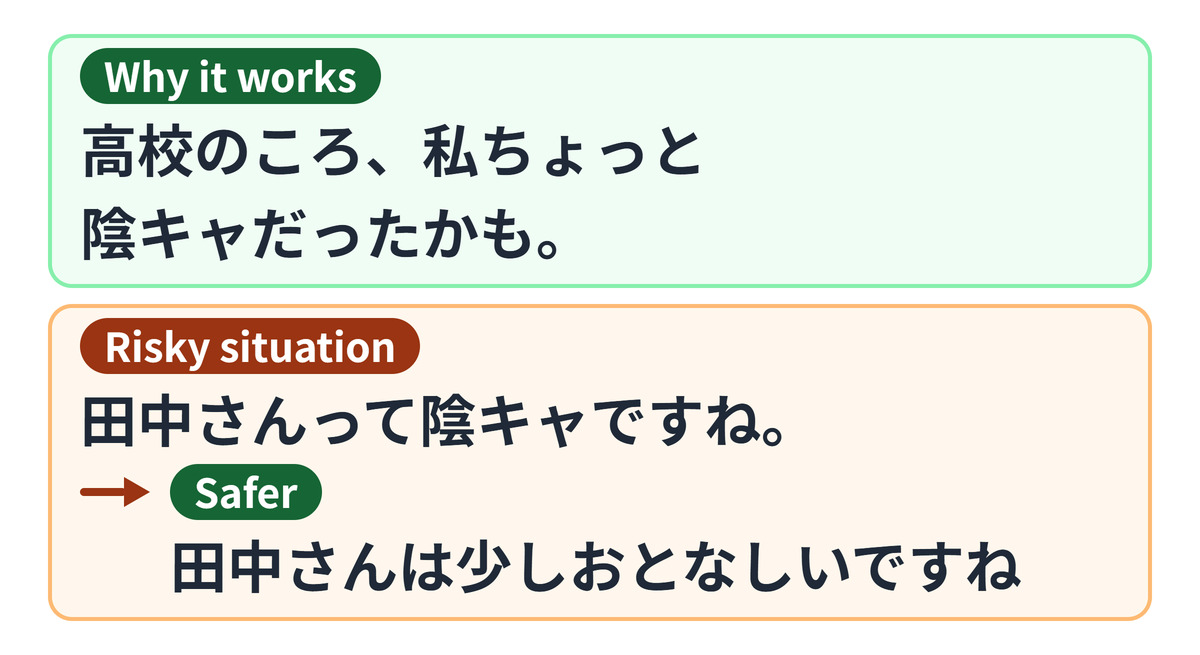
Japanese: 高校のころ、私ちょっと陰キャだったかも。
English: Back in high school, I might have been kind of in-kya.
Why it works: The speaker is talking about themselves in a light, self-aware way, so the word sounds less aggressive.
Situation: Friends discuss social types in a casual online conversation.
Japanese: あのキャラ、陽キャというより陰キャ寄りだよね。
English: That character is more in-kya than you-kya, right?
Why it works: The topic is fictional and casual, so the label feels less personally hurtful.
Risky situation: A learner calls a real classmate or coworker 陰キャ directly.
Japanese: 田中さんって陰キャですね。
Why it may sound risky: This sounds like a direct personal label and may feel insulting. A safer phrase would be 田中さんは少しおとなしいですね, depending on the context.
Quiet does not automatically mean 陰キャ
Do not use it everywhere. 陰キャ is casual slang and can sound like a negative social label. Avoid it with strangers, superiors, clients, formal writing, or any situation where polite Japanese is expected.
The safest choice depends on relationship, tone, and setting.
Describe the actual trait instead
- おとなしい人 (otonashii hito): Use this when you want to say someone is quiet or reserved in a softer way.
- 内向的な人 (naikō-teki na hito): Use this when you want to say “introverted person” more neutrally.
- 控えめな人 (hikaeme na hito): Use this when you want to describe someone as modest or not pushy.
- あまり目立たないタイプ (amari medatanai taipu): Use this when you want to say someone is not very flashy or noticeable without using a harsh label.
Questions about labeling a person
Is in-kya always negative?
Not always, but it often carries a negative or judgmental nuance. Self-use or joking use among close friends can sound lighter, but using it about someone else can feel rude.
Can I use in-kya in a business setting?
No. In-kya is very casual slang and inappropriate for formal or business contexts. Use neutral words such as おとなしい人 or 内向的な人 instead.
What's the difference between in-kya and “introvert”?
“Introvert” is usually a neutral personality trait. In-kya often carries social judgment and can imply someone is gloomy, awkward, unpopular, or outside the outgoing group.
What are some polite alternatives to in-kya?
Safer alternatives include おとなしい人, 内向的な人, 控えめな人, or あまり目立たないタイプ, depending on the nuance you need.
Who typically uses the term in-kya?
It is mainly used by younger generations in casual settings, online communities, school-life discussions, and conversations among friends.