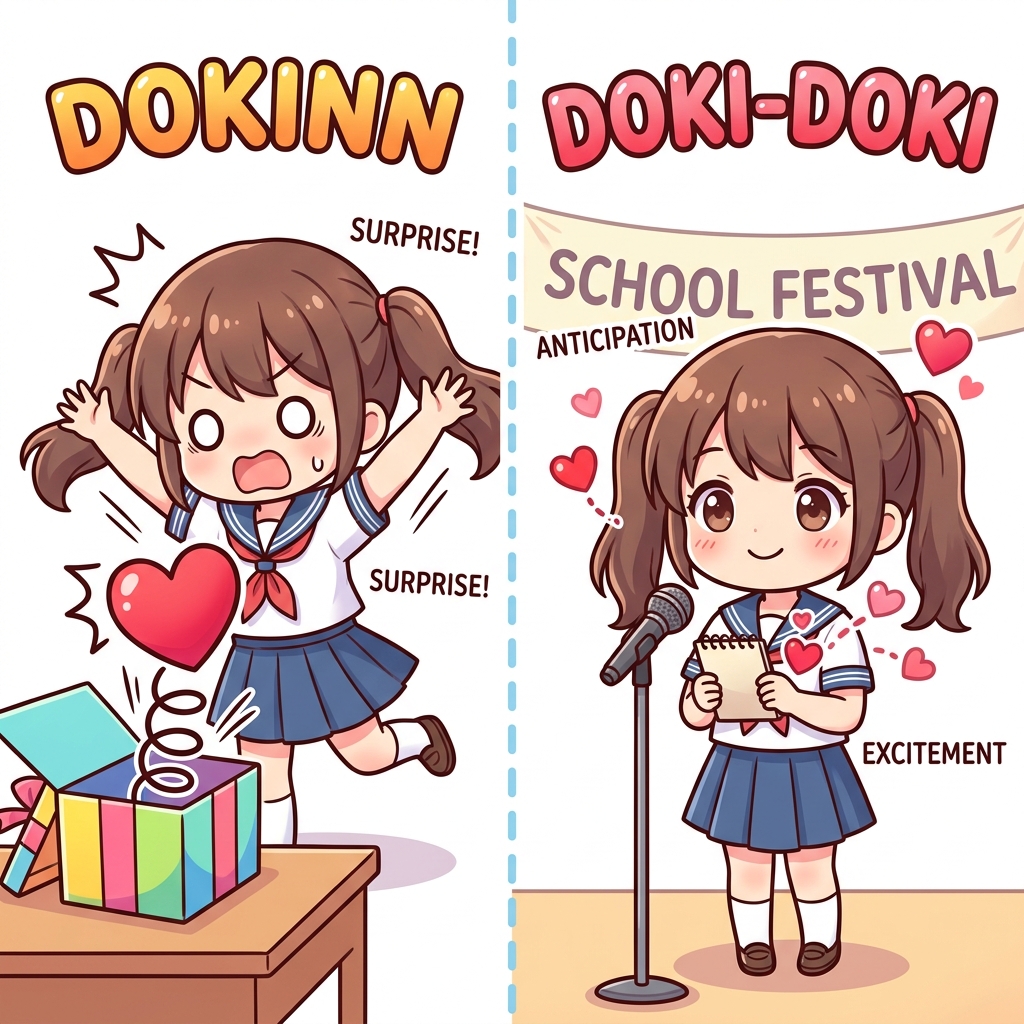
Learning Japanese onomatopoeia can be a fun and expressive way to deepen your understanding of the language, but some sounds can be tricky. Take どきん (dokin) and dokidoki, for example. Both relate to the sound or sensation of a heartbeat, yet they describe entirely different experiences. Many learners often confuse these two, leading to misunderstandings in expressing sudden fright versus ongoing excitement.
Two Similar Sounds, Different Impressions
At first glance, どきん (dokin) and dokidoki might seem interchangeable due to their similar sounds and shared connection to the heart. However, their core difference lies in the duration and intensity of the sensation. どきん (dokin) describes a single, sudden, strong throb or jolt of the heart. It’s a sharp, abrupt feeling, often triggered by surprise, fear, or a sudden rush of emotion like a surprising confession of love. Imagine your heart giving one big, unexpected leap.
In contrast, dokidoki represents a continuous, repeated thumping or pounding of the heart. This sensation is typically associated with ongoing excitement, nervousness, anticipation, or even a sustained state of fear. Think of a rapid, rhythmic beat that continues for a period, rather than a single, isolated jolt.
The Scene Behind Each Expression
Understanding the typical scenarios for each onomatopoeia helps clarify their usage. You would use どきん (dokin) when describing a moment like:
- Hearing an unexpected loud noise that makes you jump.
- Receiving a sudden, shocking piece of news.
- Experiencing a sudden, intense crush or a surprising romantic gesture.
It captures that singular, impactful moment when your heart seems to skip a beat or give a powerful lurch. It's about the emotional reaction to an event that causes an immediate, strong tactile heartbeat sensation.
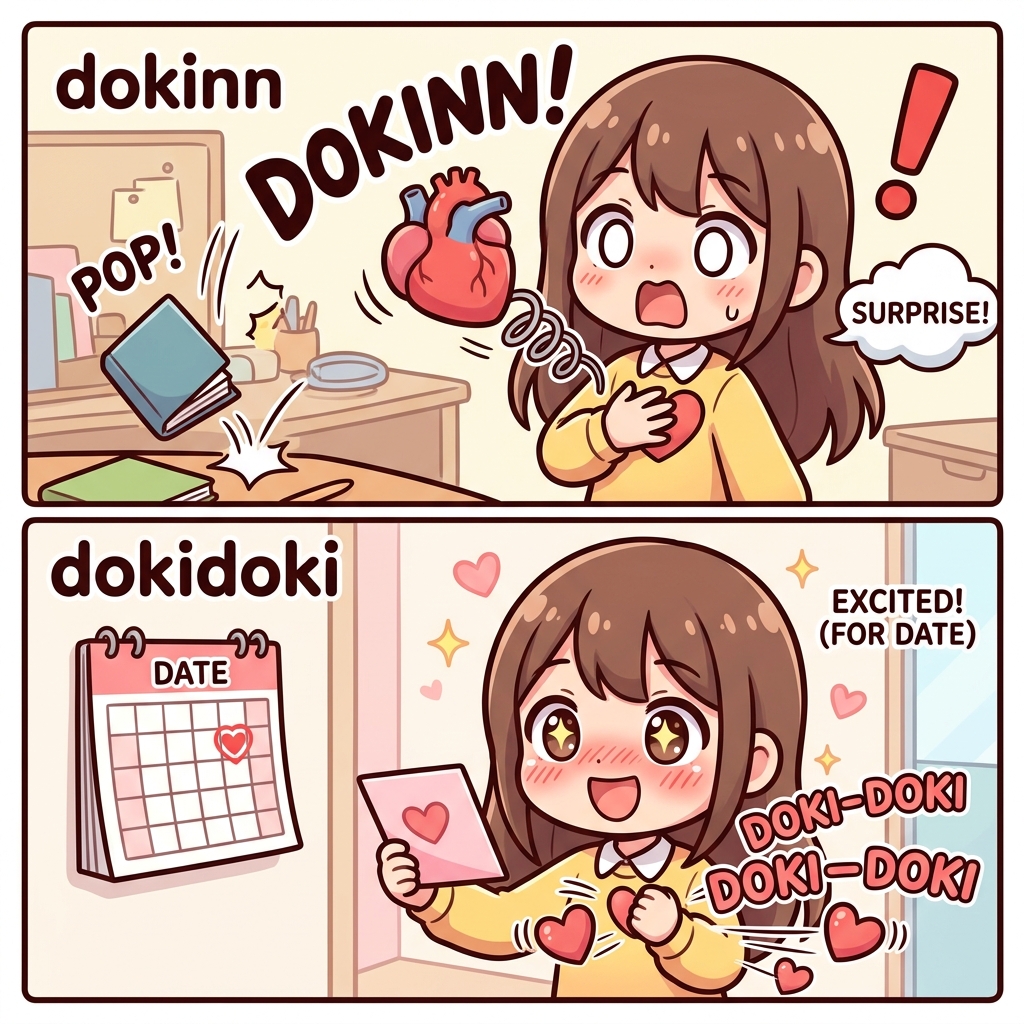
On the other hand, dokidoki is perfect for situations involving sustained emotional states:
- Waiting for important test results.
- Being on a thrilling roller coaster ride.
- Feeling nervous before a big presentation or a first date.
- Anticipating a long-awaited event.
Here, the heart doesn't just jolt once; it keeps pounding, reflecting a continuous state of heightened emotion.
How Japanese Speakers Choose Between Them
The choice between どきん (dokin) and dokidoki hinges on whether the heart's action is a singular, abrupt event or a continuous, repetitive one. The final 'n' sound in どきん (dokin) is crucial here. In Japanese onomatopoeia, a trailing 'n' often signifies a sudden, conclusive, and impactful action or sound that ends abruptly. This contrasts sharply with the repetitive, open-ended nature implied by the repeated 'doki' in dokidoki.
Why the Final “n” Marks One Sudden Jolt
Pay attention to the 'n' sound in どきん (dokin); it often emphasizes a single, strong, and conclusive beat, contrasting with the softer, repetitive rhythm of dokidoki. This subtle phonetic difference is a key indicator of their distinct meanings.
Small Nuance, Big Difference
Imagine a learner trying to express a sudden fright. They might initially think of dokidoki because it means 'heart thumping.' However, if it was a single, abrupt scare, using どきん (dokin) would be far more accurate. For instance, successfully describing a sudden scare with どきん (dokin) after initially confusing it with dokidoki, which they learned is for ongoing excitement, demonstrates a significant leap in language proficiency. Conversely, using dokidoki when only a single, abrupt jolt of the heart was intended would be a common pitfall.
Common Mistake to Avoid
A frequent error is using dokidoki for a single, sudden heart jolt. Remember, if your heart only gave one big leap due to surprise or shock, どきん (dokin) is the correct choice. Save dokidoki for when your heart is continuously pounding.
Quick Practice with Real Context
Listen to Both Expressions in Real Sentences
Play the audio and listen to how the examples sound in Japanese.
Japanese: 突然、背後から声をかけられて、心臓がどきんとした。
English: Suddenly, someone called out from behind me, and my heart gave a jolt.
Japanese: 発表会の前、緊張で胸がどきどきした。
English: Before the presentation, my heart was thumping with nervousness.
Related Expressions
| Expression | Meaning/Nuance |
|---|---|
| ドキッ / ドキッと (dokitto) | Similar to どきん (dokin), often used for a sudden, sharp jolt or surprise. Can be slightly less intense than どきん (dokin) or used more colloquially. |
| ハラハラ (harahara) | Describes a feeling of suspense or anxiety, often when watching someone else in a precarious situation. Implies a continuous, light nervousness. |
| ゾクゾク (zokuzoku) | A shiver, often from cold, fear, or excitement. Can be a continuous sensation. |
Frequently Asked Questions
What's the main difference between どきん (dokin) and dokidoki?
The main difference is duration and repetition. どきん (dokin) describes a single, sudden, strong jolt of the heart, often due to surprise or shock. dokidoki, on the other hand, describes a continuous, repeated thumping or pounding of the heart, typically from excitement, nervousness, or anticipation.
Can I use dokidoki if I'm suddenly scared?
While fear can cause your heart to pound, if it's a single, abrupt jolt from a sudden scare, どきん (dokin) is more appropriate. dokidoki implies a sustained, continuous thumping. If the fear causes your heart to keep pounding for a while, then dokidoki could be used, but for the initial, sudden jolt, どきん (dokin) is the better choice.
Mastering the distinction between どきん (dokin) and dokidoki will significantly enhance your ability to express nuanced emotions in Japanese. By understanding whether the heartbeat is a single, impactful jolt or a continuous, rhythmic thumping, you can avoid common mistakes and sound more natural. Keep practicing, and soon you'll be using these expressive onomatopoeia with confidence!