What Does “Zubizubi (ずびずび)” Mean?
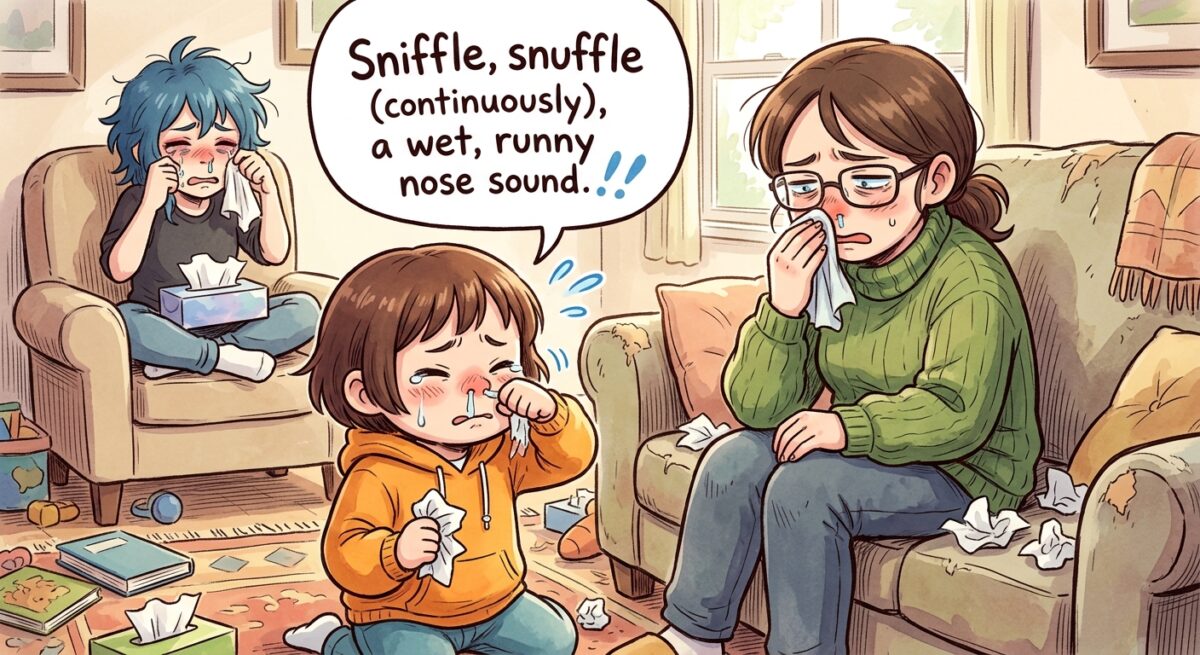
👉 Describes the continuous, often wet and somewhat irritating sound of sniffling, typically due to a runny nose caused by a cold, allergies, or crying.
👉 Implies the state of having a profusely runny nose, leading to continuous sniffling sounds.
Nuance & Depth
The sound 'ずびずび' suggests a prolonged and often slightly pathetic or helpless sniffling, without resolution (i.e., not blowing one's nose). It can evoke a sense of discomfort or mild annoyance for the listener due to its continuous, wet nature.
Zubizubi vs Sniffle, snuffle (continuously), a wet, runny nose sound.: The repeated 'ずび' sound, with its voiced 'ず' (zu) and the bilabial 'び' (bi), creates an auditory image of a continuous, somewhat 'mushy' or 'wet' sound. The repetition emphasizes the ongoing nature of the sniffling.
Imagine This Situation
Example Sentences & Audio
(He caught a cold and was sniffling ZUBIZUBI(ずびずび, making a runny nose sound) all day.)
(On a cold winter morning, the child went to school sniffling ZUBIZUBI(ずびずび, making a runny nose sound).)
(She was so sad, she was crying and sniffling ZUBIZUBI(ずびずび, making a runny nose sound) her tears and snot.)
Summary
👉 ずびずび is a highly specific onomatopoeia for the continuous, wet sound of sniffling from a runny nose or crying, conveying a sense of persistence and often discomfort.