What Does “Boribori (ぼりぼり)” Mean?
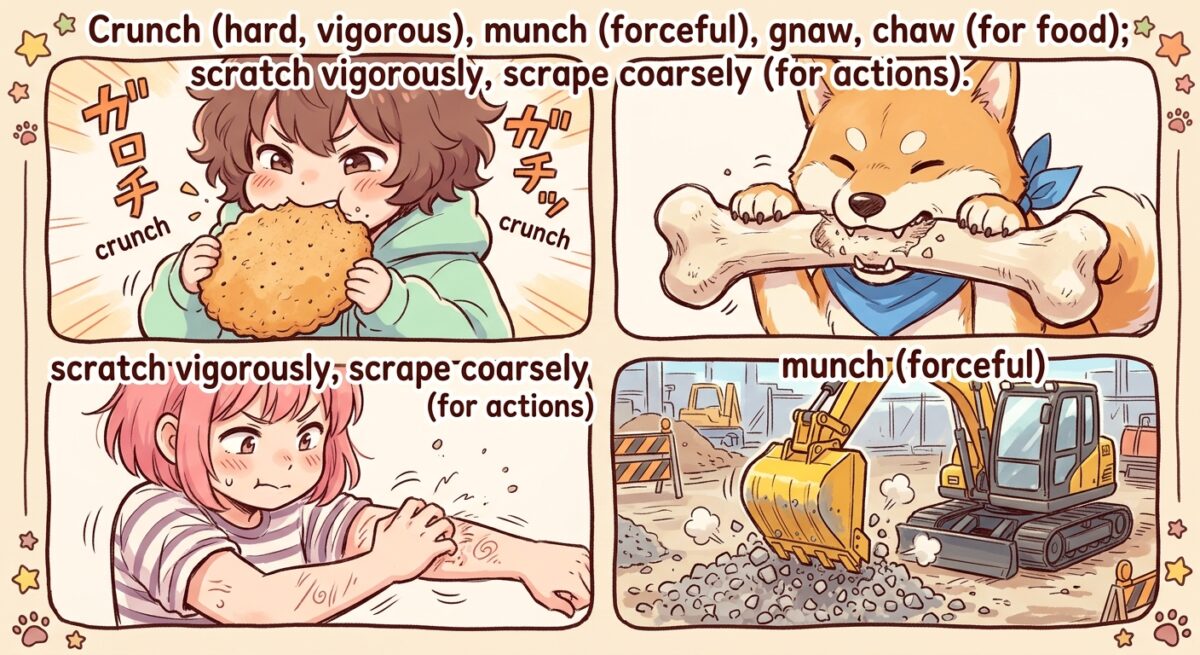
👉 Describes the sound of vigorously crunching or gnawing on something hard, solid, or coarse, often with a rough, substantial texture.
👉 Also used to describe the sound or act of vigorously scratching a persistent itch or scraping against a hard surface with force.
Nuance & Depth
ぼりぼり specifically conveys a heavier, rougher, and more forceful crunch compared to ぽりぽり. While ぽりぽり implies a light, delicate, crisp, and often pleasant snack-like crunch, ぼりぼり suggests a more robust action, often requiring more effort, like eating a very hard biscuit, a raw daikon radish, or gnawing on bone. It can also depict an intense, somewhat crude, or insistent scratching.
Boribori vs Crunch (hard, vigorous), munch (forceful), gnaw, chaw (for food); scratch vigorously, scrape coarsely (for actions).: The initial voiced bilabial stop 'ぼ' (bo) contributes to the heavier, more substantial, and forceful impression of the sound, setting it apart from the unvoiced 'ぽ' (po) which typically denotes lighter, crisper actions in Japanese onomatopoeia. The repetition 'ぼりぼり' emphasizes the continuous or repeated nature of this vigorous action.
Imagine This Situation
Example Sentences & Audio
(Eating a hard rice cracker with a loud crunching sound BORIBORI (hard crunching).)
(The dog is gnawing on a bone, making a BORIBORI sound (gnawing).)
(I vigorously scratched the itchy spot with my arm, making a BORIBORI sound (vigorous scratching).)
Summary
👉 ぼりぼり is an onomatopoeia for a vigorous, substantial, and rough crunching, gnawing, or scratching sound, characterized by force and a somewhat unrefined quality.