What Does “Baribari (ばりばり)” Mean?
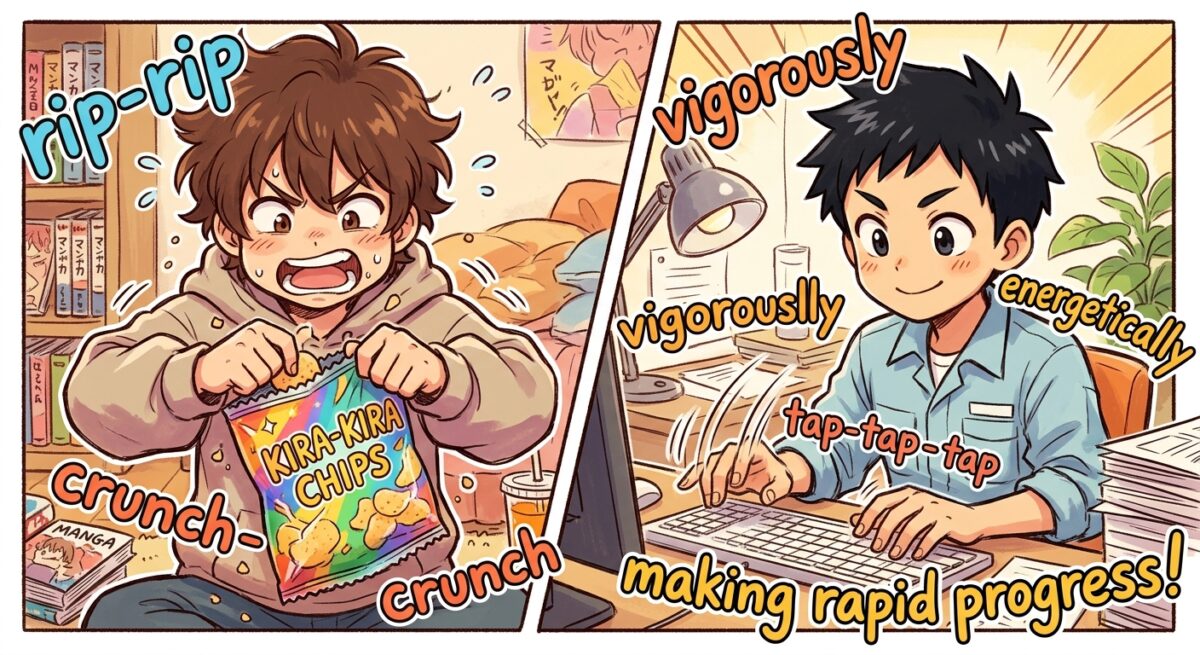
👉 The sound or action of tearing or ripping something with a rough, strong force. Also, the sound and sensation of eating something with a robust, firm crunch.
👉 Performing an action or working vigorously, energetically, or making rapid and significant progress.
Nuance & Depth
Emphasizes a strong, often rough or forceful quality. For sounds, it's not delicate, often indicating something being broken or consumed with gusto. For actions, it suggests high energy, productivity, and determination.
Baribari vs rip-rip (for tearing), crunch-crunch (for robust eating), vigorously, energetically, making rapid progress (for actions).: The repetition of 'bari' (ばり) intensifies the action or sound, suggesting continuity, recurrence, or an emphatic quality. The 'ba' sound (バ行) often connotes force, impact, or robustness in Japanese onomatopoeia, distinguishing it from lighter 'pa' (パ行) or harder 'ga' (ガ行) sounds.
Imagine This Situation
Example Sentences & Audio
(BARIBARI(ばりばり, tearing sound) peeling off the old wallpaper.)
(I can't get enough of the BARIBARI(ばりばり, robust crunchy texture) texture of this cookie.)
(She started BARIBARI(ばりばり, working vigorously) right after joining the company.)
Summary
👉 'ばりばり' describes robust tearing/ripping sounds, satisfyingly firm crunchy textures, and vigorous, energetic work or activity. It consistently conveys a sense of force, energy, and robust action.