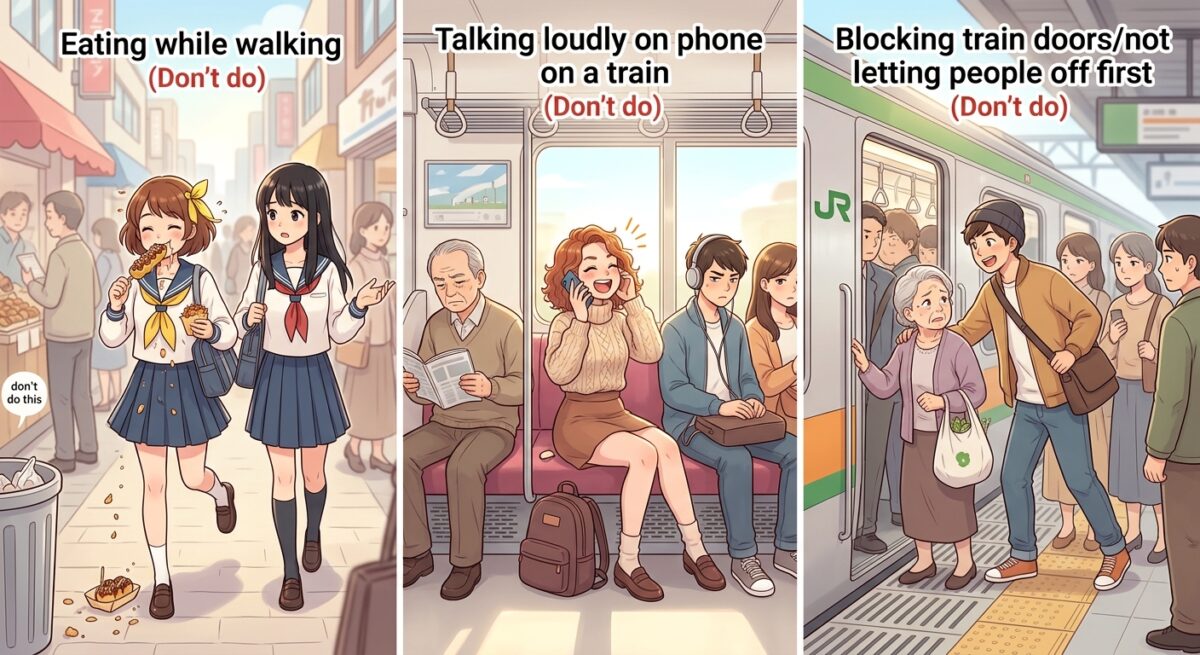
Public manners in Japan are easiest to handle as a routing question: Where am I, who operates the space, and what do the signs ask me to do? A train, shrine, restaurant, school, hotel, park, and residential street do not share one universal rulebook.
This page is a starting point. It gives a short check for shared spaces and sends you to the detailed Why Japan guide for each situation. When a posted rule or staff instruction differs from general advice, follow the rule for that place.
The 30-second public-manners check
- Read the sign. Check floor lines, no-photo notices, smoking-area signs, entry rules, and bin labels.
- Protect the flow. Move aside before stopping, taking a photo, opening a map, or reorganizing luggage.
- Match the volume. A festival and a commuter train require different choices.
- Ask before assuming. Facility staff can confirm the rule for photos, food, shoes, entry, or disposal.
- Correct small mistakes promptly. Stop, apologize, move, or follow the instruction; a long explanation is rarely necessary.
Choose the guide for your situation
| Situation | Do this now | Detailed guide |
|---|---|---|
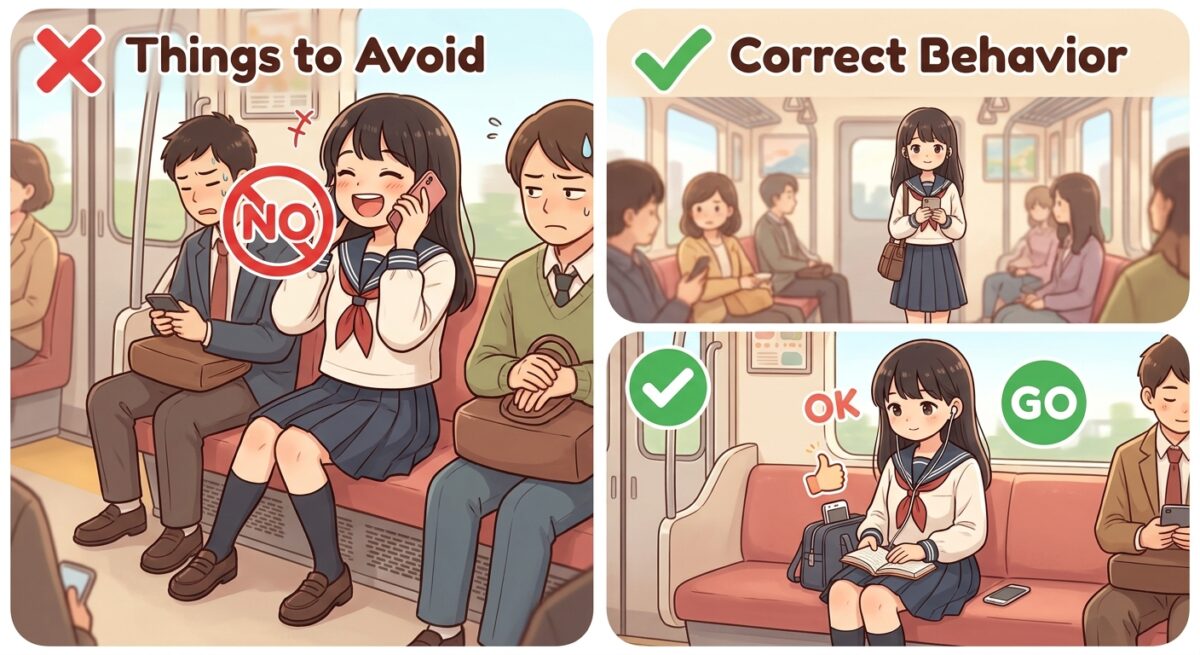
| Train or platform | Follow the queue marks, let passengers exit, keep bags close, avoid calls | Train etiquette |
| Quiet shared space | Lower your voice and consider place, time, distance, and duration | Noise by place and time |
| Taking a photo | Check signs, people, private property, safety, and publication | Photography permission guide |
| No public bin | Keep the item; use only a matching labeled bin | Trash for tourists |
| Entrance or raised floor | Pause and check the floor transition, shoe rack, slippers, and sign | When to remove shoes |
| Unclear line or waiting system | Look for a line, list, ticket machine, app, or staff instruction | Queueing by place |
Rules, facility instructions, and common practice are different
- Law or local ordinance: can create enforceable restrictions, such as some street-smoking controls.
- Operator or facility rule: applies to that train, museum, temple, shop, school, hotel, or event.
- General practice: helps you reduce inconvenience but may vary by setting and person.
- Editorial advice: is a cautious action when the exact local rule is unknown.
Do not describe every social preference as illegal. Also do not ignore a no-photo, no-entry, no-smoking, or queue instruction merely because it is specific to one facility.
Three actions prevent most problems
Move aside before you stop
At stations, shop entrances, escalator exits, and narrow sidewalks, check your map or phone from an open side area. Keep suitcases and groups out of the moving path.
Keep sound and screens to yourself
Use headphones, silence autoplay, and avoid calls on regular trains. In hotels, apartment corridors, hospitals, libraries, and residential streets, time and distance matter as much as voice level. The detailed noise guide explains the exceptions.
Use the place’s disposal system
A vending-machine collection box is generally for the drink-container types shown on it, not every item in your bag. A food court may require trays, liquids, containers, and utensils to go to different stations. If no suitable bin exists, keep the item. For restaurant-specific decisions, see restaurant and food-court trash sorting.
Smoking rules are local and facility-specific
Do not rely on whether people nearby are smoking. Check municipal signs and the building’s designated area. Tokyo Metro prohibits smoking in its stations, while street-smoking controls can differ by ward or city. Heated-tobacco rules may also be stated separately. If the permitted area is unclear, wait.
Eating, photographing, and footwear depend on place
Eating beside a festival stall can be normal while eating in a crowded moving walkway can create spills and obstruction. Photography may be allowed outdoors but prohibited inside a hall or for a marked object. Shoes may stay on in one restaurant but come off in another. Use the physical setup and posted instruction, not a national stereotype.
If you make a mistake
- Stop the action.
- Say すみません (sumimasen, “excuse me / I’m sorry”).
- Follow the sign or staff direction.
- If still unclear, ask どうすればいいですか? (Dō sureba ii desu ka?, “What should I do?”).
Do not argue that another visitor did the same thing. They may know an exception, have permission, or also be mistaken.
Official sources
- Japan National Tourism Organization: Japanese customs and etiquette
- Tokyo Metro: Things to consider when riding the subway
- Shibuya City: Street-smoking measures
Source check: August 2, 2026. Local rules and facility operations can change; current signs and staff instructions take priority.