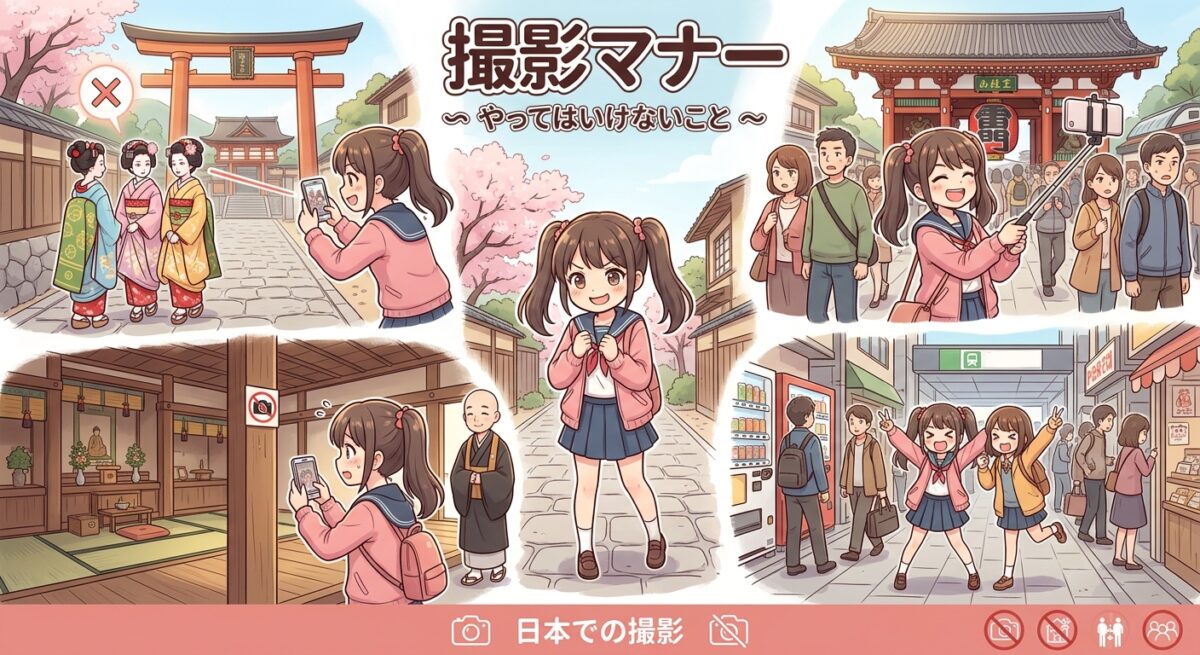
There is no single “photography rule for Japan.” Permission can depend on the place, subject, equipment, purpose, crowd level, and current instructions. A photo may be allowed outdoors but prohibited inside a hall; allowed for personal viewing but restricted for publication or commercial use.
Use this guide to make the decision before raising the camera. It explains etiquette and facility checks, not a universal legal opinion. When a sign, staff member, property owner, event organizer, or transport operator gives a specific instruction, that instruction controls the practical decision at that location.
Use this five-part photo check
- Sign: Is there a no-photo, no-video, no-flash, or restricted-area notice?
- Subject: Are you targeting an identifiable person, child, worshipper, worker, performer, patient, or student?
- Place: Is it private property, a sacred area, a gallery, a shop, a school, a station, or a moving road?
- Method: Would flash, tripod, selfie stick, shutter noise, long setup, or your body block or endanger others?
- Use: Is the image staying personal, or will it be posted, distributed, sold, or used commercially?
If any answer is unclear, lower the camera and ask. Permission to enter is not automatically permission to photograph, and permission to take a photo is not automatically permission to publish it.
A place-by-place decision table
| Place or subject | Check first | Safer action when unclear |
|---|---|---|
| Temple or shrine | Signs at gates, halls, worship areas, ceremonies, objects | Ask staff; do not photograph worshippers closely |
| Museum or historic building | Room and object signs, flash/equipment rules, use restrictions | Keep the camera down until the specific exhibit is confirmed |
| Shop or restaurant | Store policy, other customers, products, kitchen or register | Ask before photographing the interior or staff |
| School or children | Organizer permission, school policy, guardian/subject consent, SNS rules | Do not shoot or post until explicitly cleared |
| Station or train | Safety line, passenger flow, operator notice, staff and passengers | Move to a safe side area; never obstruct doors or platforms |
| Residential street or private property | Property boundary, residents, vehicles, local notices | Stay on public access and avoid targeting homes or residents |
People: ask before making someone the subject
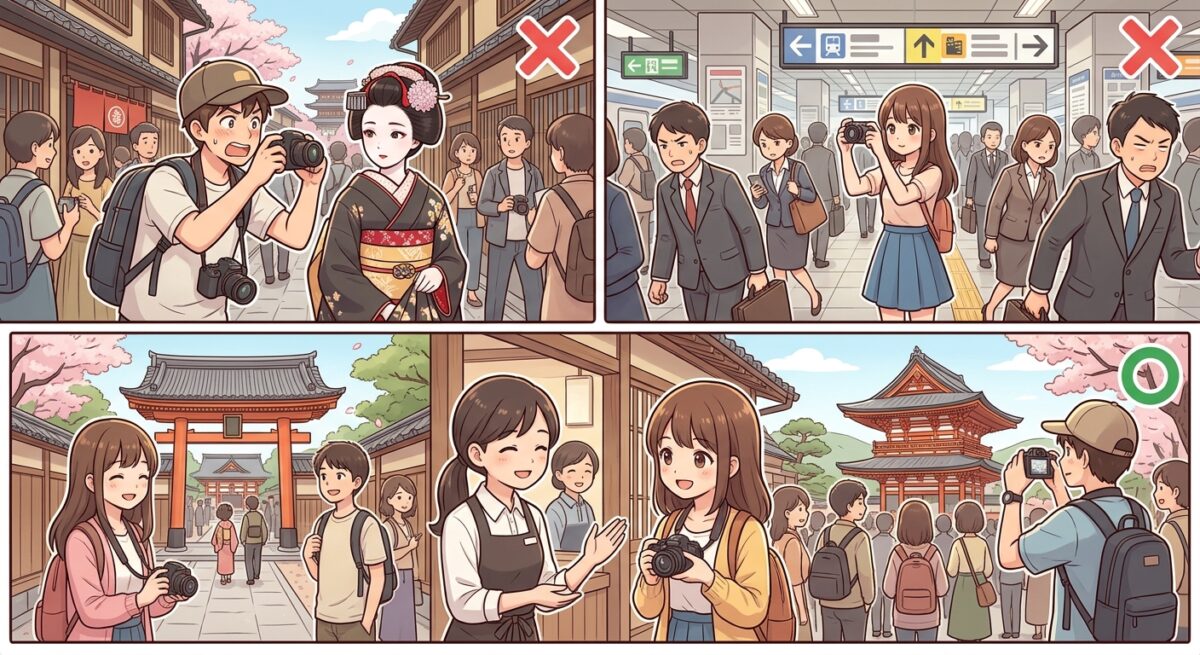
A wide street scene can incidentally include people, but deliberately photographing a recognizable stranger is a different choice. JNTO’s responsible-photography guidance asks visitors to seek permission before photographing individuals and to respect a frown, head shake, or dismissive gesture.
- 写真を撮ってもいいですか?
Shashin o totte mo ii desu ka?
May I take a photo? - SNSに載せてもいいですか?
Esu-enuesu ni nosete mo ii desu ka?
May I post it on social media?
Ask the subject directly when appropriate. A friend saying “it is probably fine” is not the person’s permission. If the answer is hesitant, conditional, or negative, do not take or post the image.
Children, schools, and organized visits
Children require extra caution because consent, safeguarding, and school policy may involve the school, organizer, guardian, and child. Do not photograph a schoolyard from outside, follow students, or publish identifiable children because the scene is visible from a public place.
For an authorized visit, confirm photography, video, audio, faces, name tags, classroom materials, and SNS use separately. The school-specific workflow is in visiting a Japanese school.
Temples and shrines: outdoor access does not settle every area
Grounds may allow ordinary personal photos while a worship hall, ritual, garden, special opening, statue, or marked object does not. Avoid interrupting prayer, crossing barriers, using flash against instructions, or staging a long shoot in a narrow approach.
- Check the entrance and the specific building or object.
- Keep worshippers out of close or targeted shots unless they agree.
- Ask about ceremonies, professional equipment, tripods, and publication.
- Stop immediately if staff or a sign says photography is not allowed.
Museums and galleries: rules can change by room and object
Tokyo National Museum illustrates why a national shortcut fails: its published policy permits some personal photography while prohibiting it in specified galleries or for objects marked with a no-photography sign. Flash, additional lighting, tripods, monopods, and selfie sticks are prohibited under that museum’s policy.
Use that as an example of a facility rule, not a rule for every museum. Check the current room and object. Special exhibitions may have different conditions from collection galleries, and personal photography permission may not allow distribution or commercial use.
Shops, restaurants, and hotels
A business open to customers is still managed space. Product displays, price labels, security areas, other guests, staff, kitchens, screens, and payment counters may require restrictions.
- Food on your own table may be less sensitive than the kitchen or other diners, but ask if the policy is unclear.
- Do not photograph staff as part of “the experience” without consent.
- A room booking does not necessarily authorize photography in shared hotel areas or of other guests.
- Commercial, influencer, tripod, or extended shoots may need advance permission even when a quick personal photo is allowed.
Ask 店内で写真を撮ってもいいですか? (Tennai de shashin o totte mo ii desu ka?, “May I take photos inside the store?”).
Stations and trains: safety before the image
Do not cross a safety line, lean into the track area, use flash toward train staff, stop in a boarding path, or hold a pose near closing doors. On board, avoid targeting passengers and keep camera sounds and equipment contained.
Tokyo Metro publishes station-photography considerations as part of its operator guidance. Follow the operator and station staff at the location. For boarding and carriage conduct, read train etiquette in Japan.
Gion, maiko, and residential districts
Kyoto’s official tourism guidance describes Southern Gion as a place where people live and work, not a theme park. It asks visitors not to stop, follow, touch, or take unauthorized photos or videos of geiko and maiko, and not to enter private property or obstruct roads.
Apply the decision, not a stereotype: stay on lawful public access, do not chase or block a person, follow local notices, and use organized performances or authorized experiences when you want a posed cultural image.
Posting is a second decision
Before uploading, check whether the original permission covered publication. Look for faces, children, name tags, tickets, room numbers, addresses, school details, vehicle plates, medical information, computer screens, and private conversations.
- Crop or blur incidental identifiers when that resolves the concern.
- Do not add a location tag that exposes a private or sensitive place.
- Do not interpret silence as consent to publish.
- If permission is withdrawn and you control the post, remove it promptly.
If someone asks you to stop
- Lower the camera and stop recording.
- Say すみません (sumimasen, “I’m sorry / excuse me”).
- Ask whether the existing photo should be deleted: この写真を削除したほうがいいですか? (Kono shashin o sakujo shita hō ga ii desu ka?).
- Follow the facility or subject’s instruction without arguing from another place’s policy.
Official and facility sources
- Japan National Tourism Organization: Responsible photography in Japan
- Tokyo National Museum: Photography and visitor guidelines
- Kyoto City Official Travel Guide: Southern Gionmachi manners
- Tokyo Metro: Station and train considerations
Source check: August 2, 2026. Photography, equipment, and use conditions can change by facility, exhibition, event, and time; current signs and direct permission take priority.