What Does “Kishikishi (きしきし)” Mean?
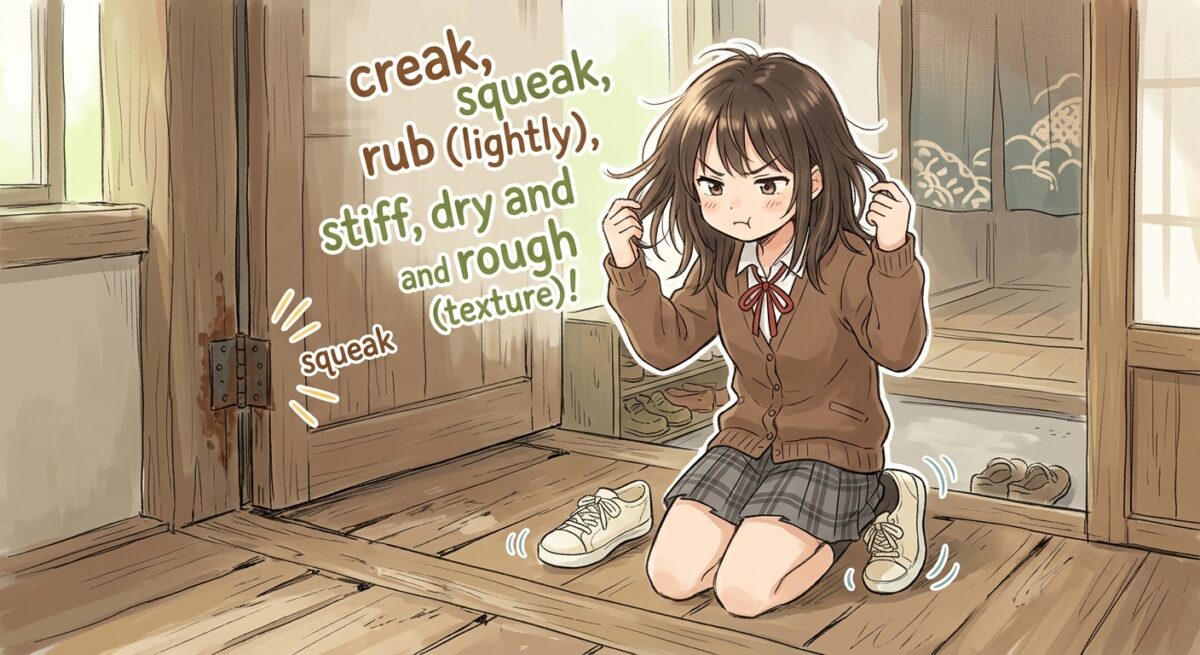
👉 A light, continuous creaking or squeaking sound, typically from wood, metal, or other hard materials rubbing together under slight pressure or movement. It suggests mild friction.
👉 Describes the state of being stiff, dry, or slightly rough to the touch due to lack of moisture or smoothness, often in a physical sense like dry hair or a stiff, unyielding material.
Nuance & Depth
Focuses on a somewhat high-pitched, persistent friction sound or a dry, unyielding sensation. It conveys a sense of slight resistance, wear, or dryness. Unlike 'ぎしぎし', it does not imply a heavy burden or strong strain, but rather a lighter, more frequent or continuous friction.
Kishikishi vs creak, squeak, rub (lightly), stiff, dry and rough (texture): The repetition of 'きし' emphasizes the continuous and repetitive nature of the sound or sensation. The 'k' sound often suggests a sharp, distinct, but not necessarily heavy, impact or friction, while the 'sh' sound conveys a rubbing or brushing quality.
Imagine This Situation
Example Sentences & Audio
(The old floor KISHIKISHI (creaked lightly) as I walked.)
(After shampooing, my hair feels KISHIKISHI (stiff and dry).)
(Every time the wind blows, the window sash KISHIKISHI (squeaks lightly).)
Summary
👉 'きしきし' describes a light, continuous creaking/squeaking sound or a stiff/dry sensation, distinctly lighter and often higher-pitched than 'ぎしぎし'.