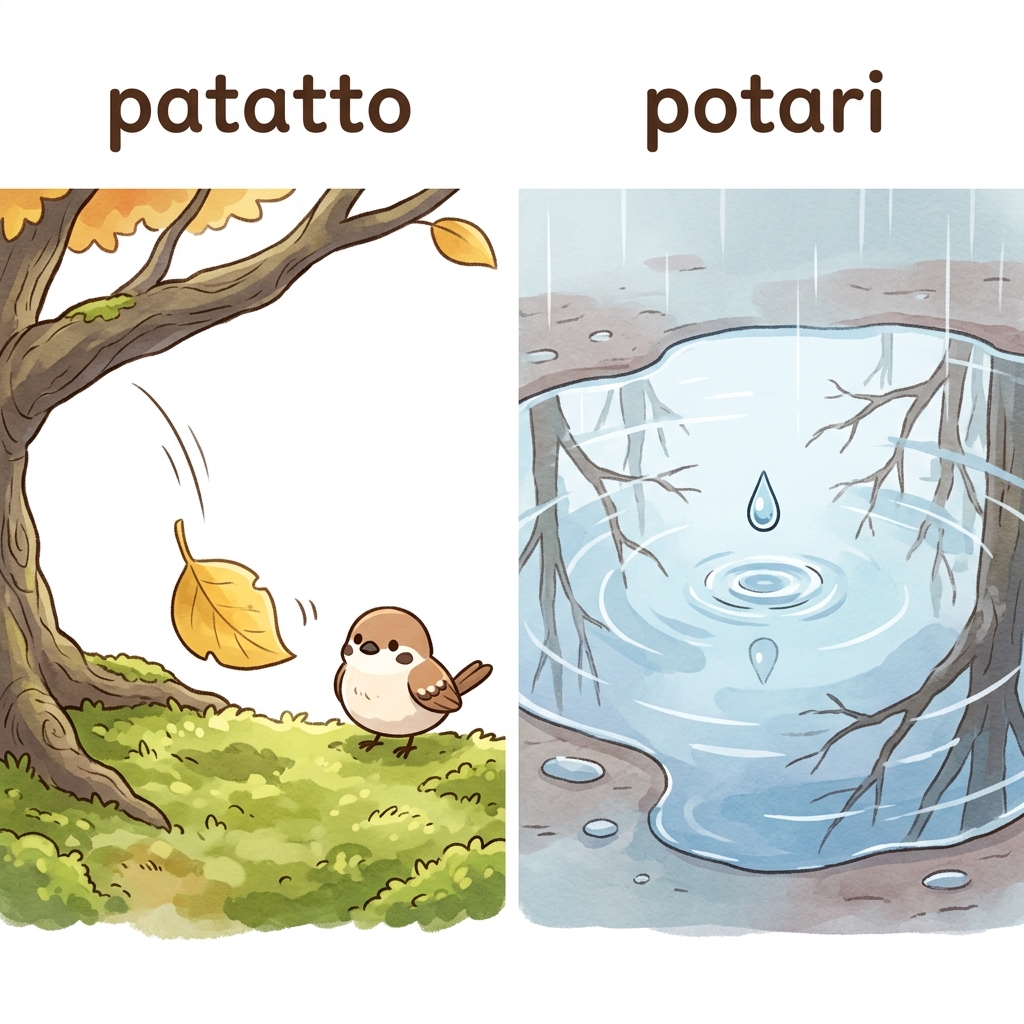
Learning Japanese onomatopoeia can feel like navigating a forest of sounds, each with its own subtle shade of meaning. Two expressions that learners may confuse are ぱたっ / ぱたっと (patatto) and ぽたり (potari). Both can describe something falling, but the feeling is very different. This guide explains how to choose the natural word depending on what falls, how it falls, and what kind of sound or image it creates.
The Core Difference
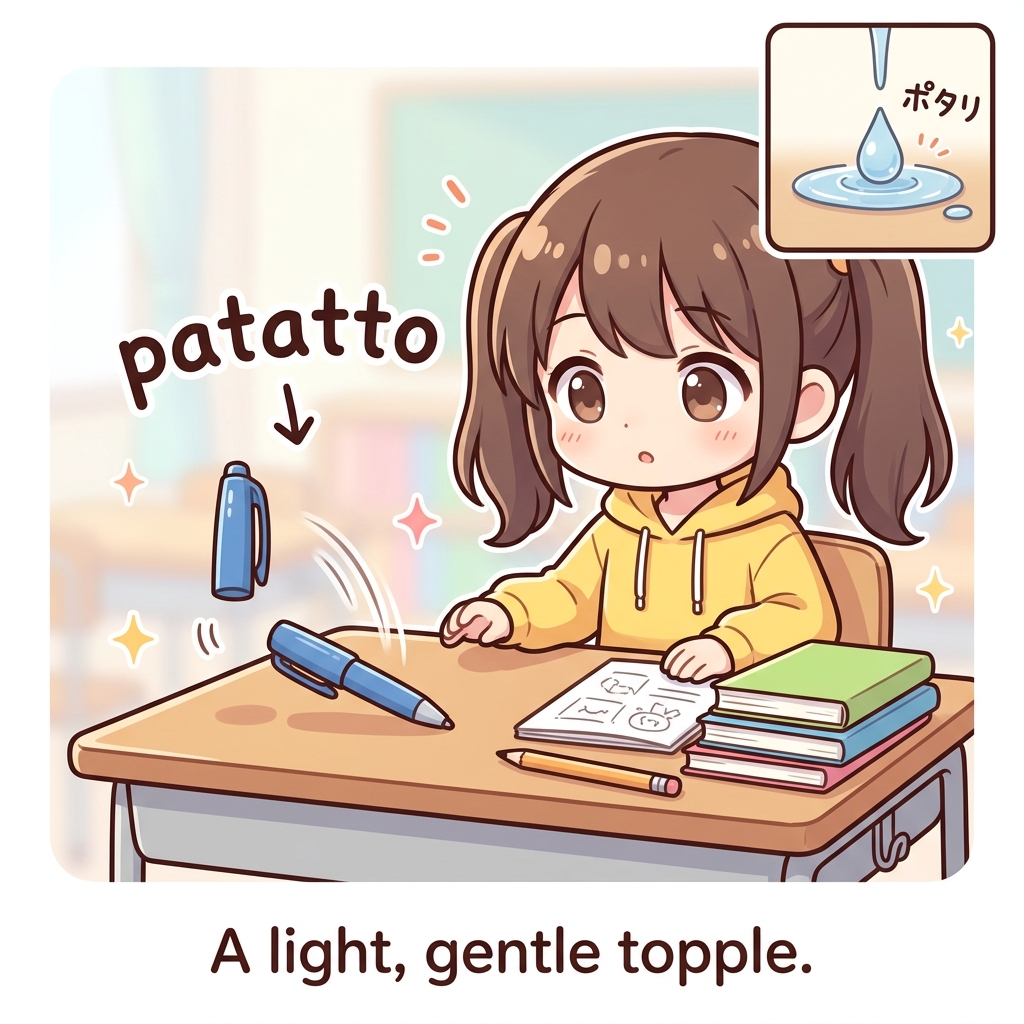
The main difference between ぱたっ / ぱたっと (patatto) and ぽたり (potari) is the type of falling action. ぱたっと often describes something light falling, toppling, stopping suddenly, or making a small dry impact. It can give the feeling of a quick, single movement, like a leaf falling, a small object tipping over, or something light dropping flat.
ぽたり (potari), on the other hand, is usually used for a single drop of liquid falling. Think of a tear falling from someone’s eye, a drop of water falling from a faucet, or a drop of blood falling from a finger. It feels softer, wetter, and more delicate than ぱたっと.
How the Feeling or Force Changes
ぱたっ / ぱたっと (patatto) suggests a quick and definite action. The movement may be light, but it often feels sudden. It can describe a small object falling, something toppling over, or something ending or stopping abruptly. The sound is usually short and dry, like a light “flop,” “tap,” or “thud.”
ぽたり (potari) creates a much softer image. It focuses on a single liquid drop forming, falling, and landing. The sound may be very small or almost silent, but the visual image is clear: one drop falls slowly or gently. It is not about a solid object losing balance; it is about a liquid drop separating and falling.
Where Each Sound Fits Naturally
To understand these words, it helps to look at natural situations where each one is used.
You may hear ぱたっ / ぱたっと (patatto) when describing:
- A leaf falling from a tree: 風で葉っぱがぱたっと落ちた。 (Kaze de happa ga patatto ochita.) - A leaf fell lightly because of the wind.
- A small object toppling over: 本棚から小物がぱたっと倒れた。 (Hondana kara komono ga patatto taoreta.) - A small item on the bookshelf toppled over lightly.
- Something light coming off or dropping: ボタンがぱたっと取れた。 (Botan ga patatto toreta.) - A button came off suddenly.
It works well for quick, light, single movements, especially when the object is not liquid.
ぽたり (potari) is natural for:
- A tear falling: 彼女の目から涙がぽたりと落ちた。 (Kanojo no me kara namida ga potari to ochita.) - A tear fell from her eye.
- Water dripping: 蛇口から水がぽたりと垂れている。 (Jaguchi kara mizu ga potari to tarete iru.) - Water is dripping from the faucet.
- A drop of blood falling: 指から血がぽたりと落ちた。 (Yubi kara chi ga potari to ochita.) - A drop of blood fell from my finger.
It is ideal for describing one soft drop of liquid. The important image is a small liquid drop falling separately and gently.
A Native-Sounding Way to Remember It
Match the Word to Solid or Liquid Movement
Think of ぱたっと (patatto) for a quick, light fall or toppling movement, often involving a small solid object. Think of ぽたり (potari) for a single soft drop of liquid, such as a tear, water drop, or drop of blood. A simple shortcut is: ぱたっと for light solid movement, ぽたり for liquid drops.
A Common Mix-Up to Avoid
A Common Mix-Up to Avoid:
A common learner mistake is using ぱたっと (patatto) for a tear falling. While both words can describe a single fall, ぱたっと sounds too dry and solid for a tear. For a tear, water drop, or other liquid drop, ぽたり (potari) sounds much more natural. This small difference helps your Japanese descriptions feel more precise.
Compare the Sound and Feeling
Play the audio and listen to how the examples sound in Japanese.
Japanese: 風で葉っぱがぱたっと落ちた。
English: A leaf fell lightly because of the wind.
Japanese: 彼女の目から涙がぽたりと落ちた。
English: A tear fell softly from her eye.
Frequently Asked Questions
Can ぱたっ / ぱたっと (patatto) be used for liquids?
Usually, no. ぱたっと (patatto) feels more natural for light solid movement, such as something falling, toppling, or stopping suddenly. For a single drop of liquid, ぽたり (potari) is usually the better choice. If you use ぱたっと for a tear or water drop, it may sound too dry or solid.
Is ぽたり (potari) only for tears or water?
No. ぽたり (potari) can describe many kinds of single liquid drops. Tears and water are common examples, but it can also be used for blood, sauce, rain, dew, or another liquid falling as one drop. The key point is not the type of liquid, but the soft, individual drop.
Mastering the difference between ぱたっ / ぱたっと (patatto) and ぽたり (potari) will help you describe small falling movements more naturally in Japanese. Remember: ぱたっと is useful for quick, light falls or topples, while ぽたり is best for a soft liquid drop.