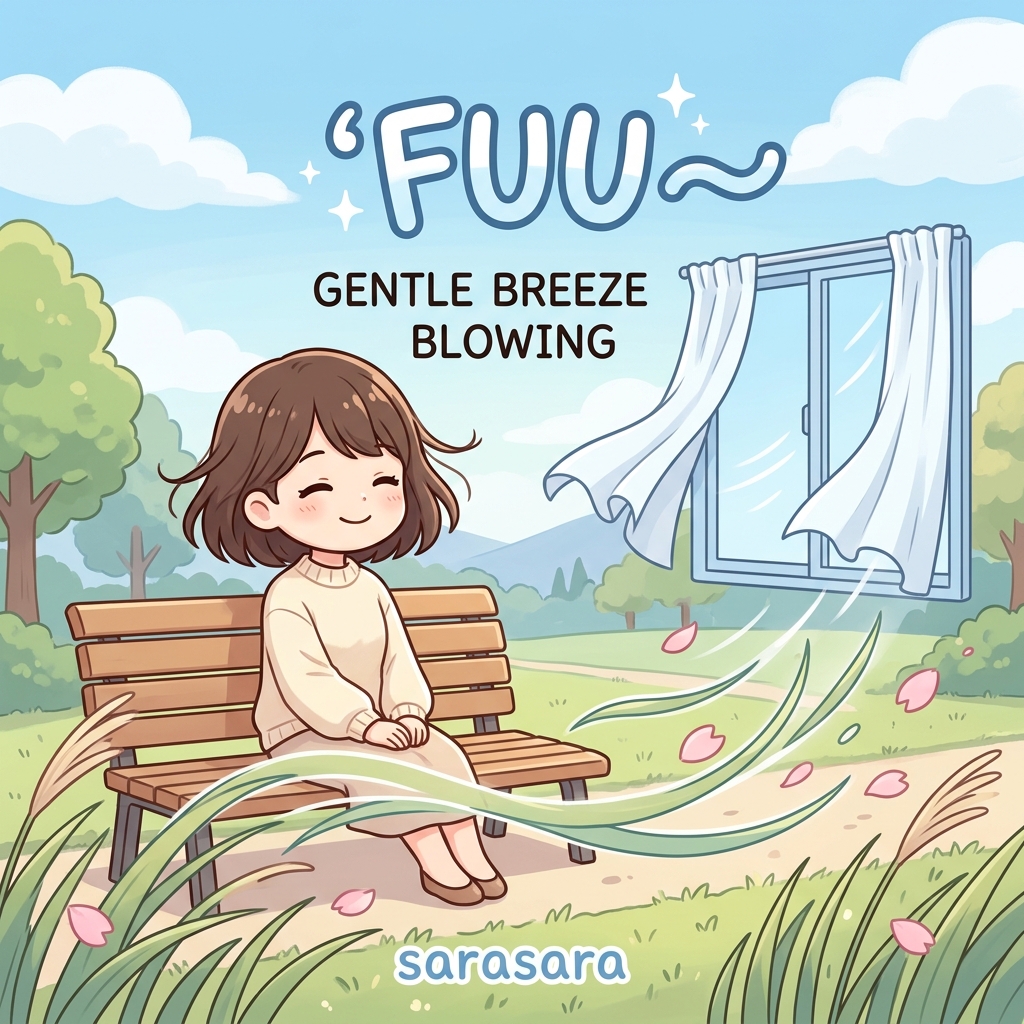
Imagine you are in a peaceful Japanese park. A light breath of air comes through the window, leaves move softly, and a small stream flows nearby. How would you describe these gentle sensations in Japanese? Many learners may confuse ふーっ (fuu) and さらさら (sarasara), because both can appear in calm, light scenes. However, they describe different kinds of sensations.
ふーっ (fuu) is often connected with a soft breath, a gentle puff of air, or air moving out slowly. さらさら (sarasara), on the other hand, often describes a light, smooth, dry, or flowing sound or texture, such as leaves rustling, hair feeling smooth, sand running through your fingers, or a stream flowing gently.
Two Similar Sounds, Different Impressions
At first glance, ふーっ (fuu) and さらさら (sarasara) may seem similar because both can feel light and gentle. But their focus is different.
ふーっ (fuu) usually suggests air or breath moving in a soft, drawn-out way. Think of blowing on hot tea to cool it, letting out a long breath, or feeling a soft puff of air. It often feels like a single gentle release of air.
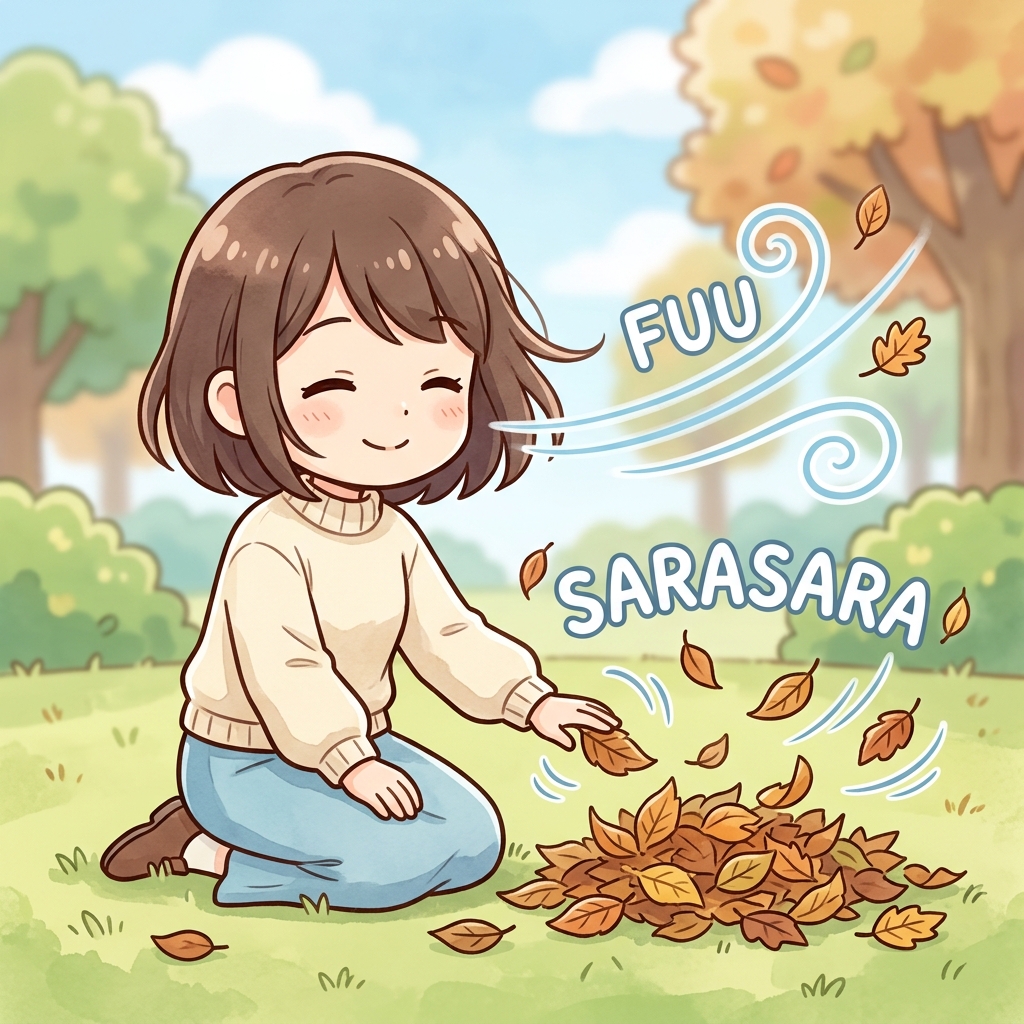
さらさら (sarasara) is broader. It can describe the soft rustling of dry leaves, the smooth feel of hair, the light sound of a stream, or fine sand moving smoothly. Instead of focusing on air itself, it often focuses on the sound, texture, or movement of something light, smooth, dry, or flowing.
The Scene Behind Each Expression
You might use ふーっ (fuu) when describing:
- A light breath escaping your lips: 「熱いお茶をふーっと冷ます。」 (To cool hot tea with a gentle puff.)
- A soft movement of air: 「窓からふーっと風が入ってきた。」 (A gentle breeze came in through the window.)
- A long relaxed breath: 「疲れて、ふーっと息を吐いた。」 (I was tired and let out a long breath.)
さらさら (sarasara) is natural in scenes like these:
- Dry leaves rustling in the wind: 「枯葉が風でさらさらと音を立てる。」 (Dry leaves rustle softly in the wind.)
- Smooth, flowing hair: 「さらさらな髪。」 (Smooth, silky hair.)
- The sound of a clear stream: 「小川がさらさらと流れる。」 (A small stream flows gently.)
- The feel of fine sand: 「さらさらな砂浜。」 (A beach with fine, smooth sand.)
Is the Source Breath, Air, or a Moving Surface?
Think of ふーっ (fuu) as a soft breath or puff of air, often happening once and gently. Think of さらさら (sarasara) as a light, smooth, dry, or flowing sound or texture. Leaves, hair, sand, and streams can all feel or sound さらさら.
How Japanese Speakers Choose Between Them
The choice depends on what you want to describe. If the focus is a breath, a puff, or air being gently blown out, ふーっ (fuu) is usually natural. If the focus is a smooth texture, fine dry movement, rustling leaves, or gently flowing water, さらさら (sarasara) is usually better.
For example, if you feel a soft breeze itself, words like そよそよ or a phrase like 優しい風 may also be natural depending on the sentence. If that breeze makes dry leaves move with a light sound, then 葉っぱがさらさら鳴る can sound natural. The important point is to notice whether you are describing the air itself, the breath, or the thing being moved.
Common Pitfall: Mixing Up Breeze and Its Effect
A common mistake is using さらさら for any light wind. さらさら usually describes the sound or texture of something light and smooth, such as leaves, sand, hair, or a stream. For air or breath itself, ふーっ, そよそよ, or a normal phrase like 優しい風 may be more natural depending on the situation.
Compare the Sound and Feeling
Play the audio and listen to how the examples sound in Japanese.
Japanese: 窓からふーっと優しい風が吹き込んできて、カーテンが揺れた。
English: A gentle breeze (fuu) blew in from the window, making the curtains sway.
Japanese: 小川のせせらぎがさらさらと聞こえ、心が落ち着いた。
English: The babbling of the stream (sarasara) was heard, and my mind felt at peace.
Small Nuance, Big Difference
Understanding the difference between ふーっ (fuu) and さらさら (sarasara) helps you describe gentle scenes more accurately. ふーっ gives the feeling of air or breath being released softly. さらさら gives the feeling of something light, smooth, dry, or flowing moving pleasantly or quietly.
These are small differences, but they make your Japanese descriptions sound much more natural.
Quick Practice with Real Context
Next time you are outside, pay attention to what you are actually sensing. Is it a breath or a soft puff of air? That may be ふーっ (fuu). Is it the sound of leaves, the smooth feel of hair, fine sand, or a stream? That may be さらさら (sarasara).
Related Expressions
| Expression | Meaning |
|---|---|
| ひゅうひゅう (hyuuhyuu) | Whistling wind, usually stronger or colder than ふーっ. |
| そよそよ (soyosoyo) | A gentle breeze blowing softly and continuously. |
| ざわざわ (zawazawa) | A rustling or murmuring sound, often noisier or more restless than さらさら. |
Frequently Asked Questions
What is the main difference between ふーっ (fuu) and さらさら (sarasara)?
ふーっ (fuu) usually describes a soft breath, puff, or gentle release of air. さらさら (sarasara) describes a light, smooth, dry, or flowing sound or texture, such as smooth hair, fine sand, rustling leaves, or a gently flowing stream.
Can I use さらさら (sarasara) to describe a light wind?
Usually, さらさら is not used for the wind itself. It is more natural for the sound or texture of something affected by wind, such as dry leaves or hair. For a gentle breeze itself, そよそよ or a phrase like 優しい風 may be more natural. If the focus is a soft puff or breath-like movement of air, ふーっ may fit.