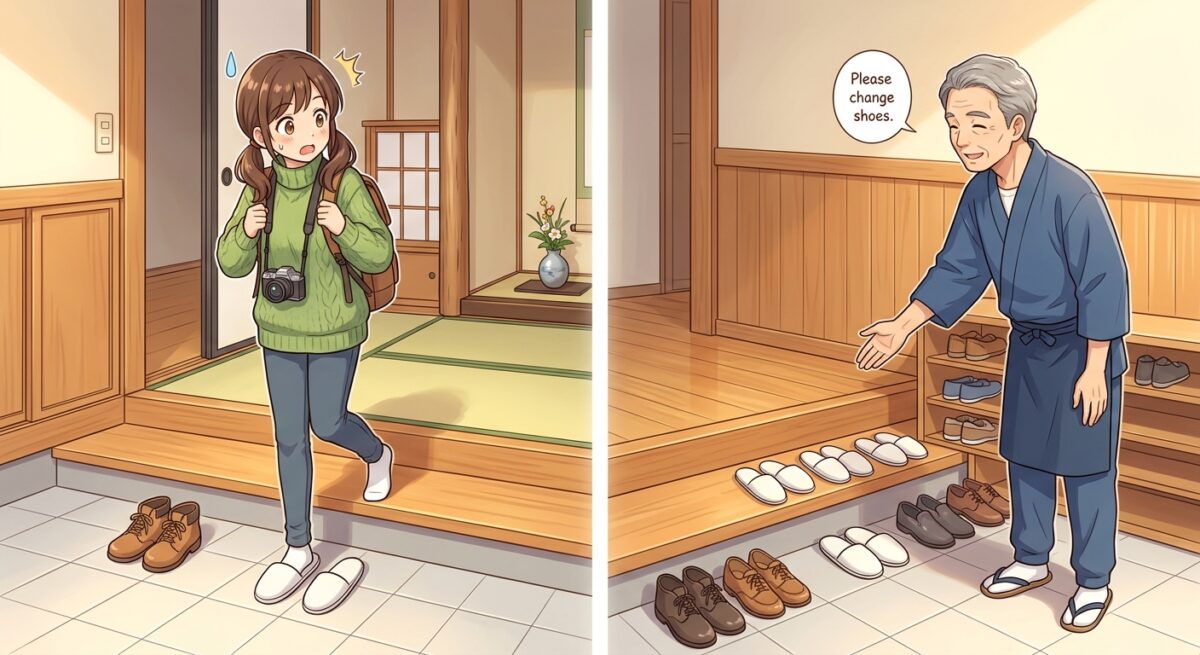
Quick answer: Do not remove your shoes in every Japanese building. Shoes usually stay on in stations, shops, modern hotel common areas, and many restaurants. They commonly come off in private homes, many ryokan, tatami rooms, and clearly marked clean areas. At each entrance, pause and look for a lower floor beside a raised floor, shoe shelves or lockers, slippers, tatami, signs, and what other visitors are doing. A building can have different rules for different rooms, so posted instructions and staff guidance take priority over any general custom.
The practical rule is simple: check the boundary before you cross it. If the entrance system is unclear, ask rather than guessing. The guide below covers homes, accommodation, restaurants, temples and historic buildings, schools, clinics, fitting rooms, baths, public toilets, and ordinary public spaces.
Use This 10-Second Entrance Check
- Stop before stepping up. A lower entrance beside a raised floor often marks the outdoor-to-indoor boundary.
- Look for storage. Shoe shelves, lockers, numbered tags, bags, or rows of shoes are strong clues.
- Check for slippers. Guest slippers near the entrance usually mean outdoor shoes stay there.
- Look at the next surface. Tatami, polished wood, treatment areas, and clean mats may have separate rules.
- Read signs and observe the flow. Other visitors are a useful clue, although staff or residents may follow a different route.
- Ask before crossing. Facility instructions always take priority over this general guide.
Places Where Shoes Are Normally Removed
Private homes
Outdoor shoes normally stay in the genkan, the lower entrance area. Remove them before stepping onto the raised indoor floor. Use slippers if the host offers them, but leave ordinary slippers outside a tatami room.
For more details, see our guide to Japanese home etiquette for visitors.
Ryokan and Japanese-style guest areas
Many ryokan ask guests to remove shoes at the main entrance, the guest-room entrance, or before a tatami area. The boundary and slipper system vary by property. A modern hotel may allow shoes in its lobby and corridors while using a different rule for a Japanese-style room or bath area.
Tatami rooms
Do not take outdoor shoes onto tatami. Ordinary indoor slippers also normally stay outside the tatami area. Check for a sign or staff instruction if the route is unclear.
Onsen and public baths
Visitors are usually asked to remove shoes at the facility entrance, and shoes or slippers should be removed before the changing room. Use the shoe locker or storage system provided and follow that facility’s signs.
Some restaurants and fitting rooms
A restaurant with raised seating, tatami, private rooms, or shoe lockers may require shoe removal even when the entrance lobby allows shoes. Some fitting rooms use a raised clean floor or mat. Check at the specific room rather than assuming the whole business follows one rule.
Places Where Shoes Usually Stay On
Shoes generally stay on in ordinary stations, airports, department stores, supermarkets, convenience stores, modern offices, and the common areas of many modern hotels. Many cafes, ramen shops, and restaurants with standard floors also allow shoes.
As a practical starting point, people normally keep their outdoor shoes on in ordinary public restrooms at stations, shops, and commercial facilities. This is not a universal rule. Check the floor boundary, signs, and whether dedicated slippers are provided, and follow the facility’s instructions. Toilet slippers are different: they may be provided inside a restroom within a home, ryokan, restaurant, clinic, or other already shoes-off indoor area. Use them only in that toilet and leave them there.
These are starting assumptions, not universal rules. A marked room, activity area, raised floor, or staff instruction can change the answer.
How to Enter a Home or Shoes-Off Area
- Stay on the lower or outdoor side while removing your shoes.
- Step onto the clean floor without putting a socked foot back where outdoor shoes have been.
- Place shoes on the shelf, in the locker, in the supplied bag, or where the host or staff directs you.
- Keep any locker key or numbered tag until you leave.
In some homes and traditional settings, people align shoes neatly with the toes facing the exit. Treat this as a possible courtesy, not an absolute nationwide rule. A host or employee may arrange them, and in a crowded entrance it is more important not to block others or ignore the facility’s system.
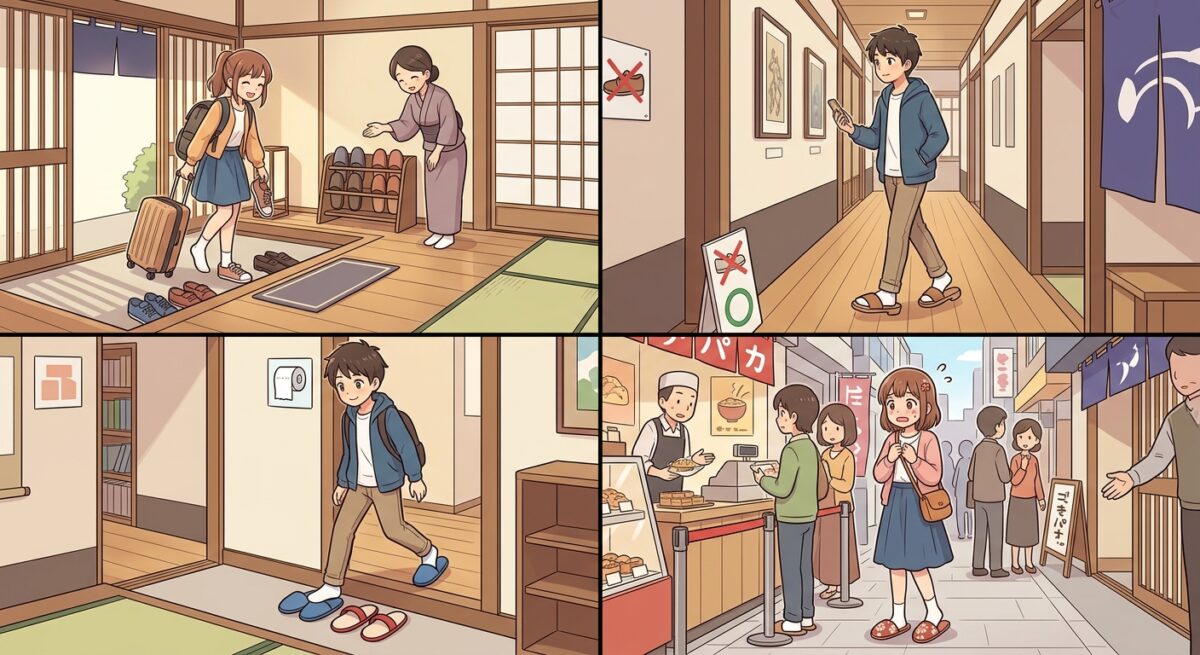
Slippers, Toilet Slippers, and Tatami
- Use indoor slippers only where the host or facility intends.
- Remove ordinary slippers before stepping onto tatami unless the facility explicitly says otherwise.
- Do not confuse ordinary indoor slippers with toilet slippers.
- Keep toilet slippers inside the toilet area.
- If no slippers are provided, do not assume that outdoor shoes are allowed; check the boundary or ask.
Location-Specific Exceptions
| Location | Practical starting point | What can change the answer |
|---|---|---|
| Temples, shrines, historic buildings | Shoes usually stay on outdoors | Inner halls, restored houses, prayer spaces, or tatami rooms may require removal; photography and footwear permission are separate |
| Schools, school events, sports halls, gyms, community facilities | Check every visit | Rules can differ by school, event, facility, room, and activity area. Visitors may be asked to use guest slippers, indoor shoes, or dedicated sports shoes; a gym competition area may follow a different rule from its entrance hall |
| Hospitals, clinics, dental offices, rehabilitation rooms, treatment areas | Check at the entrance | Footwear policies vary by facility and area. Look for shoe storage, slippers, signs, or staff guidance rather than judging by hospital size or department |
| Museums, castles, preserved houses | Check room by room | A gallery may allow shoes while a historic room or preserved interior does not |
| Restaurants | Many standard-floor venues allow shoes | Raised seating, tatami, private rooms, or lockers may signal removal |
For every location above, the facility’s sign and staff guidance take priority. The rule may apply only to one room rather than the entire building.
Before a school visit, school event, community activity, or public-facility visit, check the invitation, information email, facility website, or other advance instructions. Entrance signs and staff directions take priority if the on-site system differs.
You can also read our guide to etiquette when visiting a Japanese school.
Socks, Wet Shoes, Luggage, and Safety
Clean socks are a useful practical choice when visiting a home, ryokan, school, temple interior, or other shoes-off place. This is advice, not a legal or religious requirement. Whether socks or bare feet are accepted can depend on the facility.
If your socks or shoes are wet or muddy, pause before stepping onto tatami or a clean floor and ask what to do. Staff may offer a bag, another route, or different footwear. Keep luggage away from the footwear-changing path. Do not leave valuables inside shoes or in an unsecured shoe locker. This does not mean that a locker formally managed by the facility is unsafe. If removing or changing footwear could be unsafe because of mobility, balance, or medical needs, tell staff before attempting it and ask for a safe option.
What to Say When You Are Unsure
| Japanese | Romanization | Meaning |
|---|---|---|
| ここで靴を脱げばいいですか? | Koko de kutsu o nugeba ii desu ka? | Should I take off my shoes here? |
| スリッパを使ってもいいですか? | Surippa o tsukatte mo ii desu ka? | Can I use these slippers? |
| このままで大丈夫ですか? | Kono mama de daijōbu desu ka? | Is it okay like this? |
If you step into a shoes-off area by mistake, return to the entrance, correct the mistake calmly, and say すみません / Sumimasen / “Excuse me” / “I’m sorry.” Do not continue through the clean area simply because you feel embarrassed.
Practical Checklist
- Pause before a raised or clearly marked boundary.
- Look for shelves, lockers, slippers, bags, tatami, and signs.
- Keep shoes on in ordinary public areas unless a clue or instruction says otherwise.
- Remove shoes before entering the clean area, not after stepping onto it.
- Keep ordinary slippers off tatami and toilet slippers inside the toilet.
- Carry clean socks if your plans include traditional or shoes-off places.
- Keep luggage out of the changing path and ask for help if changing footwear is unsafe.
- When uncertain, follow staff guidance rather than a general assumption.
Official References
The following English-language pages from the Japan National Tourism Organization were checked on July 19, 2026. They provide general supporting information for the related footwear guidance; they do not establish every facility-specific example in this article.
- Japanese Manners Do’s and Don’ts — homes and other places with no-shoe policies.
- Japanese Ryokan Guide — removing shoes indoors at ryokan.
- How to Best Enjoy Japan’s Onsen — footwear at onsen entrances and changing rooms.