A visit to a private home in Japan is easier when you treat the host, not a list of national customs, as the source of truth. Homes differ in layout, family routine, age group, accessibility needs, pets, children, and how formal the invitation is.
This guide gives you a sequence for a first visit: confirm the practical details, pause at the entrance, ask before using private space, and leave without making the host guess what you need. It is written for visitors, students, residents, and expats; it does not assume that every Japanese household follows one rulebook.
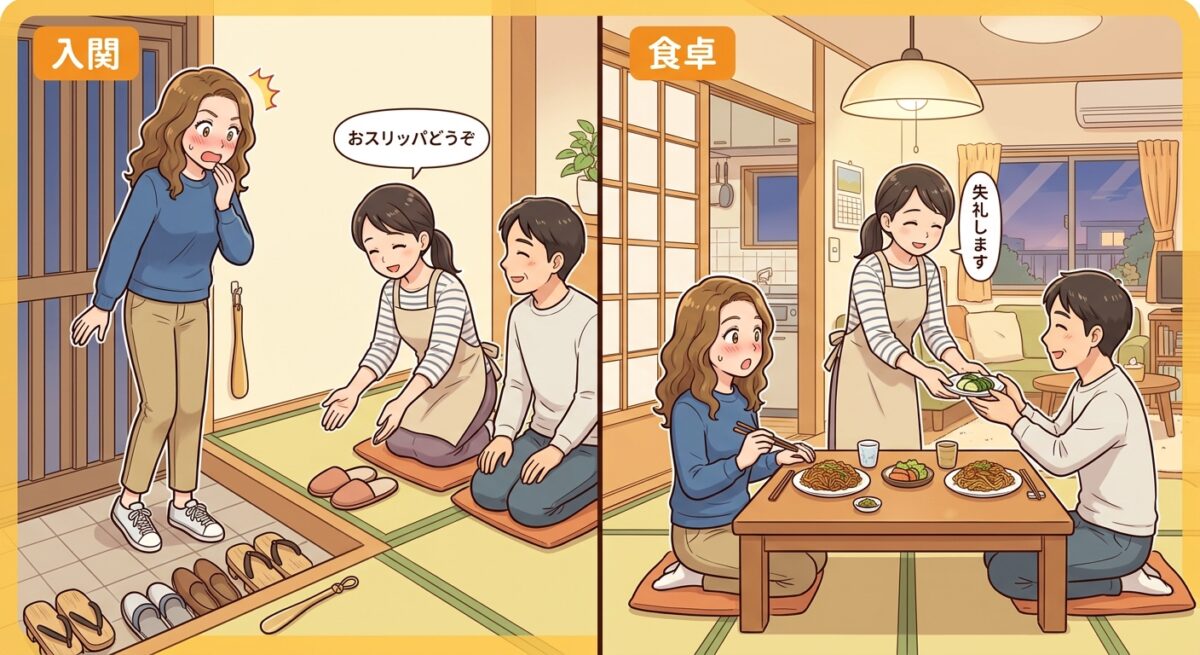
Use three rules when details differ
- Ask before arrival about anything that affects preparation.
- At the home, pause at boundaries and follow the host's instruction.
- If you make a small mistake, correct it calmly instead of turning it into a long apology.
Before the visit: confirm the details that affect the host
A message before the visit prevents more awkwardness than memorizing formal etiquette. Confirm only what is relevant; a casual coffee with a close friend needs fewer questions than a meal, a visit with children, or an overnight stay.
| Confirm | A practical question | Why it matters |
|---|---|---|
| Time and length | “Is 2:00 still good, and about what time should I plan to leave?” | The host may be planning a meal, childcare, transport, or another appointment. |
| Address and entrance | “Which building entrance or intercom name should I use?” | Apartment names, unit numbers, locked entrances, and parking instructions can be easy to miss. |
| Who is coming | Confirm every adult and child rather than bringing an extra guest. | Space, food, seating, and child safety may depend on the number of visitors. |
| Food needs | Share allergies, medical dietary needs, religious restrictions, and foods you cannot eat. | Tell the host before ingredients are bought or prepared. |
| Children, pets, or mobility | Ask about stairs, pets, room for a stroller, or anything you need to enter safely. | A compact home may not have a waiting area, lift, or child-proof space. |
| Overnight arrangements | Ask what to bring and when the household wakes, eats, bathes, and leaves. | An overnight visit affects towels, bedding, bathroom order, breakfast, and morning schedules. |
A host gift is not automatically required for every visit. The relationship, occasion, length of stay, host's preferences, food restrictions, and the burden of storing or returning a gift all matter. For that separate decision, see our guide to whether to bring a gift and what to choose.
Arriving at the home: use a five-step sequence
- Message before a meaningful delay or an unplanned early arrival. Do not assume that being early is always helpful.
- Wait for the host to open or identify the entrance. In an apartment building, use the instructed intercom and do not follow another resident through a locked door.
- Keep wet umbrellas, luggage wheels, and large bags under control. Ask where they should go before placing them on a clean floor, chair, or bedding.
- Pause at the entrance boundary. Look for the lower shoe area, a raised floor, slippers, and the host's direction.
- Greet first, then move when invited. Ojamashimasu is useful when entering, but a sincere greeting in a language both people understand is also fine.
Shoes and slippers: identify the boundary before moving
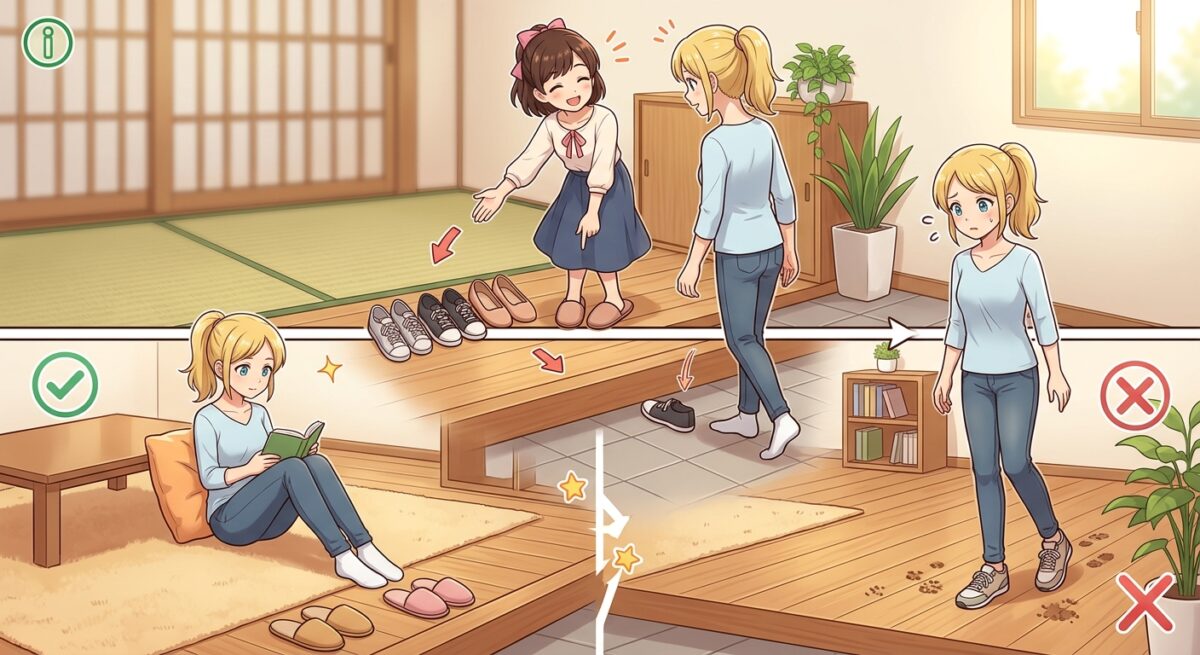
JNTO says that visitors are expected to remove shoes at the entrance in the vast majority of Japanese homes. A common layout has a lower entrance area, or genkan, beside a raised indoor floor. Remove outdoor shoes before putting a socked foot onto the raised floor, and avoid stepping back onto the lower area in socks.
That basic pattern does not answer every slipper question. A household may provide slippers, use none, keep separate toilet slippers, or ask visitors to remove ordinary slippers before tatami. If the boundary is unclear, ask instead of copying a rule from a different home. Our separate guide explains when to remove shoes and use slippers in Japan across homes and other facilities.
Turning shoes toward the door can be courteous when there is room, but it is secondary to entering safely and not blocking the doorway. Boots, mobility aids, a sleeping child, a crowded entrance, or a wet floor may change the safest sequence.
Ask where belongings go and wait for a seat
Do not assume that an empty chair, sofa, bed, counter, or patch of floor is a suitable luggage place. Wheels and bag bottoms have been outdoors, and a small home may use one surface for several purposes. Ask where to put a coat, bag, stroller, umbrella, or gift.
Wait for the host to indicate where to sit. Formal seating arrangements exist, but most visitors do not need to calculate a hierarchy in a casual home. The practical issue is whether your place blocks a doorway, kitchen route, child, heater, family altar, work area, or the host's usual seat.
Meals, allergies, and cleanup: do not make the host guess
Tell the host about dietary needs before the visit. At the table, wait until the host indicates that the meal is ready. JNTO explains that itadakimasu is commonly said before eating and gochisosama desu after a meal; these phrases express appreciation, but pronunciation is less important than clear thanks and honest advance information.
| Situation | Safer action | Avoid assuming |
|---|---|---|
| You cannot eat an ingredient | Explain it before the visit and repeat briefly if the dish is unclear. | That the host can infer an allergy from “I do not like it.” |
| Food is served before others sit | Wait, or start if the host directly invites you. | That one fixed rule applies to every family meal. |
| You want to help | Ask once before moving dishes or entering the kitchen. | That carrying plates is always helpful. |
| The host declines help | Accept the answer and keep your own area tidy. | That repeated offers are more polite. |
Protect privacy inside the home
A private home is not a public attraction. Ask before entering another room, opening a refrigerator or cabinet, using a desk, changing the temperature, or charging a device. If you need a toilet, changing space, place to pray, or quiet place for a medical task, ask directly rather than searching through the home.
Ask before taking any photo and again before posting it. A harmless-looking image can reveal a family member, child, nameplate, address, school document, delivery label, work screen, medication, family altar, or security arrangement. Permission to take a group photo is not automatically permission to publish it.
What can differ by household, generation, and layout
Regional identity may influence food, language, architecture, and family practice, but region alone does not predict a household's rules. For a visitor, the current host and the actual home are more reliable than a Tokyo-versus-rural or young-versus-old stereotype.
| Difference | What may change | What to do |
|---|---|---|
| Apartment or detached home | Entrance size, stairs, intercom, luggage space, sound sensitivity | Ask about the entrance and keep belongings compact. |
| Tatami or all hard flooring | Where slippers stop and where people sit | Follow the visible boundary and host's instruction. |
| Older or younger household members | Meal timing, formality, noise, mobility and preferred communication | Do not infer rules from age; ask about the schedule and access needs. |
| Children or pets | Doors, food, fragile items, allergy risks and supervision | Confirm in advance and follow the adult host's boundaries. |
| Casual visit or formal occasion | Clothing, gift decision, seating, meal and visit length | Ask what kind of gathering it is rather than dressing or buying by stereotype. |
Visiting with children
Tell the host who is coming and what the child may need. Bring essential food, medication, diapers, wipes, and a quiet activity rather than expecting the home to have them. Ask before using a bedroom for changing, and supervise children around stairs, balconies, heaters, sliding doors, tatami, pets, fragile displays, and work materials.
If something spills or breaks, tell the host immediately, keep people away from any hazard, and ask how they want it handled. Do not start using an unfamiliar cleaner or moving broken material without checking.
If you stay overnight
An overnight invitation needs its own confirmation. Ask what to bring, where luggage belongs, when the bathroom is available, how that household uses the bath, which towel and bedding are yours, whether doors should be locked, and what time the household wakes or leaves. Do not assume that a private home's bath works exactly like a public bath or ryokan.
In the morning, keep bedding and towels together and ask where they go. Confirm breakfast and departure plans the night before if anyone has work, school, childcare, or a train to catch.
Useful Japanese phrases for a home visit
| Japanese | Romaji | Practical meaning |
|---|---|---|
| おじゃまします。 | Ojamashimasu. | Thank you for having me / Excuse me for entering. |
| 靴はここで脱げばいいですか? | Kutsu wa koko de nugeba ii desu ka? | Should I take off my shoes here? |
| これはどこに置けばいいですか? | Kore wa doko ni okeba ii desu ka? | Where should I put this? |
| 何か手伝いましょうか? | Nanika tetsudaimashou ka? | May I help with anything? |
| そろそろ失礼します。 | Sorosoro shitsurei shimasu. | I should be going soon. |
| 今日はありがとうございました。 | Kyou wa arigatou gozaimashita. | Thank you for today. |
You do not need to use every Japanese phrase. A short, clear question in a shared language is safer than a memorized phrase that does not communicate an allergy, access need, or schedule problem.
Leaving without overstaying
- Use the agreed end time as your main cue instead of waiting for an indirect hint.
- If there was no end time, mention your departure before transport becomes difficult or the household's next routine begins.
- Collect belongings without opening storage or entering rooms alone.
- Thank the host at the door and check that you have the correct shoes, umbrella, coat, and bag.
- Send a short message later that day or the next day. A long formal note is not required for an ordinary visit.
If you made a small mistake, one apology and a correction are usually more useful than repeatedly interrupting the visit. If you damaged something, exposed private information, or created a safety problem, explain exactly what happened and ask how to make it right.
Official references and scope
The following JNTO pages support the general shoe, observation, asking, greeting, and dining guidance used above. They do not define one mandatory procedure for every private home.