The fifth station makes it sound easy
Mount Fuji is usually sold as approachable: drive or bus to the fifth station, and the summit is "just a hike" from there. I climbed it that way — a round trip from the fifth station, up and back. It took me about 11 hours.
That number is the whole point of this article. Eleven hours is not a short outing. It is not what "start from the fifth station" sounds like when it is written on a tour brochure.
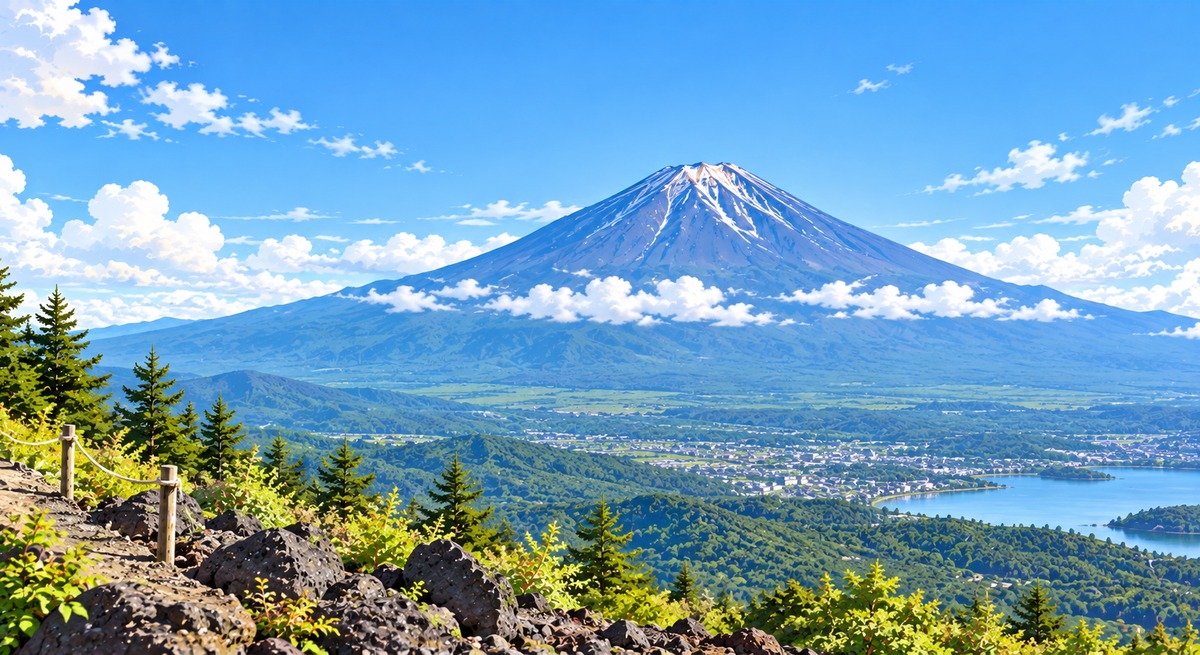
Conceptual illustration of Mount Fuji during the climbing season.
What I actually did
I went from the fifth station to the summit and back, round trip, in roughly 11 hours. That is my own time, not a general figure — different routes, paces, and conditions change this significantly (see the route comparison below). I am not going to specify which of Mount Fuji's four fifth stations I started from; the trails differ enough that it matters, and I would rather leave that unconfirmed than guess.
What I can say plainly: it was a full day on the mountain, not a few hours of sightseeing. The gap between "fifth station" as a tourist departure point and what those 11 hours actually involved is the reason I think Mount Fuji deserves to be treated as a genuine climb, not an extension of a bus tour.
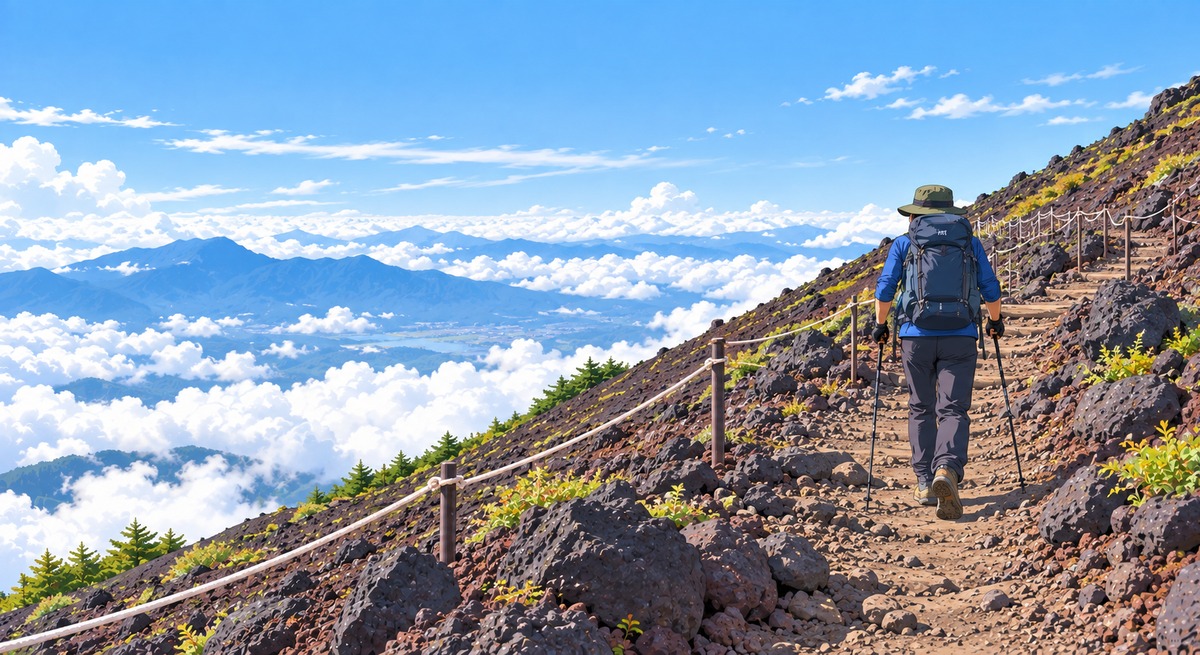
Conceptual illustration of climbing on Mount Fuji; not an exact representation of the author's route.
The routes aren't all the same
Mount Fuji has four official climbing routes, and they are not interchangeable:
| Route | Prefecture | Fifth-station elevation | Typical total time |
|---|---|---|---|
| Yoshida | Yamanashi | 2,305 m | around 10 hours |
| Fujinomiya | Shizuoka | 2,400 m | around 8 hours |
| Subashiri | Shizuoka | 2,000 m | around 11 hours |
| Gotemba | Shizuoka | 1,440 m | around 13 hours |
(Official figures, current for the 2026 season — these are general route times, not my own climb.) The point isn't which one I used. The point is that "the fifth station" means something different depending on the route, and none of the official totals are a quick afternoon.
Before you climb Mount Fuji in 2026
When I climbed, I didn't have to think about any of this. Today, climbers also need to check the current entry fee and access rules before setting out — Mount Fuji has become considerably more regulated in the last two years.
Current as of the 2026 season, confirmed from Yamanashi and Shizuoka prefecture sources:
- Entry fee: 4,000 yen per person, per climb, on all four routes — Yoshida, Fujinomiya, Subashiri, and Gotemba. This is mandatory, not a donation.
- How this changed: until 2024 there was no mandatory fee, only a voluntary 1,000 yen "conservation contribution" on the Yamanashi side. Yamanashi introduced a mandatory 2,000 yen fee in 2024, raised it to 4,000 yen in 2025, and Shizuoka's three routes introduced their own mandatory 4,000 yen fee for the first time in 2025. Both stayed at 4,000 yen for 2026.
- Yoshida route: book through the official passage-reservation system (fujisan-climb.jp). For 2026, 3,000 slots were released in advance within an overall daily cap of 4,000 climbers, and mountain-hut guests aren't counted against that cap; same-day reservation was also possible, payment was by credit card or PayPay online, cancellation was allowed through the day after payment, and the climb date could be changed up to the day before.
- Yoshida gate hours: the gate closes from 14:00 to 3:00 the next morning to anyone without a confirmed mountain-hut booking.
- Daily climber caps aren't the same on every route: Yoshida sets an overall cap of 4,000 climbers a day (mountain-hut guests excluded). Shizuoka's official page for its three routes does not state a daily numeric cap at all — rules differ by route, and not every route uses the same daily-cap system.
- Fujinomiya, Subashiri, and Gotemba (Shizuoka side): climbers must complete a short online safety and conservation course and register through the prefecture's FUJI NAVI app before climbing, which also handles the fee payment and issues a QR entry pass; the same 14:00 to 3:00 hut-reservation requirement applies.
- Season: roughly July 1 to September 10, with the exact opening date depending on weather and snow conditions each year.
- Not verified: whether children pay the same 4,000 yen fee — sources disagree and this was not confirmed against a primary government page, so confirm it directly before you travel.
Rules and fees can change by season, so check the official Mount Fuji climbing information before your own trip rather than relying on this article alone.
Why the rules got stricter
I can't say I ever saw someone get rescued on the mountain, and I'm not going to pretend I did. What I do have is a general concern — one a lot of people who've spent a day on that mountain probably share — that climbing under-equipped is a real way to get into trouble there, not a theoretical one.
The current rules back that concern up, at least in part, though it's worth separating what is officially written from what is reported about it. Officially, the Yoshida reservation system includes a formal step where climbers confirm they have the right equipment and agree to climb responsibly, plus, new for 2026, photos of the trail junctions so people don't take a wrong turn partway up — the government's own label for this is "under-equipped climbing countermeasures," not "anti-bullet-climbing." Separately, as background on why these rules exist: news reporting on the changes has said Shizuoka introduced its own mandatory fee in 2025 after Yamanashi's 2024 rules were judged effective at reducing overnight, no-sleep "bullet climbs" — that's a media characterization of the policy's purpose, not wording taken from the regulation itself. Either way, the direction of the rules is the same: less casual, more prepared.
Altitude, cold, and why "just a hike" undersells it
The summit sits at 3,776 m. Altitude sickness becomes a real possibility above roughly 2,500 m — some people feel it as low as 2,000 m — with headache, nausea, and dizziness as the common early signs. The official climbing site's own advice is blunt: if it gets bad, go down. The mountain isn't going anywhere. Temperature also drops fast with elevation, and a wet, windy fifth-station evening can turn into a genuinely cold night higher up even in the middle of summer. None of this happened to me specifically — I'm not claiming altitude sickness or a weather emergency as part of my own climb — but it's the backdrop that makes "just start from the fifth station" a misleading way to think about the day.
Trash, toilets, and the parts nobody mentions
There are no trash cans on Mount Fuji, at any station, and the mountain huts don't take your trash either — officially, everything you bring up, you carry back down. That's not just a suggestion I happen to like; it's the long-standing rule for the mountain, and it hasn't changed for 2026. I think it's a fair one: if you can carry a full water bottle up, you can carry the empty one back down. If you want a fuller picture of how trash rules work for visitors more generally in Japan, Why Japan's guide to trash separation covers the everyday version of the same idea.
Toilets from the fifth station upward are generally not free — expect a small per-use cooperation fee in cash, separate from the 4,000 yen entry fee and not something that fee covers. I could not confirm a specific current amount from a primary government source, so bring coins rather than counting on an exact figure.
What I'd tell someone before they go
I'm not writing this as a step-by-step guide, because I only did it once, from one fifth station, one way. But if I were telling a friend before their first Mount Fuji climb, it would come down to this: treat the fifth station as the start of a long day, not the easy part before the real climb. Check the current entry fee and reservation rules for whatever route you're taking before you leave — they are stricter and more specific than they used to be. Carry out everything you bring in. And budget for something closer to my 11 hours than to an afternoon walk.
If a full day on a mountain is more effort than you're after, two shorter versions of the same idea are climbing Tokyo Tower's roughly 600 outdoor steps instead of taking the elevator, and walking the entire Yamanote Line loop on foot in a single day.