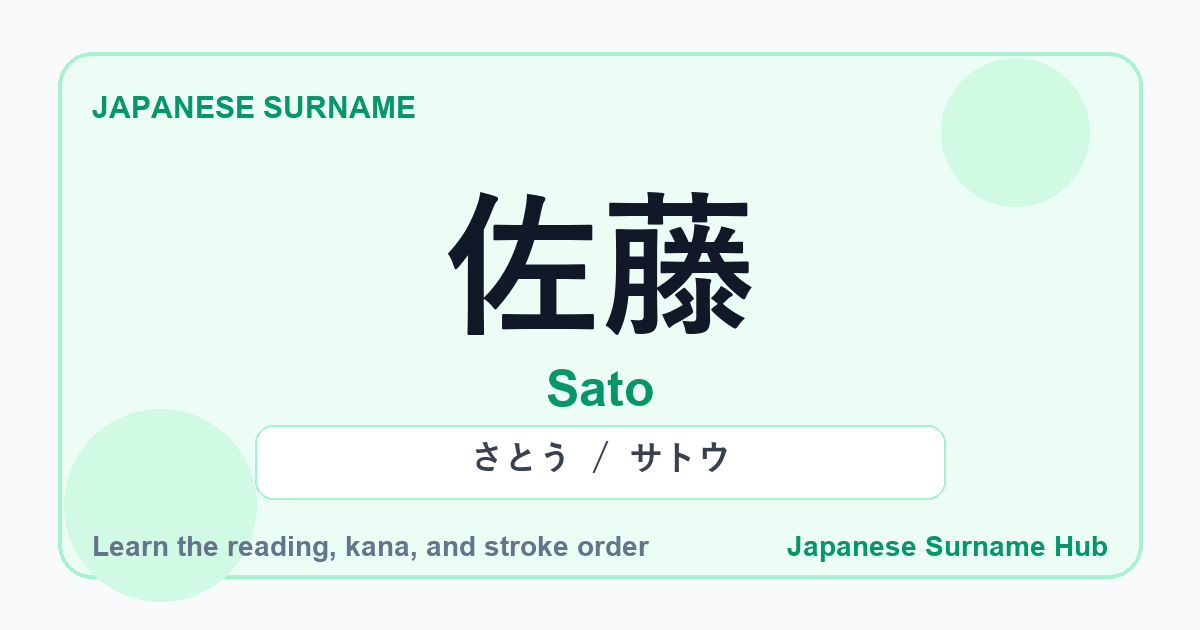
Quick Answer: 佐藤 (Sato)
Japanese Surname: 佐藤
Common Reading (Hiragana): さとう
Common Reading (Katakana): サトウ
Romaji: Sato (also commonly seen as Satō or Satou)
Pronunciation Note: The "ou" in さとう indicates a long "o" sound. While this name is often written as "Sato" in everyday English contexts, "Satō" with a macron is a more precise phonetic representation, and "Satou" directly reflects the kana spelling.
What Does the Japanese Surname 佐藤 (Sato) Mean?
The Japanese surname Sato (佐藤) is composed of two kanji characters: 佐 (sa) and 藤 (tō).
- 佐 (sa) generally means "assist," "help," or "aid."
- 藤 (tō) refers to "wisteria," a flowering plant.
A simple character-by-character interpretation might suggest something like "assist" and "wisteria." However, Japanese surnames are not always meant to be understood as direct literal phrases. Their meanings can be influenced by history, family line, place names, and naming traditions.
The character 藤 appears in many Japanese surnames and is often discussed in connection with historical naming traditions related to the Fujiwara name, which also contains 藤. However, the exact background of the Sato surname can vary by family line, region, and historical record. It is not accurate to assume that every family with 藤 in its name shares the same origin or direct lineage.
Kanji Breakdown for 佐藤
Understanding the individual kanji helps learners grasp the possible nuances behind the surname.
| Kanji | Basic Meaning | Learning Note |
|---|---|---|
| 佐 | Assist, help, aid | This kanji often carries the idea of support or assistance. It is also seen in names and words connected with helping or supporting roles. |
| 藤 | Wisteria | Wisteria is a flowering plant with cultural associations in Japan. 藤 is also a very common element in Japanese surnames, and some names containing it may be connected with older naming traditions. |
How to Read 佐藤 (Sato)
| Kanji | Hiragana | Katakana | Romaji | Reading Note |
|---|---|---|---|---|
| 佐藤 | さとう | サトウ | Sato (Satō / Satou) | The "ou" combination in さとう produces a long "o" sound. It may be romanized as "Satō" with a macron, "Satou" to reflect the kana, or simply "Sato" in everyday English contexts. |
Romaji and Pronunciation Notes
The romaji spelling for 佐藤 is typically Sato. Because the kana spelling さとう contains a long "o" sound, you may also see the following variations:
- Satō: This spelling uses a macron (ō) to clearly show the long "o" sound. It is often preferred in linguistic, academic, or learning contexts.
- Satou: This spelling follows the hiragana さとう more directly, where the final う lengthens the preceding "o" sound.
In general English-language contexts, Sato without the macron is very common. When pronouncing the name, aim for a slightly lengthened "o" sound rather than a short, clipped vowel.
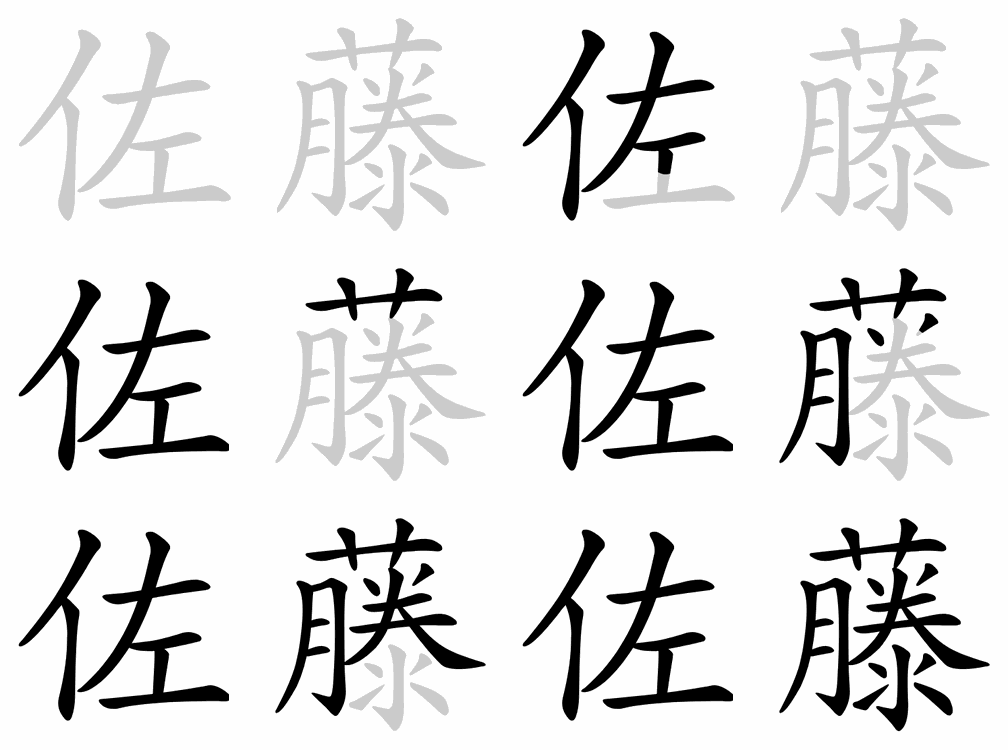
Kanji Stroke Order for 佐藤
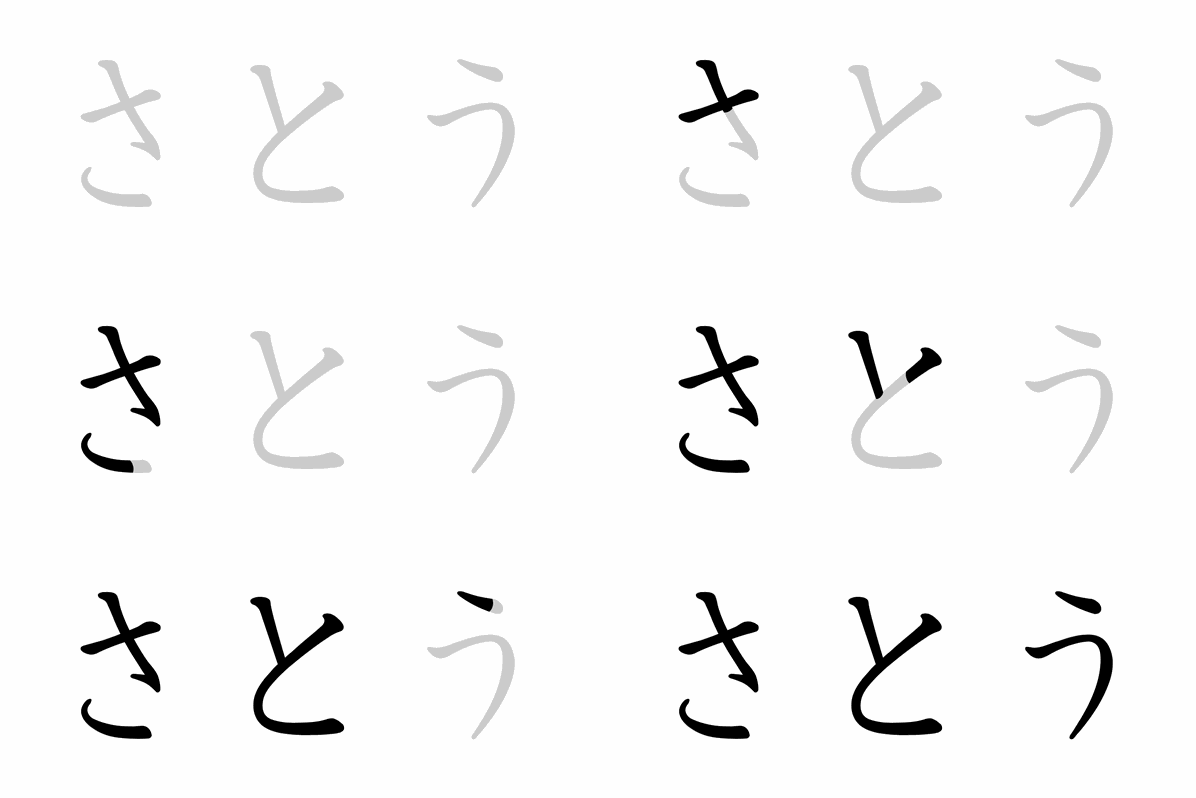
Hiragana Stroke Order
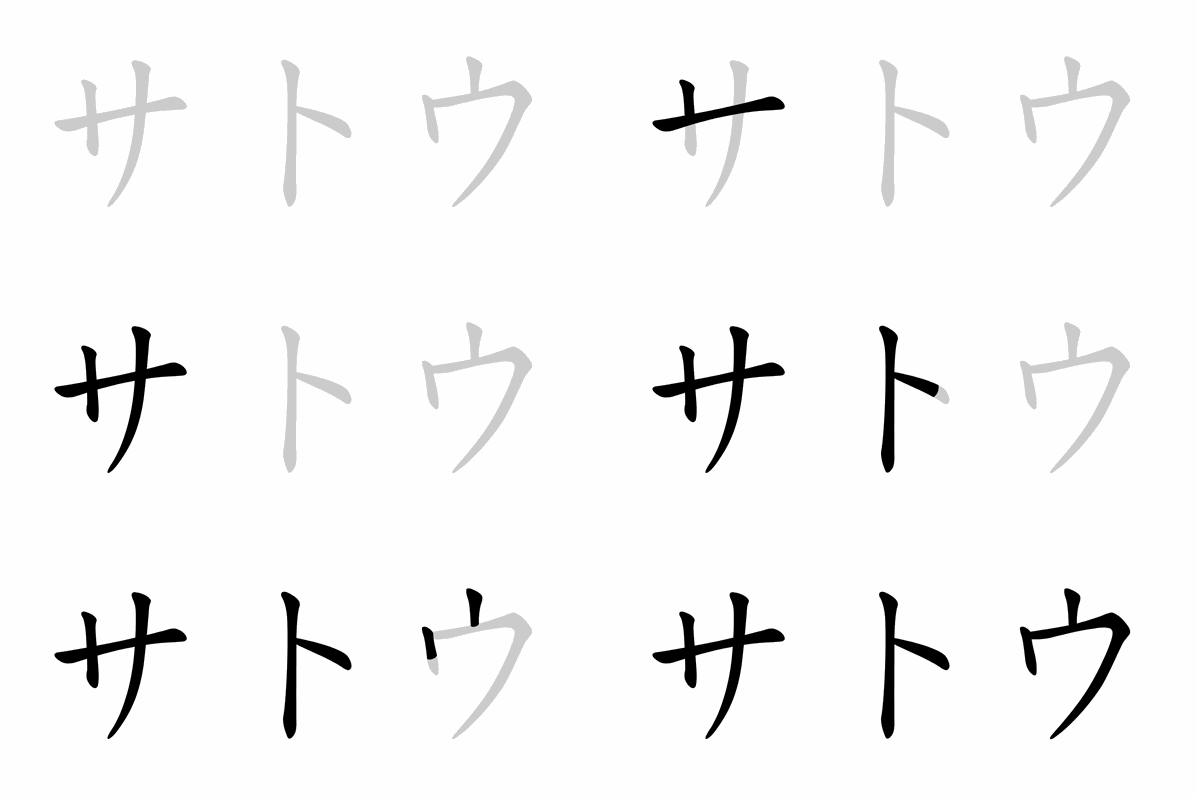
Katakana Stroke Order
Learning Note for 佐藤
Sato (佐藤) is one of the most recognizable Japanese surnames for learners. It is a useful name to study because it includes both an important surname kanji pattern and a long vowel pronunciation point.
When writing or reading this name, pay attention to the long "o" sound in さとう. The spellings Sato, Satō, and Satou can all appear depending on context, but a person's own preferred romanization should be respected in formal situations.
FAQ About 佐藤 (Sato)
Is 佐藤 (Sato) a common Japanese surname?
Yes. 佐藤 (Sato) is a very well-known Japanese surname and is widely recognized in Japan. It is a useful surname for Japanese learners to know.
What does the "藤" (tō) in 佐藤 (Sato) mean?
The kanji 藤 (tō) means "wisteria," a flowering plant. It is also a common element in Japanese surnames. Some explanations connect names containing 藤 with historical naming traditions, but the exact background can differ depending on family line, region, and historical records.
Are there other ways to write the surname 佐藤?
The kanji form 佐藤 is the standard form learners are most likely to encounter. In rare or historical cases, other name forms may exist, but when accuracy matters, it is always best to confirm the person's preferred writing and reading.
How do I pronounce the long "o" sound in Sato?
The "ou" in the hiragana さとう indicates a long "o" sound. In romaji, this may appear as Sato, Satō, or Satou. For pronunciation, hold the "o" sound slightly longer than a short vowel.
Does the Sato surname have a single origin story?
Not necessarily. Like many Japanese surnames, 佐藤 can have complex historical backgrounds. The kanji meanings and naming traditions provide helpful clues, but it is not accurate to claim one single origin story for every family with this surname.
Want to turn your own name into Japanese?
Use our Japanese Name Converter to see how your first name can be written in Japanese katakana and creative kanji ideas with meanings.
Try the Japanese Name Converter
Creative kanji ideas are for inspiration only. Foreign names are usually written in katakana.