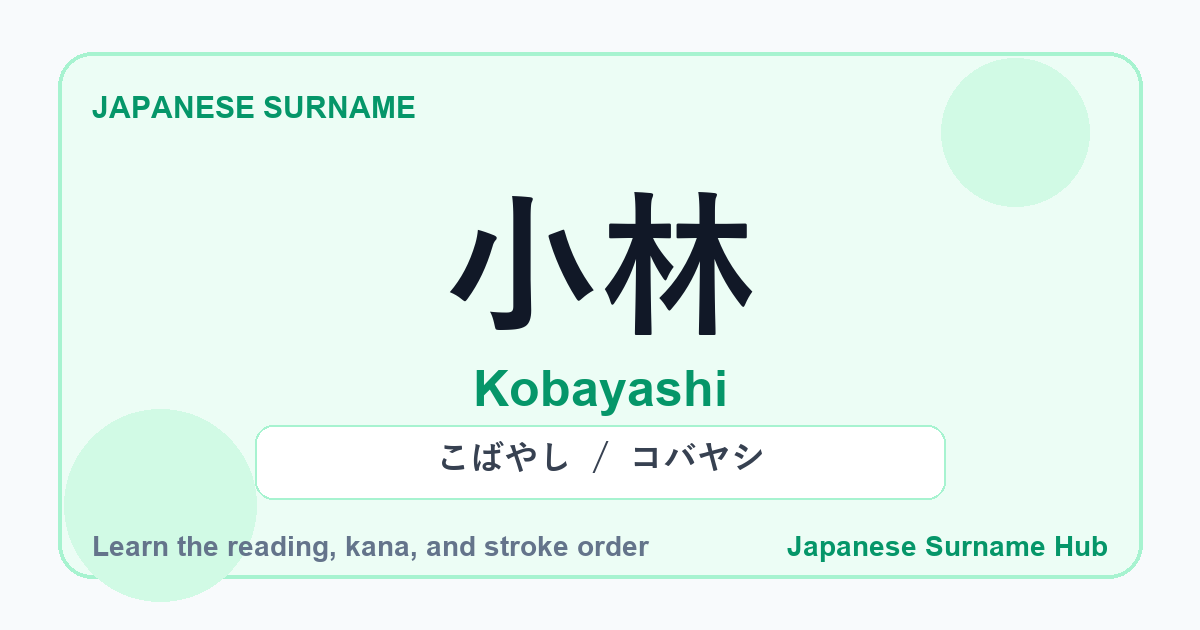
Quick Answer: Kobayashi (小林)
The Japanese surname Kobayashi is written with the kanji 小林. It is a widely recognized surname in Japan.
- Kanji: 小林
- Common Reading: Kobayashi
- Hiragana: こばやし
- Katakana: コバヤシ
- Romaji: Kobayashi
- Long Vowel Note: There are no long vowels in the standard reading of Kobayashi, so macrons are not used.
What Does the Japanese Surname Kobayashi (小林) Mean?
The surname Kobayashi (小林) can be understood as "small forest" or "small woods." It is a good example of a Japanese surname that feels connected to nature or a local landscape.
Many Japanese surnames developed from geographical features, place names, local landmarks, or historical naming traditions. For Kobayashi, the combination of "small" and "forest" may suggest a connection with a small wooded area. However, the exact background can vary by family line, region, and historical record. The literal meaning is useful for learners, but it should not be treated as one single fixed origin story for every family named Kobayashi.
Kanji Breakdown for Kobayashi (小林)
The surname Kobayashi is composed of two kanji characters:
| Kanji | Basic Meaning | Learning Note |
|---|---|---|
| 小 | Small, little | This kanji can be read as ko or shō depending on the word. It means "small" or "little" and appears in common words such as 小さい (chiisai, small) and 小学校 (shōgakkō, elementary school). |
| 林 | Forest, woods, grove | This kanji can be read as hayashi or rin depending on the word. It visually suggests multiple trees and appears in words such as 森林 (shinrin, forest). |
How to Read Kobayashi (小林)
The reading of 小林 as Kobayashi involves a common Japanese sound change called rendaku (連濁).
| Kanji | Hiragana | Katakana | Romaji | Reading Note |
|---|---|---|---|---|
| 小林 | こばやし | コバヤシ | Kobayashi | 小 is read as ko. 林 is often read as hayashi, but in this surname the h sound changes to b, producing bayashi. This kind of sound change is called rendaku and appears in many Japanese compound words and names. |
Romaji and Pronunciation Notes
The standard romaji spelling for this surname is Kobayashi. When pronouncing Kobayashi, keep each sound clear and fairly even:
- Ko: close to "ko" in "coat," but kept short
- Ba: close to "ba" in "banana"
- Ya: close to "ya" in "yard"
- Shi: close to "she" in "sheet"
There are no long vowels in the reading こばやし, so no macrons such as ō or doubled vowels such as oo are needed in the romaji spelling.
Kanji Stroke Order for 小林 (Kobayashi)
Understanding the stroke order for each kanji can help with memorization and recognition.

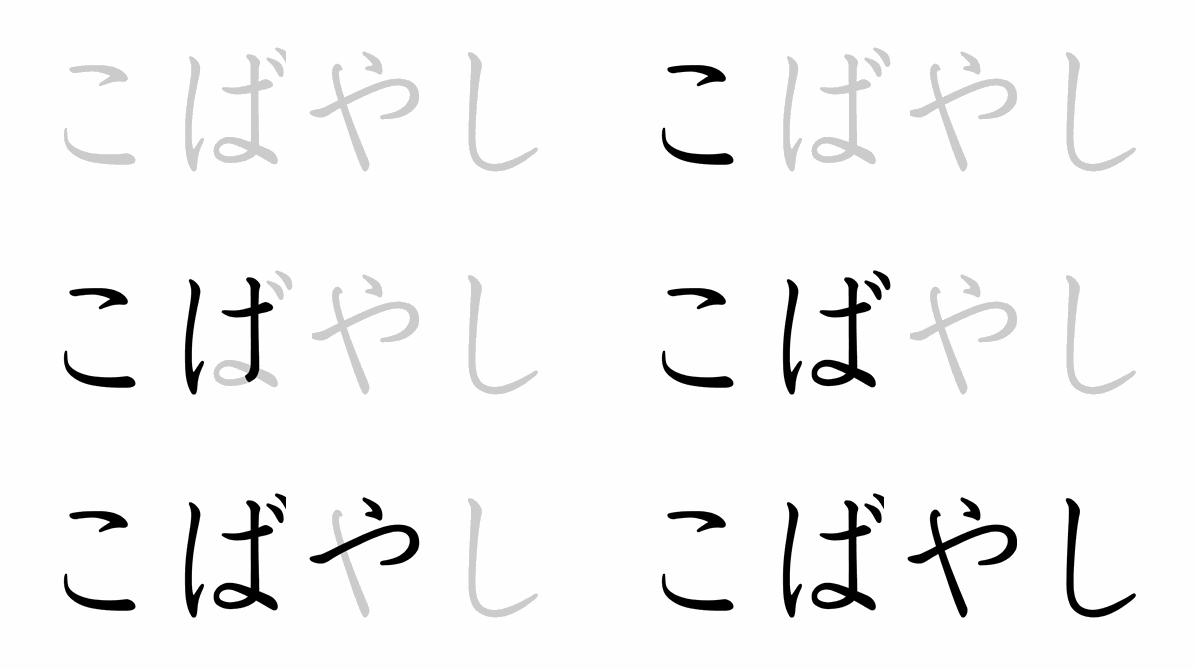
Hiragana Stroke Order for こばやし (Kobayashi)
Here is how to write the hiragana for Kobayashi.
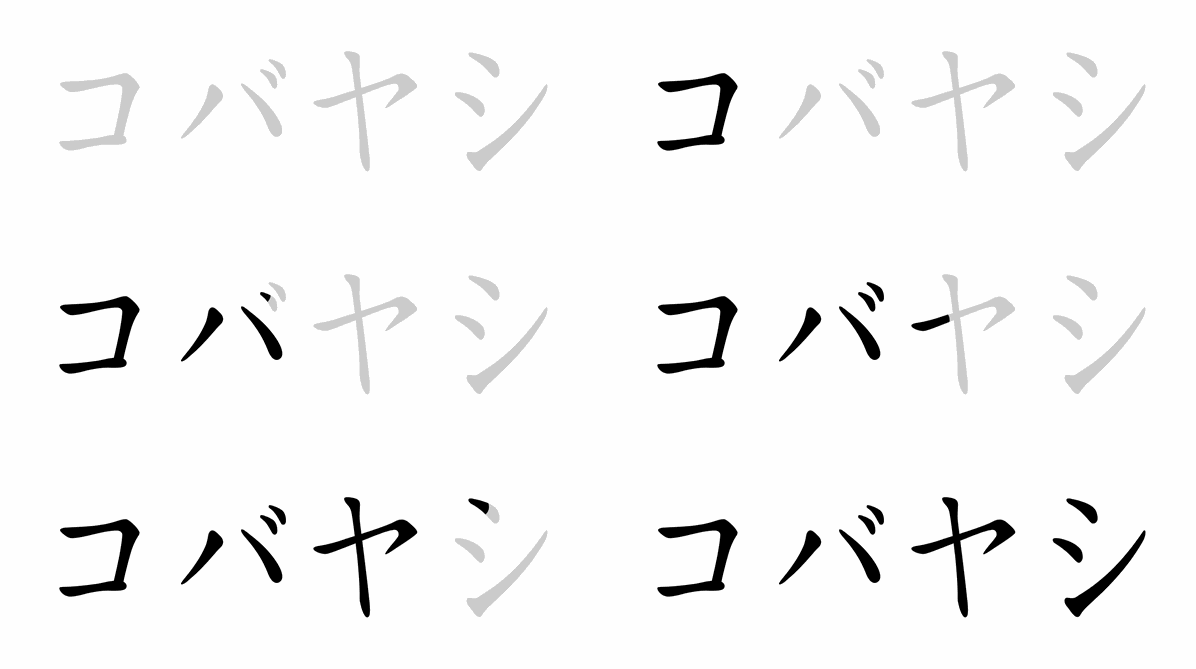
Katakana Stroke Order for コバヤシ (Kobayashi)
Here is how to write the katakana for Kobayashi.
Learning Note for Kobayashi
When learning the surname Kobayashi, remember these key points:
- Meaning: "Small forest" or "small woods" provides a helpful visual anchor for the kanji.
- Pronunciation: Pay attention to the rendaku sound change from hayashi to bayashi. Recognizing this pattern can help with other Japanese names and words.
- No long vowels: The romaji spelling is straightforward and does not require macrons.
- Common recognition: Kobayashi is a widely recognized surname, so learners are likely to encounter it in many contexts.
Practicing the kanji stroke order and the hiragana/katakana readings will help reinforce your understanding of this familiar Japanese surname.
FAQ About Kobayashi (小林)
Is Kobayashi a common Japanese surname?
Yes. Kobayashi is a very well-known Japanese surname and is widely recognized in Japan. It is a useful surname for Japanese learners to know.
Are there other ways to write Kobayashi?
The kanji form 小林 is the form learners are most likely to encounter. Other rare name forms may exist, but when accuracy matters, it is best to confirm the person's exact kanji spelling and preferred romanization.
What is the origin of the surname Kobayashi?
Kobayashi is often explained as a place-name surname meaning "small forest" or "small woods." It may suggest a connection with a small wooded area, but the exact background can vary by family line, region, and historical record. It is not accurate to assume one single origin story for all families named Kobayashi.
How do you pronounce Kobayashi correctly?
Kobayashi is pronounced ko-ba-ya-shi, with each sound kept clear and fairly even. The key point is the sound change where hayashi becomes bayashi. There are no long vowels, so no macron is needed.
Why is 小林 read as Kobayashi, not Kohayashi?
This is because of rendaku, a Japanese sound change where the first sound of the second part of a compound can become voiced. In this case, hayashi changes to bayashi, producing Kobayashi.
Want to turn your own name into Japanese?
Use our Japanese Name Converter to see how your first name can be written in Japanese katakana and creative kanji ideas with meanings.
Try the Japanese Name Converter
Creative kanji ideas are for inspiration only. Foreign names are usually written in katakana.