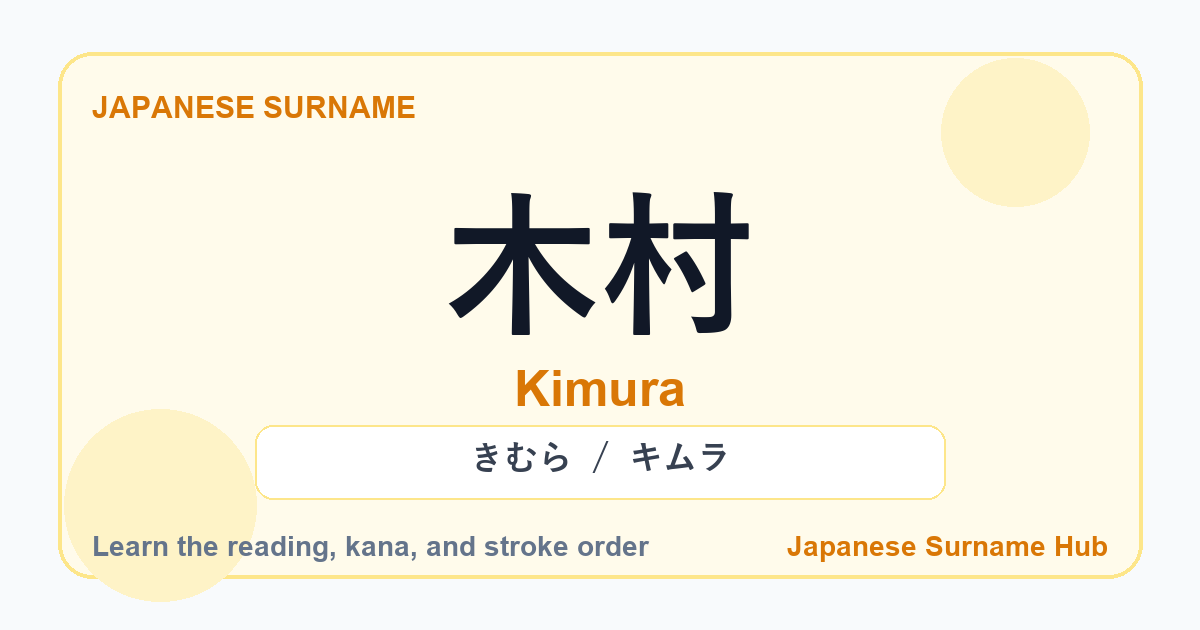
Quick Answer: Kimura (木村)
The Japanese surname Kimura (木村) is a familiar and widely recognized family name in Japan. It is usually read as Kimura, written in hiragana as きむら, and written in katakana as キムラ.
The name uses two kanji: 木 (ki), meaning “tree” or “wood,” and 村 (mura), meaning “village.” A simple way to understand the name is “tree village” or “wood village.”
The standard reading Kimura has no long vowels, so no macron is normally needed in romaji.
What Does the Japanese Surname Kimura (木村) Mean?
The surname Kimura (木村) is made from two common kanji. 木 means “tree” or “wood,” and 村 means “village.”
Together, the name can be understood as “tree village” or “wood village.” Like many Japanese surnames, it may be connected to a place name or to a local landscape, such as a village near trees, woods, or a wooded area.
However, surname meanings should not always be treated as a fixed modern definition. The exact background can vary by family line, region, and historical records. The kanji give a useful clue, but they do not always tell the full family history.
Kanji Breakdown for Kimura (木村)
Looking at each kanji helps explain why the surname is easy for learners to remember.
| Kanji | Basic Meaning | Learning Note |
|---|---|---|
| 木 (ki) | Tree, wood | 木 is a basic kanji that appears in many words related to trees, wood, and nature. In surnames, it may point to a place connected with trees or wooded land. |
| 村 (mura) | Village | 村 means “village” and is often seen in Japanese place names and surnames. It can suggest a family name connected to a village or local community. |
How to Read Kimura (木村)
The standard reading of 木村 is Kimura. This is a straightforward surname reading: 木 is read as ki, and 村 is read as mura.
| Kanji | Hiragana | Katakana | Romaji | Reading Note |
|---|---|---|---|---|
| 木村 | きむら | キムラ | Kimura | This is the standard and most common reading of the surname 木村. |
Romaji and Pronunciation Notes
The romaji spelling for 木村 is Kimura. It has three short syllables: Ki-mu-ra.
- Ki (き): Close to “key,” but kept short.
- Mu (む): Close to “moo,” but shorter and lighter.
- Ra (ら): A light Japanese r sound. It is made with a quick tap of the tongue and is not the same as a strong English r or a rolled Spanish r.
There are no long vowels in きむら, so the romaji does not need a macron.
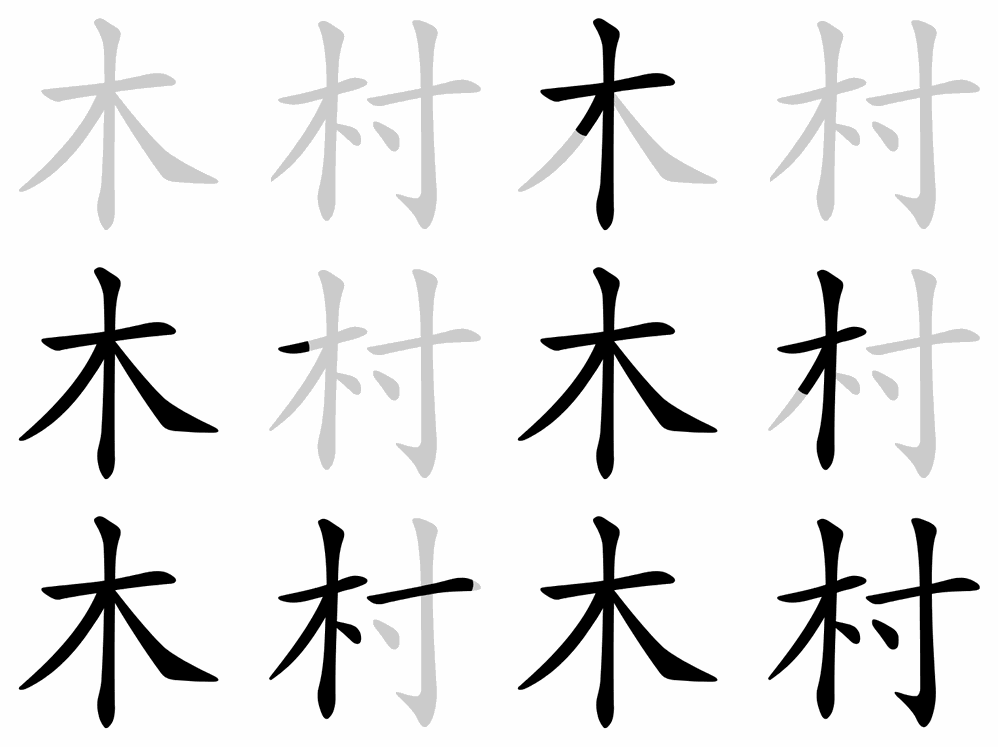
Kanji Stroke Order for 木村
Learning stroke order can help you recognize and write the kanji more accurately. Here are the stroke orders for 木 and 村.
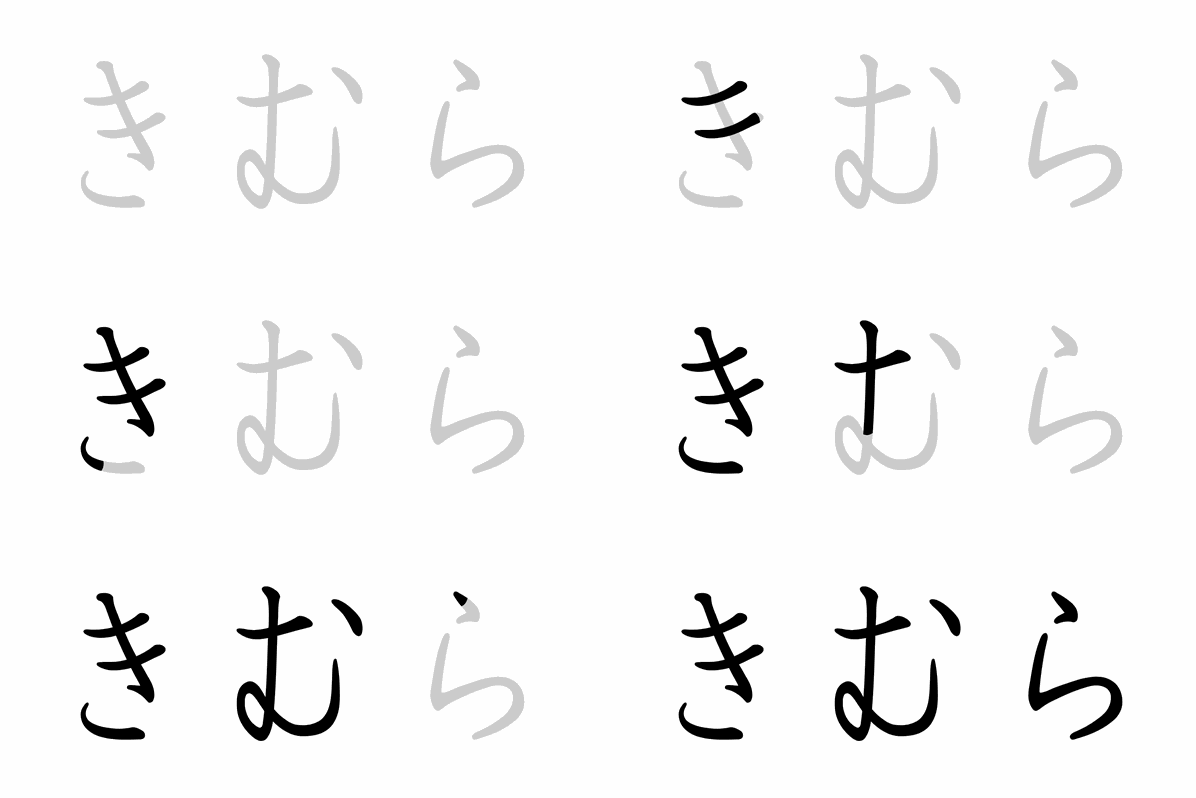
Hiragana Stroke Order for きむら
Hiragana is a phonetic script used in Japanese. Here is how to write the reading きむら.
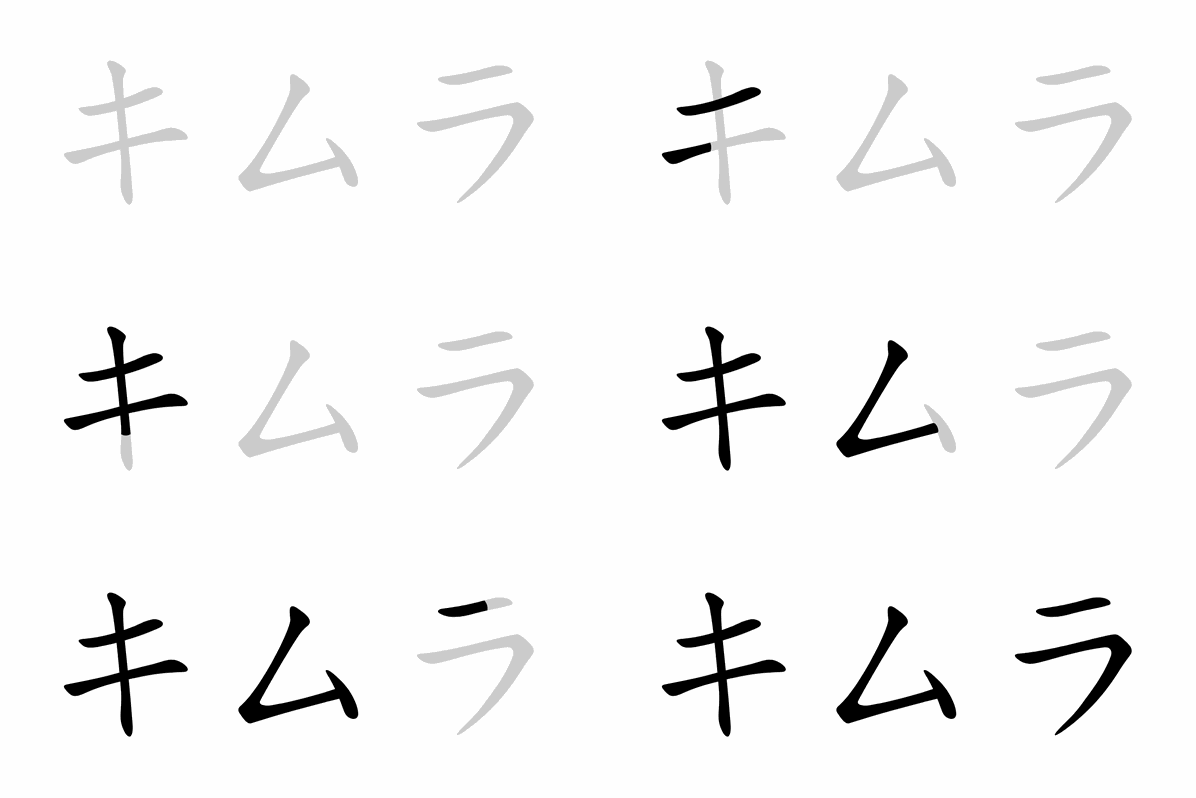
Katakana Stroke Order for キムラ
Katakana is another phonetic script in Japanese. Here is how to write キムラ.
Learning Note for Kimura
Kimura is a useful surname for Japanese learners because both kanji are common and the reading is regular. 木 means tree or wood, and 村 means village, so the meaning is easy to remember.
The pronunciation is also simple: Ki-mu-ra. There are no long vowels or unusual sound changes.
Even so, when accuracy matters, it is always best to confirm a person’s preferred name reading. Japanese surnames can sometimes have variant readings, though Kimura is usually very consistent.
FAQ About Kimura (木村)
Is Kimura a common Japanese surname?
Yes. Kimura is a familiar and widely recognized Japanese surname. Japanese learners are likely to see it in names, media, and everyday examples.
What is the origin of the surname Kimura?
Kimura is often explained as a place-name type surname, with a literal meaning like “tree village” or “wood village.” It may have referred to a village or area connected with trees or wooded land. The exact origin can vary by family line and historical records.
Are there other ways to write Kimura in kanji?
木村 is the standard and most common kanji form for Kimura. Other rare spellings may exist, so a person’s own written name should always be confirmed when accuracy matters.
Does the surname Kimura have a long vowel?
No. The standard reading きむら does not contain a long vowel, so the romaji is written simply as Kimura, without a macron.
How do I pronounce the r sound in Kimura?
The r sound in ら is a quick, light tap of the tongue. It is softer than the English r and is not rolled. For many learners, it may sound somewhere between a light r and l.
Want to turn your own name into Japanese?
Use our Japanese Name Converter to see how your first name can be written in Japanese katakana and creative kanji ideas with meanings.
Try the Japanese Name Converter
Creative kanji ideas are for inspiration only. Foreign names are usually written in katakana.