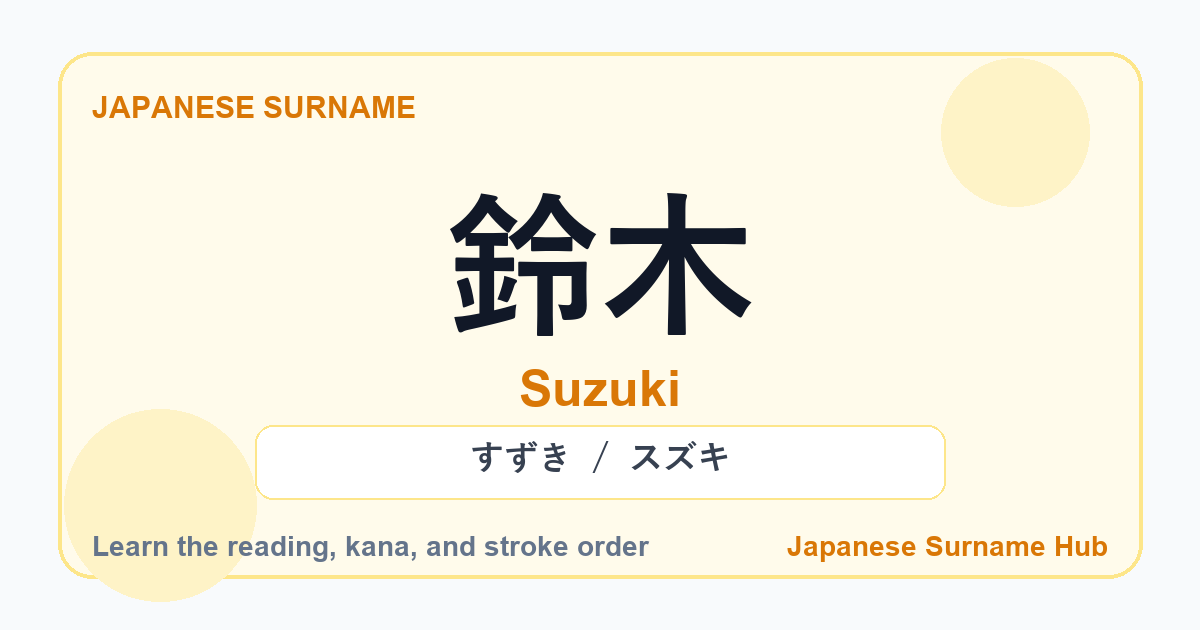
Quick Answer: Suzuki (鈴木)
Japanese Surname: 鈴木
Common Reading: Suzuki
Hiragana: すずき
Katakana: スズキ
Romaji: Suzuki
Pronunciation Note: There are no long vowels in the standard reading of Suzuki, so a macron is not typically used. The pronunciation is close to "soo-zoo-kee," with each sound kept short and even.
What Does the Japanese Surname Suzuki (鈴木) Mean?
The Japanese surname 鈴木 (Suzuki) is composed of two kanji characters: 鈴 (suzu), which means "bell," and 木 (ki), meaning "tree" or "wood." A simple literal interpretation is therefore "bell tree" or "bell wood."
However, Japanese surnames are not always meant to be understood as direct word-for-word meanings. One documented line, the Suzuki family of Kii Province, served the Kumano shrines, and Suzuki families are thought to have spread to other regions as Kumano worship spread. Still, the exact background can vary by family line, region, and historical record. It is safer to treat the kanji meaning as a helpful clue rather than a single definitive origin story for every Suzuki family.
Kanji Breakdown for Suzuki (鈴木)
Understanding the individual kanji helps learners grasp the possible meaning and visual structure of the surname.
| Kanji | Basic Meaning | Learning Note |
|---|---|---|
| 鈴 (suzu) | Bell | This kanji appears in words related to bells and ringing sounds, such as 風鈴 (fūrin, wind chime) and 鈴の音 (suzu no ne, sound of a bell). |
| 木 (ki) | Tree, wood | 木 is a basic kanji representing a tree. It appears in many nature-related and material-related words, such as 木材 (mokuzai, wood material) and 森林 (shinrin, forest). |
How to Read Suzuki (鈴木)
The reading of 鈴木 as "Suzuki" is the standard and most widely recognized pronunciation.
| Kanji | Hiragana | Katakana | Romaji | Reading Note |
|---|---|---|---|---|
| 鈴木 | すずき | スズキ | Suzuki | This is the standard and most commonly recognized pronunciation for this surname. The reading su-zu-ki is straightforward, with no long vowel mark needed. |
Romaji and Pronunciation Notes for Suzuki
The romaji spelling for 鈴木 is Suzuki. When pronouncing it, aim for clear and even sounds:
- Su: close to "soo," but kept short
- Zu: close to "zoo," but kept short
- Ki: close to "key," but kept short
Combined, it sounds close to "soo-zoo-kee." There are no long vowels in this reading, so Suzuki is not normally written with macrons such as "Suzūki" or doubled vowels such as "Suzuuki."
Kanji Stroke Order for 鈴木 (Suzuki)

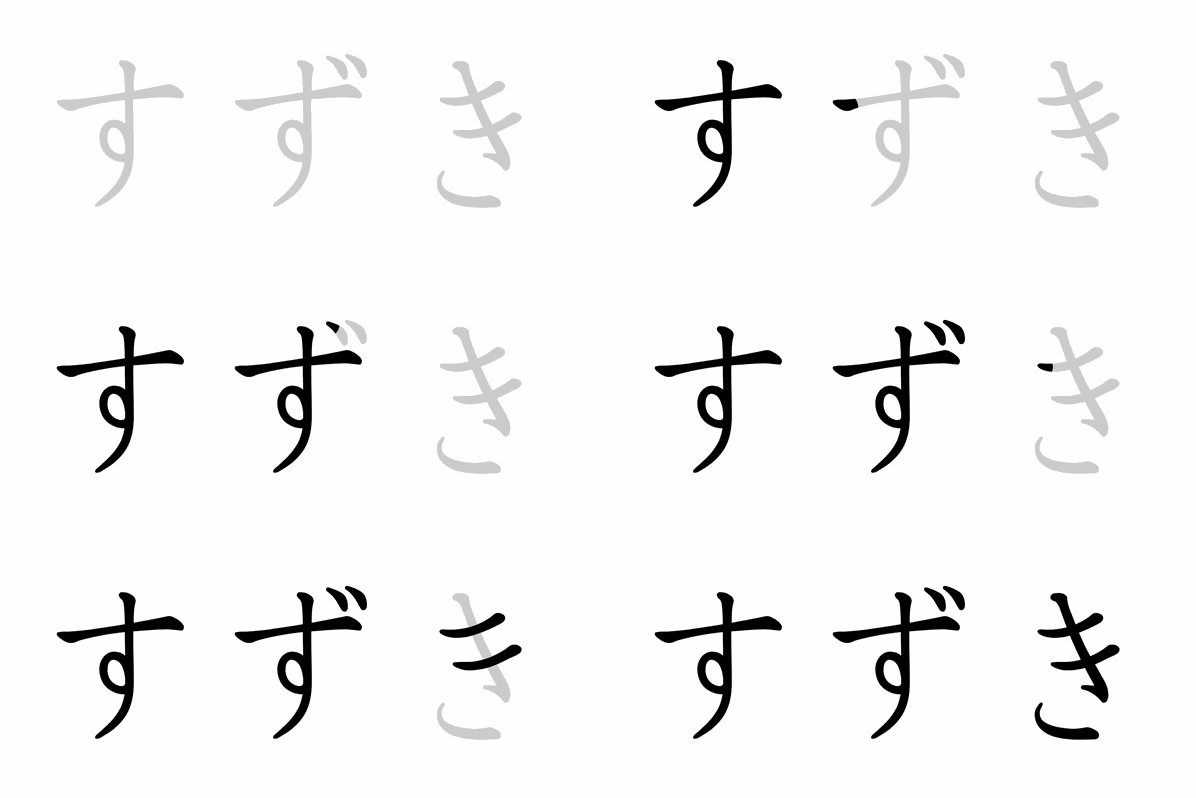
Hiragana Stroke Order for すずき (Suzuki)
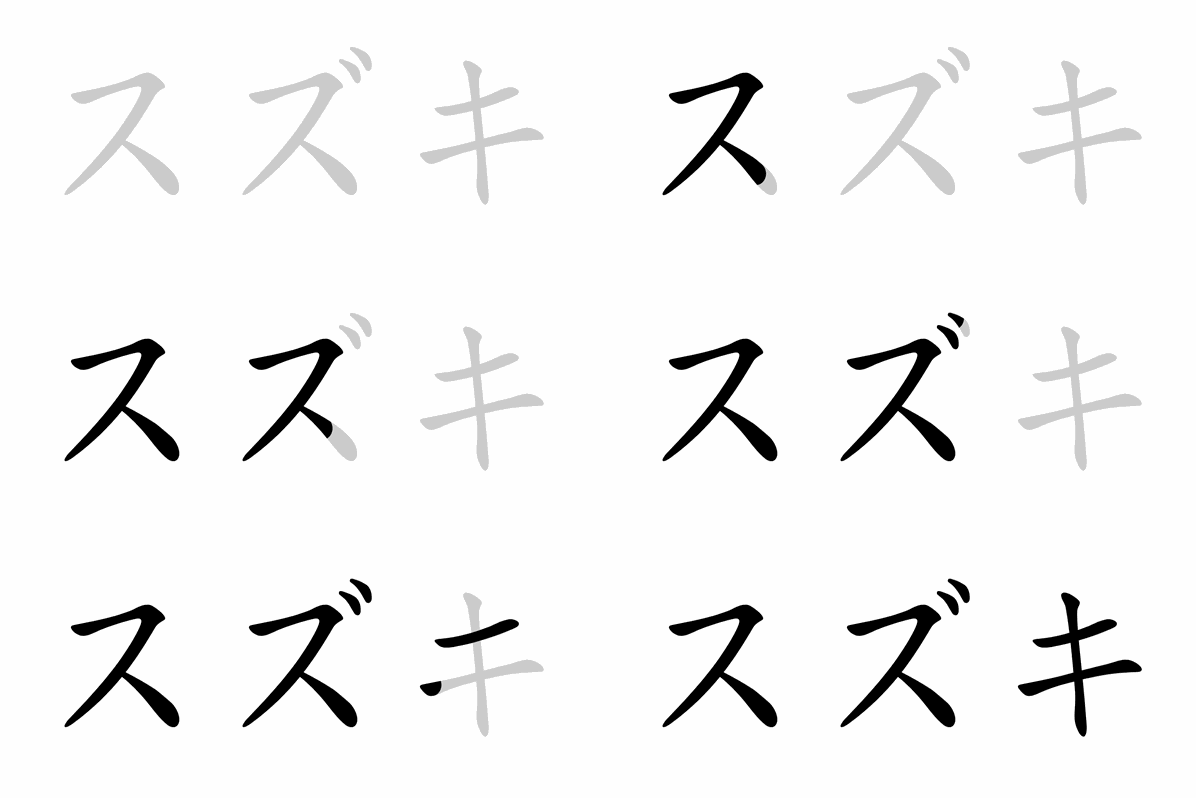
Katakana Stroke Order for スズキ (Suzuki)
Learning Note for Suzuki
The surname Suzuki is widely recognized in Japan, and learners are likely to encounter it in many contexts. Here are some useful points:
- Practice pronunciation: Focus on the clear, even pronunciation of su-zu-ki. Since there are no long vowels, it is relatively straightforward for learners.
- Recognize the kanji: Being able to recognize 鈴木 is useful because both 鈴 and 木 also appear in other Japanese words.
- Use the literal meaning carefully: The literal meaning can be understood as "bell tree" or "bell wood," but surname origins are often more complex than direct kanji meanings.
- Confirm names when accuracy matters: Suzuki is a very standard reading, but in formal contexts, it is still good practice to confirm a person's preferred romanization and name spelling.
FAQ About Suzuki (鈴木)
Is Suzuki a common Japanese surname?
Yes. Suzuki is a very well-known Japanese surname and is widely recognized in Japan. It is a useful surname for Japanese learners to know.
What is the origin of the Suzuki surname?
The surname 鈴木 combines 鈴 (suzu, "bell") and 木 (ki, "tree"). One documented historical line was the Suzuki family of Kii Province, closely tied to the Kumano shrines (source: 改訂新版 世界大百科事典 (Heibonsha), entry 鈴木氏). However, the exact background can vary by family line, region, and historical records.
Are there other ways to write Suzuki?
The kanji form 鈴木 is the standard and most commonly seen form for this surname. Other rare or historical name forms may exist, but 鈴木 is the form learners are most likely to encounter. Always confirm a person's preferred writing when accuracy matters.
How do I pronounce Suzuki correctly?
The pronunciation is close to "soo-zoo-kee," with each part pronounced clearly and evenly. There are no long vowels in this reading, so no macron is needed.
Does the surname Suzuki have a specific meaning?
Literally, the kanji can be interpreted as "bell tree" or "bell wood." However, the historical meaning of a surname may be connected to place names, local traditions, family history, or older naming practices rather than a direct literal meaning for every family.
Want to turn your own name into Japanese?
Use our Japanese Name Converter to see how your first name can be written in Japanese katakana and creative kanji ideas with meanings.
Try the Japanese Name Converter
Creative kanji ideas are for inspiration only. Foreign names are usually written in katakana.